

Skip to content
Search

Latest Stories

Follow Us:
Top Stories

Two kings. Really?

Opinion

Two kings. Really?

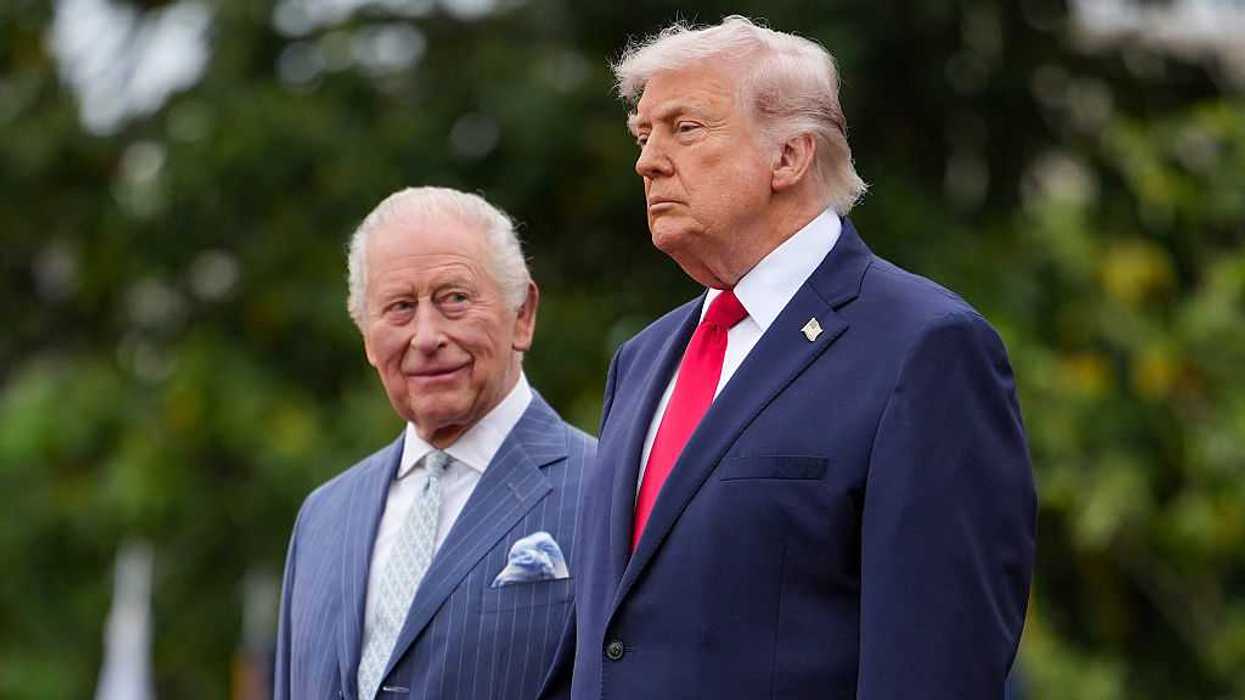
King Charles III and U.S. President Donald Trump attend a state arrival ceremony on the South Lawn of the White House on April 28, 2026 in Washington, DC.

(Photo by Andrew Harnik/Getty Images)

Last month, the King of England came to Congress and schooled us on what it means to be American. This would be hysterical if it wasn't so tragic.

To understand why, you need to understand two things happening inside our government right now.


The first is the unitary executive theory -- the idea that the president has sole, total control over every agency, every employee, every decision in the executive branch. Not leadership. Control. For most of our history this was fringe. Congress created independent agencies -- the Federal Reserve, the FDA, the National Weather Service -- precisely so expert, nonpartisan work could be insulated from whoever happened to be in office. Madison called the concentration of all powers in one set of hands "the very definition of tyranny."

But in February 2025, Trump signed an executive order declaring all federal agencies "must be supervised and controlled" by the president. Project 2025 laid the blueprint. Then came the purge: FTC commissioners fired, a Federal Reserve governor targeted, USAID dissolved, inspectors general removed, thousands of civil servants stripped of protections.

What does this look like in your life? The National Weather Service lost roughly 600 people. Then on July 4, the Guadalupe River rose 26 feet in 45 minutes and more than 130 people died across central Texas, including 27 campers and counselors at Camp Mystic. The administration's 2026 budget proposes eliminating the NOAA lab that developed key flash flood prediction tools. At the NIH, about 2,300 grants totaling $3.8 billion were terminated, affecting at least 383 clinical trials. The FDA lost nearly 4,000 employees. Foreign food inspections hit historic lows.

The second thing is a strain of nationalism, championed by Israeli political theorist Yoram Hazony, that argues a nation isn't built on ideas like "all men are created equal" but on tribal bonds -- shared blood, language, religion, ancestry. Hazony's conferences feature regular speakers like JD Vance, Marco Rubio and Sen. Josh Hawley. This philosophy has entered the White House.

You can hear it when Trump calls immigrants people "poisoning the blood of our country." You can see it in ICE's transformation: at-large arrests up 600%, nearly 70,000 people in detention, two U.S. citizens shot dead by federal agents.

I know many of us have been told -- by the administration, by the news, by people we trust -- that immigrants are driving crime. I understand why that's frightening. But the data doesn't support it. Immigrants, including undocumented immigrants, commit crimes at lower rates than native-born citizens. The administration's own records confirm that the majority of people arrested in these operations have no criminal record. Because throughout history, when leaders need the public to accept an extraordinary expansion of power, they first have to make people afraid enough to let them.

Which brings me to this week. Trump welcomed King Charles to the White House and spoke of settlers who "bore in their souls the blood and noble spirit of the British," of founders whose "veins ran with Anglo-Saxon courage." He rejected the idea that America is "merely an idea."

King Charles told a different story. He called Congress "this citadel of democracy created to represent the voice of all American people." He said the founders "drew strength in diversity." He cited the Magna Carta -- the charter that established no one, not even a king, is above the law. He urged America to "ignore the clarion calls to become ever more inward-looking."

He was not being polite. He was sounding an alarm.

Then, apparently without irony, the White House posted a photo of the two men with the caption: "TWO KINGS."

This country was founded because we didn't want kings. The unitary executive seizes the power. The nationalism decides who it's used against. A real king came here and reminded Congress what makes nations strong. Our president stood in the same building and spoke of bloodlines and genetic inheritance.

I know which vision I recognize as American.

Sara Sharpe LaMance of Chattanooga is a writer, communication strategist and the founder of The Letters Project and STILL/WILD.


Read More

Tank and fighter plane with lots of coins and banknotes.

A former Navy Lieutenant Commander warns that Trump and his associates are profiting from the Iran conflict through defense contracts, crypto ventures, and prediction markets while putting American troops and taxpayers at risk.

Getty Images, gopixa

The Blood Money Presidency

Trump is running a war racket. Between arms dealing, prediction markets, and crypto, the war in Iran is looking more and more like a not-so-elaborate scheme to rake in blood money for himself and his cronies. Even his own Defense Secretary attempted to buy defense stocks on the eve of the war. At least, if you have been wondering what we’re still doing at war with Iran, then Trump’s financial dealings may offer an explanation.

The Trumps are war dogs. Powerus, a startup based in West Palm Beach, was founded only last year, specializing in counter-drone tech tailored for none other than Middle East operations. Then, in March, just after Trump started a war in the Middle East, the company went public–and Donald Trump Jr. and Eric Trump joined the board with sizable equity stakes. The conflict of interest may be their entire business model. Just weeks after the brothers came aboard, the Air Force gifted Powerus its first military contract for an undisclosed number of interceptor drones. At the same time, the company is pitching drone demonstrations to Gulf countries that know buying from the President's sons is sure to curry favor. As former chief White House ethics lawyer Richard Painter put it: “This is going to be the first family of a president to make a lot of money off war — a war he didn’t get the consent of Congress for.

Keep Reading Show less
Trump’s petty pursuit of his ‘enemies’

President Donald Trump speaks during an arrival ceremony on the South Lawn of the White House in Washington, D.C., on April 28, 2026.

(Jim Watson/AFP via Getty Images/TCA)

Trump’s petty pursuit of his ‘enemies’

When the history books write about Donald Trump, they’ll have a lot to say — little of it positive, I’d be willing to wager.

His presidencies have been marked by rank incompetence, unprecedented greed and self-dealing, naked corruption, ethical, legal and moral breaches and, as we repeatedly see, a rise in political division and anger. From impeachments to an insurrection to who-knows-what is still to come, the era of Trump has hardly been worthy of admiration.

Keep Reading Show less
Whenever political violence erupts, Washington starts playing the blame game

Agents draw their guns after loud bangs were heard during the White House Correspondents' dinner at the Washington Hilton in Washington, D.C., on April 25, 2026. President Trump is attending the annual gala of the political press for the first time while in office.

(Mandel Ngan/AFP/Getty Images/TNS)

Whenever political violence erupts, Washington starts playing the blame game

A heavily armed California man was caught trying to storm the White House correspondents’ dinner Saturday with the apparent intent to kill the president.

It didn’t take long for Washington to start arguing. Democrats denounce violent rhetoric from the right, but the alleged assailant seemed to be inspired by his own rhetoric. President Trump, after initially offering some unifying remarks about defending free speech, soon started accusing the press of encouraging violence against him. Critics pounced on the hypocrisy.

Keep Reading Show less
Fulcrum Roundtable:  ‘Chilling Effect’ on Dissent
soldiers in truck

Fulcrum Roundtable:  ‘Chilling Effect’ on Dissent

Congress and the Trump administration are locked in an escalating fight over presidential war powers as President Donald Trump continues military action against Iran without congressional authorization, prompting renewed debate over the limits of executive authority.

Julie Roland, a ten-year Navy veteran and frequent contributor to The Fulcrum, joined Executive Editor Hugo Balta on this month's edition of The Fulcrum Roundtable, where she expressed deep concerns regarding the Trump administration’s impact on military nonpartisanship and the rights of service members.

A former helicopter pilot and lieutenant commander, Roland has used her weekly column to highlight what she describes as a systemic attempt to stifle dissent within the armed forces.

Keep Reading Show less