
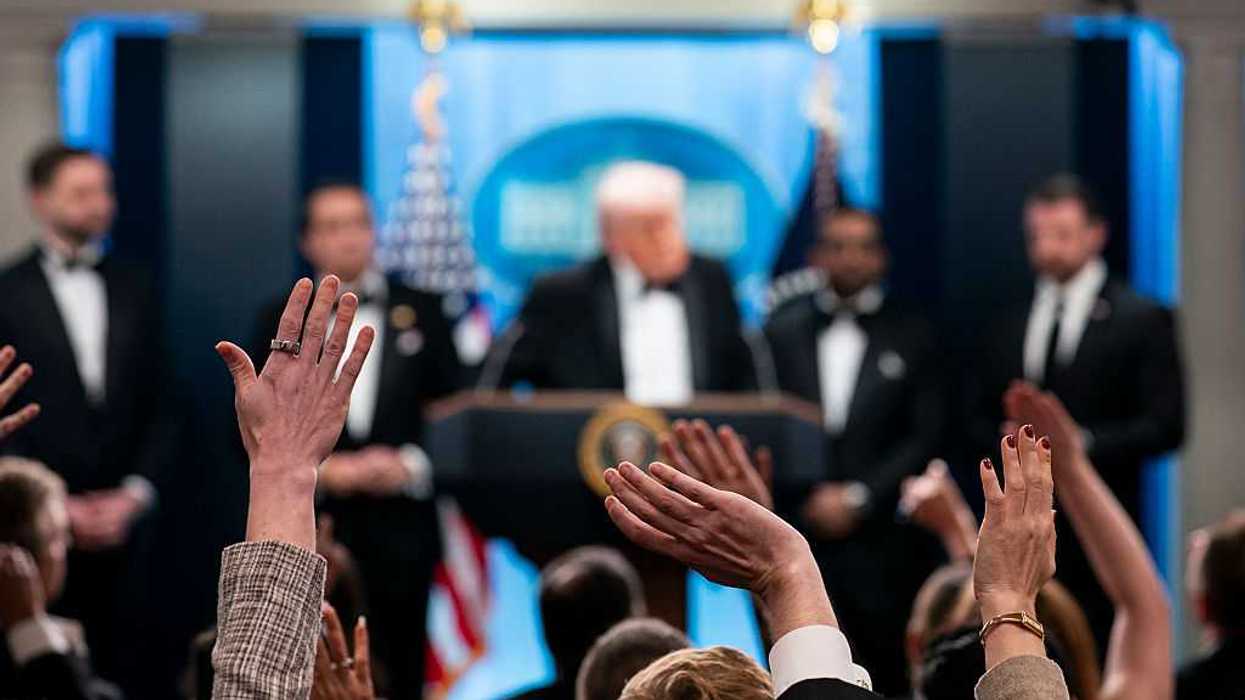

“Freedom of conscience, of education, of speech, of assembly are among the very fundamentals of democracy, and all of them would be nullified should freedom of the press ever be successfully challenged.” – Franklin D. Roosevelt, 32nd U.S. President
Throughout America’s 250 years, the tension between the White House and the press is as old as the republic itself. Several presidents haven’t necessarily tried to repeal the First Amendment (which protects the press), per se, or the Fifth Amendment (which protects journalists’ confidential sources). Instead, some have tried to control the narrative and limit press access.
Let’s try to understand why restricting freedom of the press by the current president should be of concern, as FDR so eloquently stated back in 1940.
The President’s and the media’s constitutional friction
The First Amendment clash: Some presidents view media scrutiny as an obstruction to governing and/or a threat to national security, whereas the press views executive branch secrecy and access restrictions as a direct assault on the right to inform the public.
The Fifth Amendment clash: When the government uses surveillance and/or the threat of jail time to force journalists to reveal confidential sources, it creates a battle over federal overreach and the rule of law.
The most significant reason why a few presidents push back against the press is that, since the failed Vietnam War, the Watergate scandal, and media coverage escalating to round-the-clock news, some leaders have realized that unhindered media access swayed public opinion against their administrations.
Historian scholar Harold Holzer’s work on the presidency reveals that many leaders treat journalists as political threats rather than democratic partners. They fear, not revere, the press (The Presidents vs. The Press, 2021).
There are 15 specific examples where freedom of the press has been challenged during the 16 months of Trump’s 2.0 presidency. Here’s a capsule summary of the incidents:
Direct legal and financial attacks:
1) On Sept. 15, 2025, a $15 billion defamation lawsuit was filed against The New York Times and four journalists for their reporting on the book titled Lucky Loser.
2) A $10 billion suit against the BBC over the editing of Trump’s Jan. 6 speech was filed on Dec. 15, 2025.
3) And on July 18, 2025, a $10 billion lawsuit was filed against The Wall Street Journal for reporting the president’s relationship with Jeffrey Epstein.
Access restrictions:
1) In February, 2025, Associated Press reporters were indefinitely banned from press events after refusing to use the president’s preferred term “Gulf of America” instead of “Gulf of Mexico.”
2) In 2025, news outlets CNN, NPR, NBC News, The Hill, Politico, The New York Times, and The Washington Post were denied Pentagon office space.
3) In September, 2025, the Department of Defense required reporters to sign a pledge promising not to use material even if it was unclassified.
4) On March 4 and 10, the Pentagon barred Associated Press, Reuters, and Getty Images photographers from attending Iran War briefings.
Regulatory coercion and censorship:
1) The administration used FCC regulatory approval for the $8 billion Paramount-Skydance merger as leverage, which led CBS to cancel The Late Show with Stephen Colbert.
2) On May 1, 2025, executive orders were issued to cancel NPR and PBS federal funding; a congressional request occurred on June 3.
3) On March 14, 2025, the administration attempted to shut down Voice of America and Radio Free Europe.
4) On April 6, 2026, regarding a leak about a U.S. rescue operation in Iran, Trump told journalists to “give [the source] up or go to jail.”
5) The administration launched an official government tool – White House Bias Tracker – to track and publicly flag “media bias,” which serves as a state-sponsored blacklist for journalists.
Personnel targeting:
1) Notable reporters, like Don Lemon and George Fort, were arrested on Jan. 29 while covering public protests.
2) On Oct. 3, 2025, Atlanta-based Spanish-language journalist Mario Guevara was deported to El Salvador following critical reporting.
3) On Jan. 14, the FBI raided the residence of Hannah Natanson, a Washington Post journalist, allegedly to uncover the source of a government contractor leak.
Citizen caveat emptor and Congressional oversight
Fifteen attempts by President Trump to restrict freedom of the press in 16 months of his second presidency are unprecedented and should be a clarion call to every American to demand action. Bipartisan congressional oversight is long overdue.
It’s time to seriously reflect on the breadth, depth, and scope of GOP President Ronald Reagan’s Oct. 6, 1983, historic comment: “Since the founding of this nation, freedom of the press has been a fundamental tenet of American life. The economic freedom that has earned us such great bounty and the precious freedoms of speech and assembly would have little meaning or be totally nullified should freedom of the press ever be ended.”
Steve Corbin is a professor emeritus of marketing at the University of Northern Iowa and a non-paid freelance guest columnist contributor to 158 newspapers and 47 social media platforms in 44 states.