I have often discussed my parents' fleeing Cuba, in part, for free speech.
The Washington Post just purged one third of their team, including reporters who are stationed in Ukraine and the middle east, reporting on critical international affairs.
A Washington Post reporter's home was raided by the FBI.
Don Lemon, a former CNN anchor, was arrested.
Instagram banned me - twice.
I became a feminist in the 90s (I was probably one sooner, but didn’t know the meaning). I was an immediate fan of Ms. Magazine, specifically the principle that the magazine had no advertisements because of the sexism, expectations, and pressure that women feel by looking at unrealistic images of models.
I immediately subscribed to the notion to try to do everything I can to stay away from advertising and from propaganda.
For the same reason I love Ms. Magazine; I hate social media. It is not real. It creates a semblance of perfection or pressure to keep up with standards that are not accurate or possible. It allows bullying. It causes depression in teens. It violates privacy and sells your data. The list goes on.
But social media can feel like a necessary evil. Most places I go, people connect over their Instagram accounts. Businesses advertise, and social action is taken on social media.
I created an Instagram account using my business email, hoping to highlight the work of my organization and to stay apprised of things that were happening for survivors across the country. A couple of weeks into having an account, never having posted, using a professional headshot and my professional email - I was banned.
I had to prove that I was real. I had to upload a picture of my driver’s license. I had to upload a copy of my passport. And when that still wasn’t enough, I had to record an image of me looking at the camera and looking to the left, to the right, up, and down. I remained banned. Silenced.
I went to an event later that week where a CEO of a migrant farm worker immigrant rights group told me that her account was banned. I felt like there was a connection there and wondered if we were being monitored and targeted.
I filed an appeal. Nothing. I emailed Instagram. Nothing. I ChatGPT’d “how do I file an appeal with Instagram.” Nothing.
My friend said, "What did you do?” Nothing--except follow groups pursuing survivors and social justice.
A few months later, I thought I would attempt again. I was feeling disconnected from not having access to Instagram. Using an email I had previously used for a now deactivated Facebook account, I created a new Instagram account.
I started following the protests of the national strike for January 30, and that same day, January 30, 2026, I got banned. I again uploaded a video of me turning my head to the left, to the right, up and down. I uploaded my driver’s license and my passport, and I was told I had violated community standards - permanently banned, again.
Silenced. I have never posted one thing. I once reposted something from my organization. I think my account lasted about a week.
Now I wonder: do I have free speech? I am not sure if I was banned because I lead a nonprofit, but outspoken leaders across the country are being silenced. Reporters are being arrested and attacked. Legal observers have been assassinated. First responders were assassinated. Nonprofit leaders silenced.
I can’t help but see a pattern.
My job as a lawyer is to advise people of their rights. We are proud at Survivor Justice Center to give “voice and choice.” We do not tell our clients what to do, but provide them with their legal options. This is a core tenent of being an attorney and a guiding principle to my beliefs.
As an attorney, I must give this advice: it is imperative we continue to speak out and exercise our right to free speech. We must not be complicit. We must continue to fight for those rights of others, even when our voices are silenced.
However, for the first time, I feel afraid to be on the streets exercising this right. I have asked my board for a plan if I am arrested. Was banning me on Instagram only the start? Am I now a target due to my job, my beliefs, or the fact that I’m a daughter of immigrants?
I encourage my staff to speak out against injustice; when my friends express hesitancy at attending rallies or gatherings, I remind them of their rights and encourage them to utilize them. But the recent silencing of critics has made me doubt my own advice. Should I encourage people to use their voice when I know the potential consequences?
My parents fled a communist dictatorship where their rights to free speech were stripped. I have a staff member who was born into a regime with a dictator in Chile; she recently remarked that what we are facing now feels like what she experienced and what her family fled.
The stories of my parents' escape from Cuba linger in my head; I’m reminded of their struggles when I see news of people being punished just for standing up for what they believe in. Even now, journalists in Cuba face harsh penalties for sharing the truth, often dismissed as “fake news” (sound familiar?).
The reality of my parents' past and my future are colliding, and it’s terrifying.
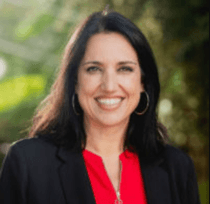
Carmen McDonald is an attorney who serves as executive director of the Survivor Justice Center; she is a former Public Voices Fellow of the OpEd Project and Blue Shield California.