


An aggressor shouting “Free Palestine” choked a 32-year-old Jewish man near Adas Torah synagogue recently in the Pico-Robertson neighborhood in LA.
This episode, following on the heels of thousands more, is a stark reminder that the surge of antisemitism in the U.S. continues unabated.
On the same day, the Supreme Court of the United States rolled back a major tenet of the Voting Rights Act of 1965 that had supported Black voters' rights in Louisiana.
The surge in racism and antisemitism is discouraging after all the efforts to bring together the Black and Jewish communities, a movement championed by the late Rev. Jesse Jackson Sr., who died earlier this year.
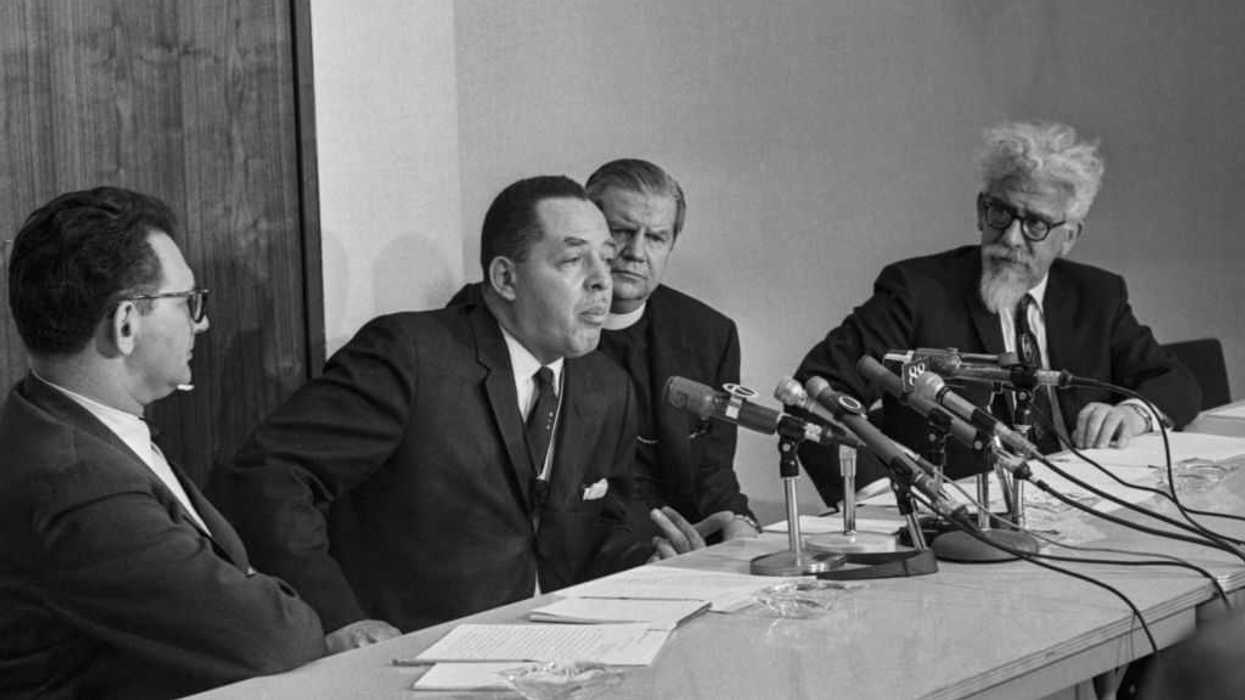
I saw Jackson’s allyship with Jewish leaders up close. My late husband, Rabbi Marc Tanenbaum, was then Director of Interreligious Relations at the American Jewish Committee. He was among those with whom Jesse Jackson engaged in the wake of the “Hymietown” scandal.
Rather than retreat into their corners, hurling accusations at each other, they shared a stage at the Queens College People-to-People program. Ignoring violent threats and unruly demonstrators outside, they each acknowledged the issues that divided them and affirmed the importance of the Black-Jewish allyship, which both deeply valued. Both had walked the walk in support of each other’s communities, and that strong foundation held, despite the controversy.
Unfortunately, that foundation seems to be crumbling–at least among younger Blacks and Jews. Yet, that allyship is more urgently needed than at any time since the Civil Rights Movement of the 1960s.
Today, old and new issues threaten both communities: voting rights, white supremacy, hate speech, hate crime, replacement theory, immigration, gerrymandering, minority status, reproductive health and rights, and Christian nationalism.
There are far fewer issues that divide us: white privilege, affirmative action, antisemitism, and Israel/Palestine.
The first divisive factor ignores the fact that as much as 15% of the Jewish community in America is comprised of Jews of color. Valid research has yet to be done outside the U.S., but an educated guess is that there are hundreds of thousands of additional Jews of color worldwide. As such, Blacks and Jews are bound together by intermarriage, conversion, and ethnicity.
Affirmative action quotas can evoke opposite responses in Jews and Blacks. For Jews, quotas have historically meant exclusion. For Blacks, they are the road to inclusion.
Nevertheless, when the U.S. Supreme Court struck down race-based admissions in a 2023 ruling, Jewish organizations, such as the Anti-Defamation League, American Jewish Committee, and the Reform movement’s Religious Action Center, condemned the decision; and Jews have generally favored affirmative action.
As for antisemitism, many Jews tend to forget that Black Americans endorsed the United Nations resolution calling for the establishment of the State of Israel in 1947. Harvard University Professor Ralph Bunche won the Nobel Peace Prize in 1950 for his mediation efforts following Israel’s War of Independence in 1948. He was the first Black American to win the prize.
When Israel airlifted to safety 14,000 Black Jews from Ethiopia in Operation Solomon in 1991, 36 Black mayors across the U.S endorsed that effort.
Black organizations joined the fight to free three million oppressed Jews in the Soviet Union.
The National Urban League supported the repeal of the “Zionism is racism” resolution at the United Nations in 1991.
In 1999, Jesse Jackson worked for the release of 13 Iranian Jews who had been arrested and charged as Zionist spies.
All of these acts of support for Jews and Israel were done by older generations of Blacks. It’s quite a different story for the younger generation.
A 2023 study by Eitan Hersh and Laura Royden in the Journal of Race, Ethnicity and Politics, with an oversample of 18–30-year-olds, revealed that younger Black adults are a particularly high-risk subgroup for antisemitic attitudes, relative both to white youth and to older Americans. Unlike many other prejudices, antisemitism is not lower among younger minority cohorts.
Earlier studies showed similar results, attributed to the rise of Black nationalist and Third-Worldist ideologies that cast Jews/Zionism as colonial or racist forces. This led to binary thinking that cast people as either pro-Israel or pro-Palestine, as if they were mutually exclusive. And it denied the indigeneity of Jews to Israel.
This brings us to the elephant in the room: Israel.
Israel has been weaponized as a wedge issue to separate the Black and Jewish communities. But Israel is not relevant to the domestic issues that threaten it. To the extent that it has become a litmus test for mutual support, the obsession with Israel undermines both groups’ interests.
Jews need to stop demanding that Blacks loudly proclaim their support for Israel in order to gain Jewish support. And Blacks need to stop expecting Jews to renounce their Zionism in order to deserve their support.
As painful as it is for each side to put these litmus tests aside, they are beside the point when it comes to dealing with urgent domestic issues that threaten both communities.
Blacks and Jews are both under attack by haters and extremists. But if both groups remain in their silos, each is vulnerable to forces that divide them in pursuit of agendas that undermine all.
There is a different model for allyship. Put aside litmus tests on issues that disrupt the ability to work together.
Instead of advocating for each other, focus on issues that impact both communities in common. The former has led to each community feeling abandoned by the other at key moments. If people coalesce around issues in which both have a big stake, they will be helping everyone by working together on shared interests.
Dr. Georgette Bennett is the founder and president of the Tanenbaum Center for Interreligious Understanding and founder and Chair of the Multifaith Alliance. She is the author of Thou Shalt Not Stand Idly By, and Half-Jew Full Life, and co-author of Religicide.