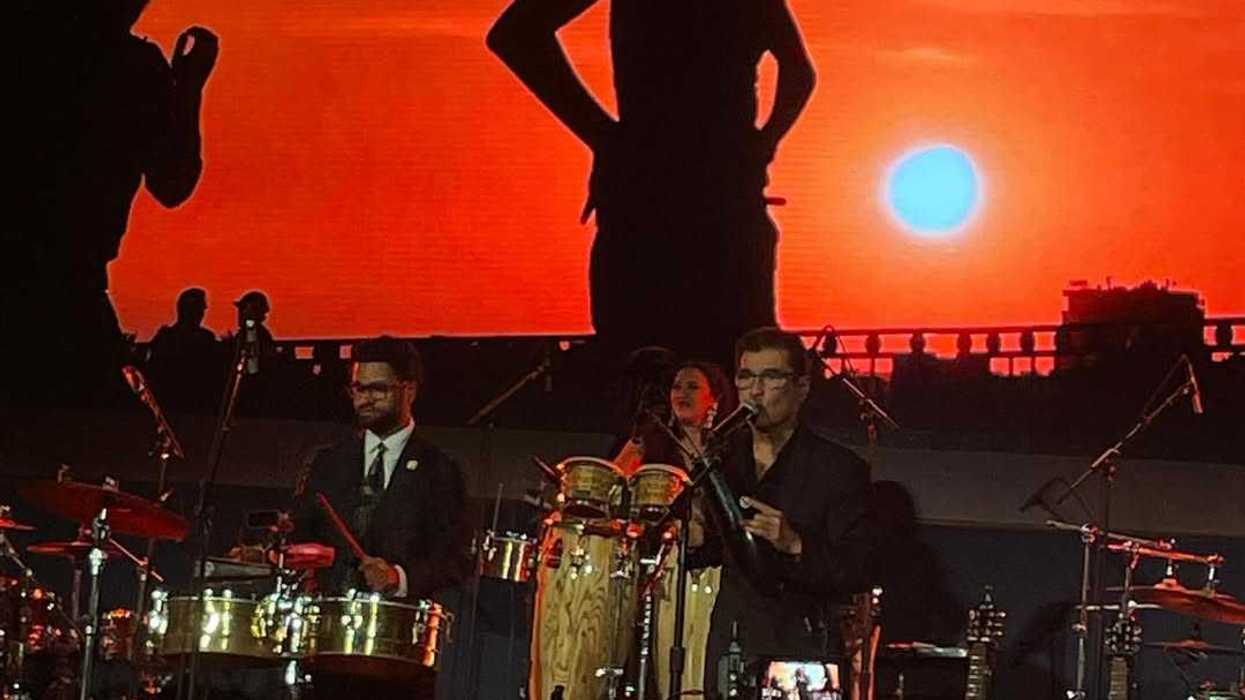

WASHINGTON, D.C. – Representatives and senators remain fiercely divided over President Donald Trump… yet they remain united over John Denver.
On May 13, hundreds of attendees packed the U.S. Capitol Building’s auditorium for Congressional Record, a concert where musical Republican and Democratic members of Congress alike showcased their talents. Denver’s Take Me Home, Country Roads served as the grand finale, with all members joining onstage in a rousing performance across party lines.
Quotes
At a pre-concert reception, The Fulcrum asked two Republican and two Democratic members about their musical tastes and backgrounds.
“I like everything from big band to classic rock,” said Ohio Republican Rep. Bob Latta – who wasn’t performing himself, but whose wife, Marcia Sloan, sang America the Beautiful as part of the House Spouse Glee Club. Asked about his own musical skills, or lack thereof: “My piano teacher told my parents not to waste any more money.”
At 27, the youngest member of the current Congress by a solid three years, Florida Democrat Rep. Maxwell Frost is also the first Gen Z member elected. Asked whether he’d turned any of his middle-aged or older House colleagues on to any of his favorite modern music, Frost replied, “I’ve put a few people onto [electropop duo] Magdalena Bay.”
Michigan Republican Rep. Tim Walberg often leads worship songs with his guitar at a weekly Thursday bipartisan congressional prayer group. Asked what music plays in the car, he answered like the true Michigander he is: “I usually listen to Motown.”
Illinois Democrat Rep. Jonathan Jackson also wasn’t performing, but didn’t hesitate when asked to name his favorite concert he’s ever attended: “The Jackson 5, at Chicago’s 1972 Black Expo.” (He was too humble to mention that his father, the late Jesse Rev. Jackson, organized the expo.) “Music takes people to where they want to be,” said the son.
 Congressman Mark Messner (IN) on the trumpet.
The concert’s origins
The Congressional Record concert was created by Kevin Canafax and Geoff Browning, who didn’t even know each other in person – they connected on Facebook.
Canafax is a Cincinnati-based vice president at a financial services company by day, but leads the Led Zeppelin tribute band Soul Shadow by night. He conceived of taking his annual arts education fundraiser, Suits That Rock, featuring local business leaders performing songs, to the nation’s capital for Congress members to take up the act.
Lacking connections in the area, he read a Roll Call profile article about Browning, who worked for Massachusetts Democratic Rep. Katherine Clark at the time, but also performed for the unclassifiable D.C.-area Band of Tomorrow. (The group’s official website’s description: “funk // rock // reggae // samba // disco // soul // fire // auditory contraband collective.”)
After connecting on Facebook, the two men launched the inaugural concert in September 2024. Their clever name, Congressional Record, puns on the Congressional Record, Congress’s official transcribed archives of floor speeches and votes.
Both the first and second concerts were timed to the D.C. “fly-in” week sponsored by advocacy organization National Association of Music Merchants (NAMM), which champions increased public funding of arts education in schools.
“We hope this becomes an annual event like the Congressional Baseball Game,” said Browning, who now works as director of public policy for a software company.
The congressional performers rehearsed over two days with the professional backing band who accompanied them, at the Capitol Hill-area recording studio Ivakota. “They would pop in throughout the day,” trombone player Reggie Pace said, “when they weren’t in committee.”
 Representatives Jared Huffman (CA), Becca Balint (VT), and Sean Casten (IL) perform together.
The setlist
Earlier that day, Congress voted on such bills as the Nationwide Consumer and Fuel Retailer Choice Act. But by night, the eclectic mix of genres included:
- Jazz, with Indiana Republican Rep. Mark Messmer’s upbeat trumpet rendition of Glenn Miller’s In the Mood.
- Country, with Arkansas Republican Rep. Rick Crawford’s twangy guitar stylings on his original song I Can’t Go to Arizona.
- Folk, with John Prine’s Angel from Montgomery featuring Vermont Democrat Rep. Becca Balint on vocals and guitar, California Democrat Rep. Jared Huffman also on guitar, plus Illinois Democrat Rep. Sean Casten on keys.
- Pop rock, with Florida Democratic Reps. Darren Soto on vocals and guitar, plus Frost on drums, performing their original Wishing on a Lucky Star, from their band Astromax.
- Christian hymns, with Will the Circle Be Unbroken? featuring Walberg on guitar and Texas Republican Rep. Michael McCaul singing, alongside a cameo from Miss America 2026 and singer Cassie Donegan.
A swan song
2024’s Congressional Record concert ended with bipartisan Congress members onstage together singing an inspiring rendition of Let It Be by the Beatles. 2026’s installment similarly ended with Take Me Home, Country Roads. A song from the 1960s, then the 1970s.
Those eras marked perhaps the peak of what’s been retroactively termed “the monoculture.” Most people got their news from Walter Cronkite at 6:30 PM, their comedy from Johnny Carson at 11:30, and nearly everybody knew the biggest songs.
Those eras also marked perhaps the high-water mark for political bipartisanship. Just look at the Senate’s list of near-unanimous Supreme Court confirmation votes from the period. This was a time when a Republican president created the Environmental Protection Agency.
That’s likely not a coincidence. It was a time not of unanimity, but at least of relatively shared facts, sources, and reference points.
Vice versa, it’s also likely not a coincidence that the 2010s-20s dissolution of political centrism and bipartisan compromise occurred alongside the much-discussed demise of “cultural universals”: current television shows, books, or music that most people consume or know.
Indeed, the same factors contributed to both phenomena, on both the political and cultural levels. Social media. Algorithms. Echo chambers. Ideological and digital self-segregation. The corresponding plummet of mass market media formats, such as print journalism and over-the-air television or radio.
Over the decades, Country Roads clearly transcended its regional origins to become a “cultural universal.” By the 2025 Super Bowl, the entire Superdome stadium sang along.
Is there an equivalent song from the past decade or so? One which would truly get every stadium attendee – or Congress member – singing along, knowing all the lyrics? Across political parties, across races, across genders, across generations?
A society failing to create such a cross-demographic culture is also unlikely to create such cross-ideological public policy. Shared culture may not lead to shared governing, but they’re borne of the same roots.
The closing chord rang out. The audience gave a standing ovation. Perhaps this concert will indeed become an annual event. But we should aim for an America where such cultural and political unity also occurs on the other 364 days of the year.
Jesse Rifkin's writings about politics and Congress have been published in the Washington Post, Politico, Roll Call, Los Angeles Times, CNN Opinion, GovTrack, and USA Today.
SUGGESTIONS:
Congress Bill Spotlight: Easter Monday Act, Federal Holiday
Congress Bill Spotlight: SERVE Act, To Undo Trump Renamings
Congress Bill Spotlight: MAMDANI Act, Blocking Funds to NYC
Congress Votes With Only One House or Senate Dissenter, 2025