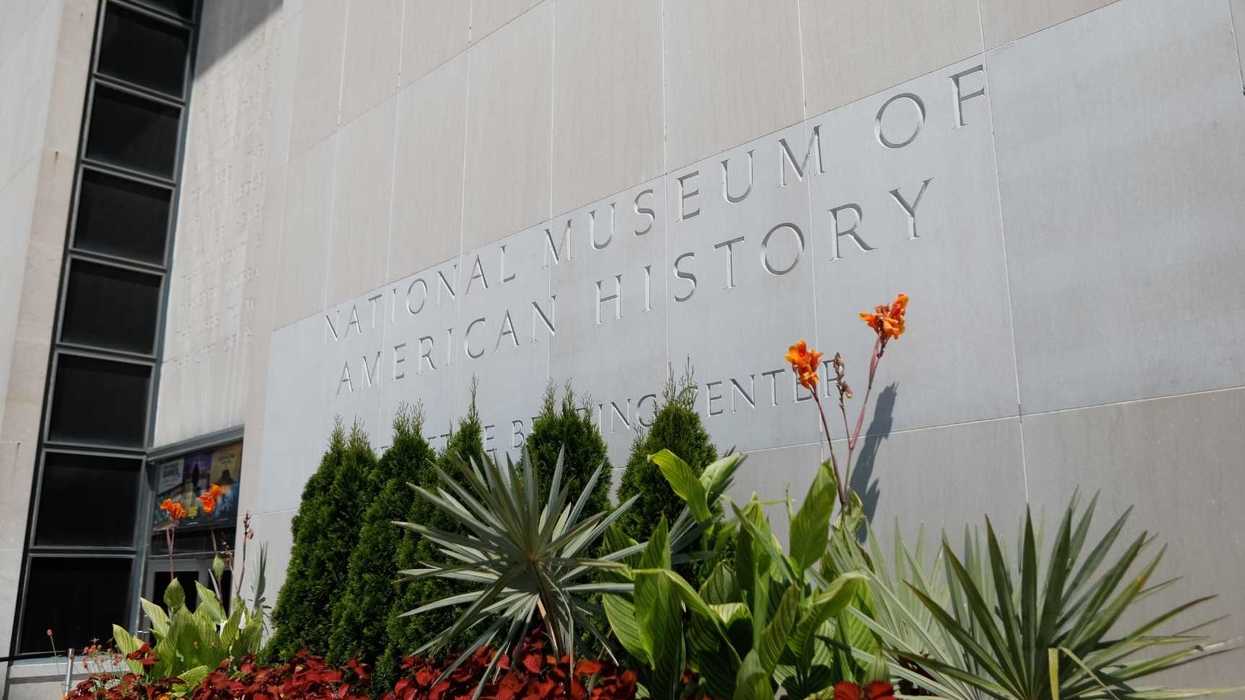

On July 24, the National Park Service began installing temporary signs on the walkways leading to the Smithsonian’s National Museum of American History. Following an order by President Trump, visitors are now directed toward a White House report claiming the museum has been captured by “extreme political activism.” Above the entrances to the National Museum of American History, will be these words: “Warning: the exhibits in this museum were prepared by people who don’t want you to love your country.”
As an African American woman, a cultural anthropologist, and a former museum director, I am aware of how dangerous this sign is. Indeed, the words in this warning carry the false and dangerous assumption that an individual or an institution cannot tell the truth about the past in our country and love our country.
Museums do much more than collect and display objects or works of art. Through an exhibition, a museum is charged to tell stories, and not just pretty stories or stories about pleasant happenings. History museums must be intentional about telling the whole story, which can and often does mean telling the story of events that can make one feel uncomfortable because these histories sometimes do not reflect the best that human beings can be. Psychologist Dolly Chugh has a term for what standing in front of that discomfort actually feels like. She calls it “belief grief,” which she defines as the shame, guilt, disbelief, and despair that surface when we unlearn a version of the past that we had believed was true. That grief is real, and it deserves to be taken seriously.
But the answer to this discomfort with the past is not to shield American people from our national story that produces “belief grief.” A country secure in its own future can afford an honest account of its past.
What a Warning Sign Is Actually Warning About
The 162-page report issued with the National Park Service’s new signage, titled “Saving America’s Story,” was produced by the White House Domestic Policy Council and released on July 4, the same week the administration marked the 250th anniversary of the Declaration of Independence. The report followed a March executive order, “Restoring Truth and Sanity to American History,” that had already directed the vice president and the Domestic Policy Council to identify and remove “improper ideology” from Smithsonian museums that it said had drifted from “straightforward historical education” toward ideology.
But presenting American history that is stripped of its contradictions can never be a truthful telling of our country’s past. And it will ask all Americans to love a country they were never allowed to actually know. In response to the signage President Trump has ordered to be placed at entrances to the Smithsonian American History Museum, the historical profession itself has not stayed quiet. The Organization of American Historians, the largest professional body of US historians, called the report part of “an ongoing and multi-pronged assault . . . against accurate and evidence-based history in American public life.” The National Council on Public History said, “Inclusive history is not partisan history; it is honest history.” Those aren’t fringe reactions or political stances. They are the discipline’s own professional associations, on the record, defending a standard of evidence over a standard of comfort.
The past does not stay in the past. It has descendants and it shapes our understanding of today. Pretending otherwise doesn’t produce patriotism. It produces amnesia. A museum that only tells visitors what makes them comfortable is not providing history. It is performing public relations. The secretary of the Smithsonian, Dr. Lonnie Bunch, and the director of the Smithsonian’s Museum of American History, Dr. Anthea Hartig, have described their work as grounded in scholarship, nonpartisanship, and “the fullness of America’s story.” That is not a slogan. It is the standard the Smithsonian holds itself to.
What Kind of Pressure This Actually Is
It’s important to be precise about what is happening with the signage that is being place at entrances to the Smithsonian’s American History Museum because it is not an obvious form of censorship. No one has shut down an exhibit by force or removed a single object from a wall. What’s happening is in some ways more detrimental: an American president and a committee he has appointed are directing the public toward one version of the record and away from another on the grounds that the version it disfavors is not history at all but “ideology.”
Look at the sequence of events. In March, an executive order directed the Domestic Policy Council to identify “improper ideology” in the Smithsonian’s museums. In July, the report supplied its justification for this action. Now the actual signs are physically placed on the walkways that visitors will use to enter, directing them to the administration’s own account before they have set foot inside. These signs display the explicit warning that the people who built the exhibits “don’t want you to love your country.”
Each step in this process involves President Trump and a committee he appointed using their positions not to argue with a museum’s scholarship, which it is free to do, but to physically intercept visitors on public walkways and tell them what to distrust before they have seen exhibits for themselves.
Who Pays for a Managed Past
Who loses the most when a nation’s history is being told based on the views of the president of our country and a committee he appointed rather than told in full? It is not the visitor who already knows the difficult chapters in the story of our country. And it is not the descendants of enslaved people. The disservice is to visitors who do not know much about the history of our country and walk into the Smithsonian American History Museum ready to learn but are then told is told in advance what they must believe about what they will see.
A managed past does not protect the vulnerable. It was never meant to. It protects the comfortable, shielding them from the discomfort of complicity rather than shielding anyone from harm. And it does this at the expense of everyone’s ability to understand how we arrived here together. A people who cannot learn the truth about its past cannot fully understand its strengths and challenges in the present. And it will be mighty difficult to prepare for its future. This fundamental truth is captured in this saying: “You can’t know where you are going if you don’t know where you have been.”
Why This Matters Beyond One Museum
The debate over the Smithsonian’s signage is not simply an argument about labels on exhibits or buildings. It is an argument about who gets to define what counts as an “accurate” historical account, backed by the authority of the federal government itself. That is a live question for anyone who cares about deliberative democracy, because a public that only encounters a curated, reassuring version of its own past is not being equipped to deliberate or think for itself.
Self-governance depends on citizens who can sit with disagreement, weigh conflicting or contradictory evidence, and reason through complexity together. It does not depend on citizens who arrive at a museum already told what conclusions to reach. A public steered toward a single approved narrative before it even walks through the door isn’t being protected from confusion, it’s being denied the chance to deliberate at all. You cannot weigh a story you were never allowed to encounter on its own terms.
Museums are not luxuries. They are lifelines. They preserve collective memory. To treat that work as suspect, or to post a warning label over it, is to treat memory itself as a threat when memory is not the threat. Selective memory is.
We must reach back and understand the whole weight of our past, not just the part that’s easy to carry. That means visiting the museums under pressure now, not after the pressure has done its work. It means telling the Smithsonian, and every institution facing this same test, that the public they answer to wants the full record, not the flattering one. It means insisting, at every age and in every generation, that looking back clearly is not weakness; it is how we, as a people, find our way forward.
A democracy that cannot face its past will not be equipped to face its future. The choice in front of us is not between comfort and discomfort. It is between memory and amnesia, and only one of those can carry a nation forward.
Johnnetta Betsch Cole is a noted anthropologist, educator, author, speaker, and social justice activist. She is the former president of both Spelman College and Bennett College and currently is a Charles F. Kettering Foundation senior fellow.
This article was originally published as part of From Many, We, a Charles F. Kettering Foundation blog series that highlights the insights of thought leaders dedicated to the idea of inclusive democracy.












 Scenes from Favela Rocinha, Brazil - (R-L) Rows of brick homes, Hugo Balta on a motorcycle taxi, and steep, winding roadsHugo Balta