




In its first two seasons, the HBO Max series “The Pitt” about the fictional Pittsburgh Trauma Medical Center, has received over 30 nominations and has won 11 Emmy’s including Outstanding Drama Series for the last two consecutive years. It may be fair to say, “The Pitt” has connected.
People ask me constantly: Is "The Pitt" real?
They ask it half-joking, expecting me to laugh and say, “Of course not,” at Hollywood's usual over-the-top exaggeration and glamorization of a busy emergency department.
But when it comes to "The Pitt," I don't laugh, I nod.
The response I immediately get is universal. “Wait, what, are you serious?”
After working in emergency departments for 28 years, I see this show is less entertainment with a medical backdrop, and more like a documentary with a script. And that distinction matters, because "The Pitt" has quietly become something unique in American television-- a modern-day canary in the coal mine.
In the late 1800s, British physiologist John Scott Haldane began investigating why coal mine explosions kept killing miners even when no fire or blast ever reached them. He traced it back to carbon monoxide, a gas with no color and no smell, invisible until it was fatal. The canary became an early-warning instrument, making an invisible danger visible before it became lethal.
That's precisely the role "The Pitt" is playing now. For years, emergency medicine has been trying to describe an invisible gas: ED boarding and a safety net stretched past its design limits. It took “The Pitt” putting crisis in front of 11 million viewers, in real time, over a single continuous shift, to make the connection.
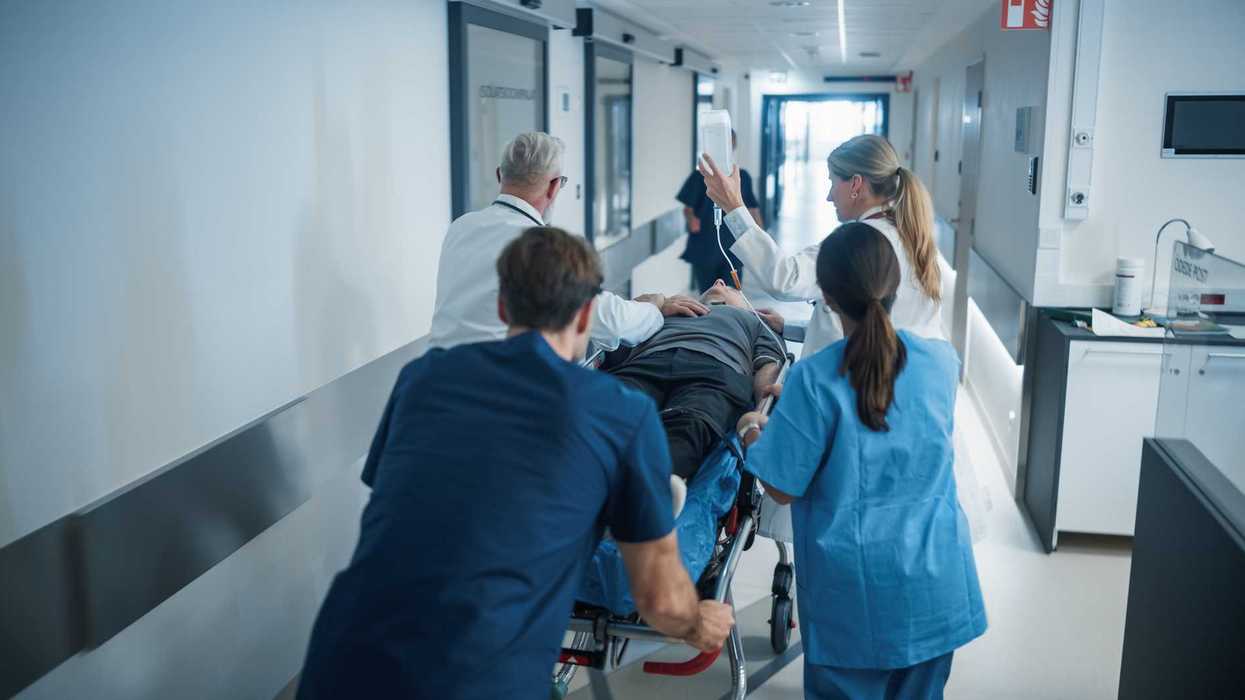
"The Pitt" doesn't dramatize emergency medicine so much as it exposes it with uncomfortable accuracy. That includes admitted patients “boarding” in hallways because there are no inpatient beds to admit. So a physician must decide, in real time, whom to see first when everyone needs to be seen now. None of this is exaggerated for drama. If anything, it's restrained.
That's the deeper truth the show gets right: the emergency department has become the place where the breakdown of the American health care system eventually lands. The patient who can't get a primary care appointment for six weeks comes to the emergency department instead.
The patient with no insurance, no stable housing, uncontrolled diabetes, or a mental health crisis with nowhere else to go comes to the emergency department. Emergency departments have become the safety net of last resort, and the show captures what it feels like to be the thread that net is fraying on.
“The PITT” offers proximity. Watch the fictional Dr. Michael “Robby” Robinavitch played by Noah Wyle, try to hold his department together for 12 straight hours, and something clicks. Entertainment succeeds where advocacy alone often stalls, because it makes people feel what you’re saying: this system is buckling, and it's buckling in front of patients who have nowhere to go.
"The Pitt" now dramatizes for a national audience that the ED isn't just where emergencies happen. It is where health inequity becomes visible, measurable, and, if we pay attention, addressable.
The U.S. healthcare ecosystem needs capacity, emergency departments need capacity, and without it systems become overwhelmed. The traditional economics of supply and demand are not optimal when it comes to the healthcare sector because healthcare is not the same as widgets.
It is critical then to think outside the box to make an inefficient system more efficient. That starts with creating operational capacity across our entire healthcare ecosystem.
There is not one single all-encompassing solution, but likely a path forward that involves small but impactful actions such as efforts around optimizing patient flow, streamlining operations, and leveraging data without relying on the creation of more inefficient systems.
"The Pitt" has done its job; it has made the invisible visible. Now it's up to the healthcare collective – policymakers, administrators, medical staff, advocates, volunteers, patients, funders--to fix the air, not just admire the canary that warned us.
Dr. Heather Prendergast is a Professor of Emergency Medicine, Attending Physician, and Vice Dean of Clinical Affairs at the University of Illinois College of Medicine , and a Public Voices Fellow of the OpED Project at the University of Illinois.