
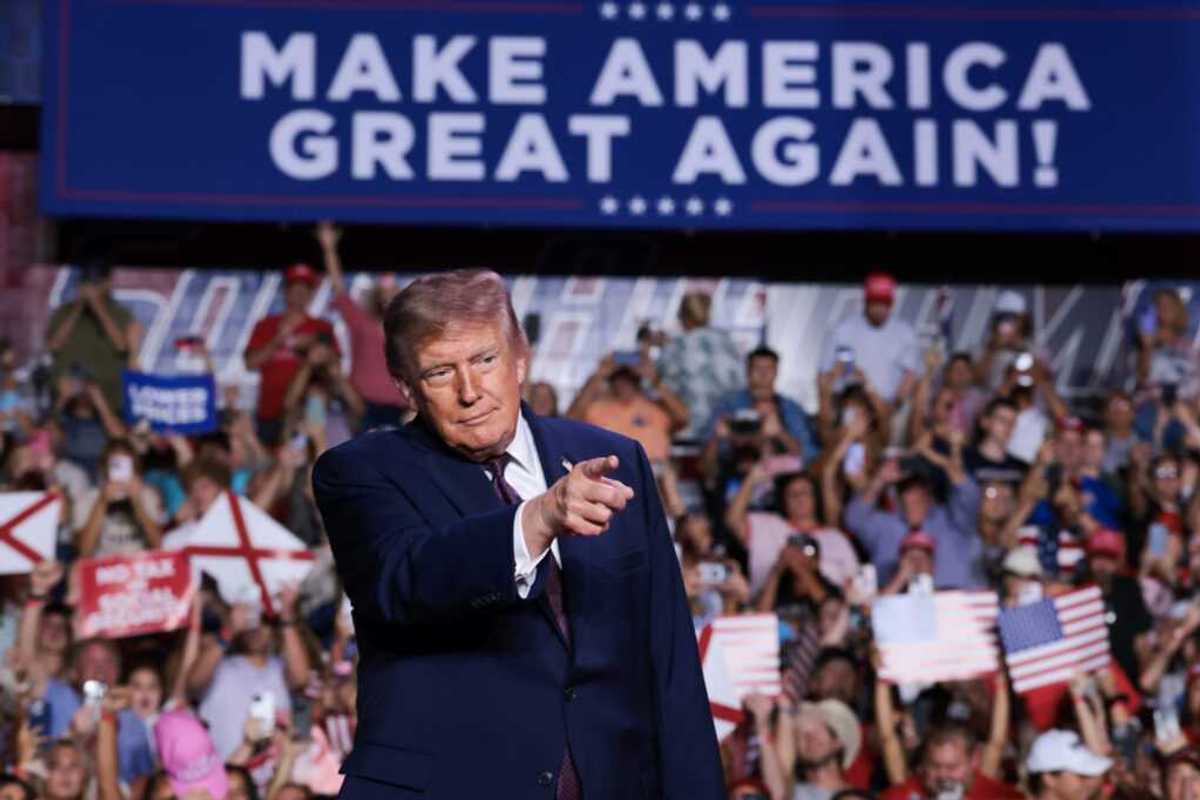



Before becoming president, his name brands included Trump: The Board Game, Trump Magazine, and Trump Steaks.
What the bill does
Democratic legislation in Congress would prevent any federal “asset” – such as a federal building, department, or military base – from being named after a sitting president.
The House version, the Federal Property Integrity Act, was introduced on December 23 by Rep. April McClain Delaney (D-MD6).
The Senate version, the SERVE Act, was introduced a few weeks later on January 13 by Sen. Bernie Sanders (I-VT).
The acronym SERVE stands for Stop Executive Renaming for Vanity and Ego.
Context: the news
President Donald Trump has recently named (or renamed) a number of things after himself, including the Kennedy Center, the U.S. Institute of Peace, a “Trump-class” line of new Navy battleships, and a new form of savings account called Trump Accounts.
Some of these changes were arguably not made by Trump himself. For example, the Kennedy Center was technically renamed by its Board of Directors. Trump, for what it’s worth, claimed he was “surprised” by the renaming.
However, Trump himself had referred to the building as the “Trump Kennedy Center” in remarks earlier that same month, plus Trump appointed all of the board’s current voting members. (The board also consists of some ceremonial “ex officio” members who weren’t appointed by Trump, but who also don’t actually vote.)
Some of the renamings are of dubious legality. The “Trump Kennedy Center” seems to contradict a 1964 congressional law establishing a Kennedy-only name. Similarly, the name “U.S. Institute of Peace” was established by a 1984 congressional law.
In September, The Fulcrum covered the MEGA (Make Entertainment Great Again Act), a Republican congressional bill to legislatively add Trump to the Kennedy Center’s name, which would be of more certain legality. However, the bill has not received a committee vote – and, indeed, has yet to attract a single cosponsor, not even any fellow Republicans.
Context: recent history
Plenty of other federal assets are named for presidents, often while they were still living, but generally only once they were ex-presidents. Some examples from recent decades:
- In 2013, the EPA (Environmental Protection Agency) headquarters was renamed after former President Bill Clinton.
- In 1999, CIA headquarters was renamed after former President George H.W. Bush.
- In 1998, Washington National Airport was renamed after former President Ronald Reagan. (The airport is technically owned by the federal government, though they’ve leased its operations to an independent authority through 2067.)
Has this happened before?
For a presidential administration to essentially name something after the sitting president himself, though, is a different story. Although it has happened before… kind of.
The city of Washington, D.C. was named during George Washington’s presidency in 1791, by the three commissioners tasked with overseeing the new capital’s development. Washington himself did appoint all three commissioners, though it seems doubtful that they renamed the city at Washington’s behest, as the Trump renamings have apparently been.
Indeed, Washington himself avoided using that name in his official correspondence, instead referring to it as “the federal city.”
The Hoover Dam was named during Herbert Hoover’s presidency, but by Interior Secretary Ray Lyman Wilbur. That example might be more comparable to the current Trump situation, though, since Hoover himself apparently desired the name.
While its name was changed to the Boulder Dam in 1933, by Hoover’s political opponents, President Harry Truman signed a 1947 resolution renaming it the Hoover Dam once again. Hoover wrote Truman that he was “deeply grateful” for Truman rescinding the prior “disgraceful action.”
What supporters say
The current legislation’s Democrat supporters argue that America’s leader shouldn’t be able to name anything after themself, at least not while they’re the incumbent.
"Congress must stop the 'Trump branding' of our national treasures and memorials," Rep. McClain Delaney said in a press release. "My bill will ensure that no other federal landmark can ever be named in honor of a sitting president. It's past time that lawmakers drew a firm line to prevent these types of activities."
“Naming public buildings after himself [is] something that dictators have done throughout history,” Sen. Sanders said in a separate press release. “For Trump to put his name on federal buildings is arrogant and it is illegal. We must put an end to this narcissism — and that’s what this bill does.”
What opponents say
Opponents counter that Trump deserves all these renamings, based on his actions in office.
The Kennedy Center name change reflects “the unbelievable work President Trump has done over the last year in saving the building, not only from the standpoint of its reconstruction, but also financially and its reputation,” White House Press Secretary Karoline Leavitt posted on X, formerly Twitter.
“President Trump will be remembered by history as the President of Peace,” Secretary of State Marco Rubio posted on X, formerly Twitter. “It's time our State Department display that” by renaming the U.S. Institute of Peace.
(Trump claims to have ended eight wars, though an Associated Press fact-check disputed that number. 2025 Nobel Peace Prize winner and Venezuelan activist Maria Corina Machado gave her award to Trump in January. The Nobel Foundation clarified that though the physical prize can be transferred, the actual honoree is always considered the official winner.)
What happens now
The House version of the legislation has attracted nine Democratic cosponsors. It’s been referred to three House committees: Transportation and Infrastructure, Natural Resources, Oversight and Government Reform.
The Senate version has attracted an identical nine Democratic cosponsors. It’s been referred to the Senate Homeland Security and Governmental Affairs Committee.
With odds of passage low in the current Republican-controlled Congress, Democratic lawsuits might be the more likely path to success instead.
In December, Rep. Joyce Beatty (D-OH3) sued the administration to reverse the Kennedy Center’s renaming, claiming it was illegal since only Congress can do so. As of this writing, no oral arguments have been scheduled for the case, nor has any court issued a decision.
Similar legislation
A few other Democratic bills would implement comparable policies.
Kennedy Center Protection Act
Rep. McClain Delaney, lead House sponsor of the aforementioned bill to erase all federal asset renamings after Trump, also introduced the Kennedy Center Protection Act to rename that specific one.
“The Kennedy Center is a memorial to a fallen president,” Rep. McClain Delaney said in a press release. “Changing the name of the Kennedy Center is a betrayal of President Kennedy’s legacy and an affront to the American people and our shared history.”
The bill has attracted 10 Democratic cosponsors and has been referred to the House Transportation and Infrastructure Committee.
No Glory for Hate Act
In both the two prior Congresses, Rep. Linda Sánchez (D-CA38) introduced the No Glory for Hate Act to prevent any federal asset from being renamed after a president who was impeached by the House twice – a status which only applies to Trump.
(The Senate acquitted Trump on both impeachments, which is how he was able to remain in office. Two other presidents, Andrew Johnson in 1868 and Bill Clinton in 1998, were each impeached once; both were also acquitted.)
“He fueled falsehoods, promoted racism and hatred, and eventually ignited the events of January 6th,” Rep. Sánchez said of Trump in a 2023 press release. “This bill ensures that there is no glory for hate – not a building, statue, or even a park bench."
The bill never received a committee vote, not even in the 2021-22 Congress when Democrats controlled the House. Neither Rep. Sánchez nor any other member appears to have yet introduced the bill in the current Congress – though there’s still nearly a year left.
Jesse Rifkin is a freelance journalist with The Fulcrum. Don’t miss his report, Congress Bill Spotlight, on The Fulcrum. Rifkin’s writings about politics and Congress have been published in the Washington Post, Politico, Roll Call, Los Angeles Times, CNN Opinion, GovTrack, and USA Today.
SUGGESTIONS:
Congress Bill Spotlight: MAMDANI Act, Blocking Funds to NYC
Congress Votes With Only One House or Senate Dissenter, 2025











The President Invited Iran to Bomb My Home