


In 2016, the journalist Marsha Gessen published an essay offering Americans guidance on how to survive autocracy. Gessen’s first rule: “Believe the autocrat. He means what he says. Whenever you find yourself thinking, or hear others claiming, that he is exaggerating, that is our innate tendency to reach for a rationalization.”
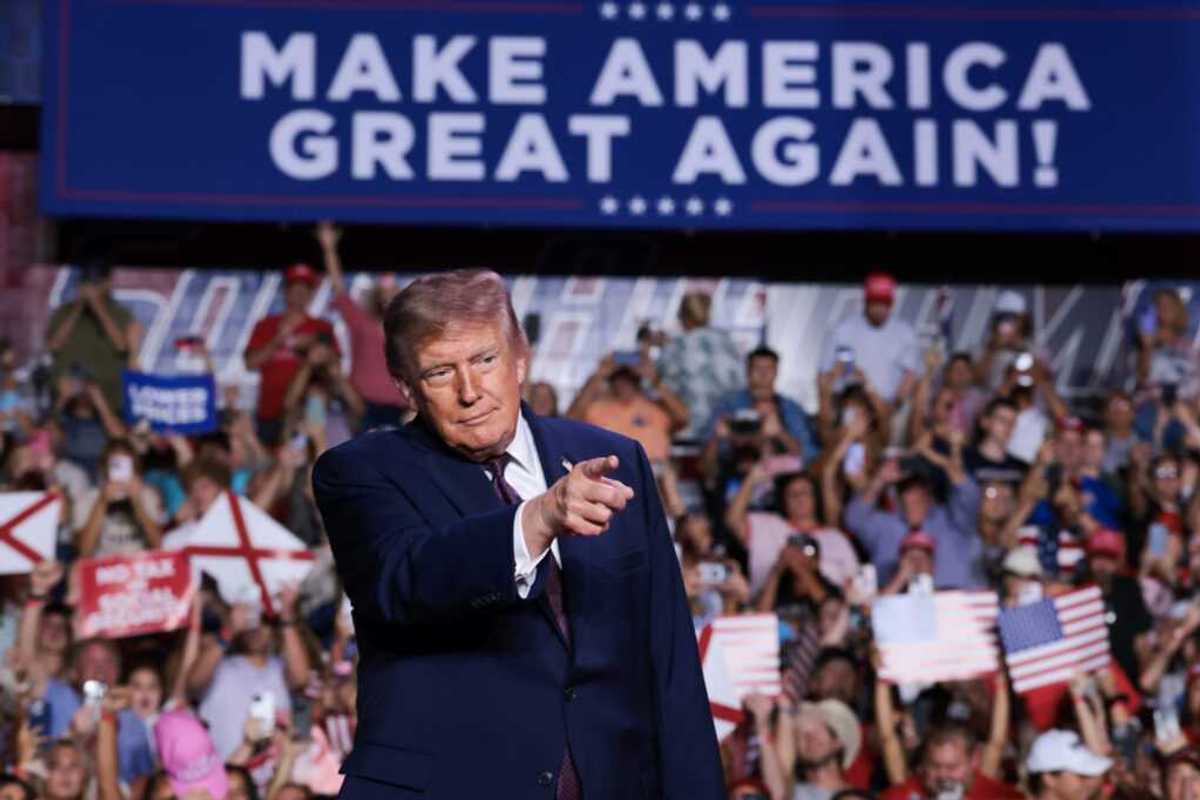
Earlier this month, President Trump escalated his rhetoric about the 2026 elections, calling out corruption, predicting fraud, and threatening to take over the administration of those elections. We should pay attention to what he is saying.
The preservation of democracy hangs in the balance. Now is the time for Republicans in Congress to urge the president to change course.
On February 2, the president told podcaster and former FBI deputy director Dan Bongino that he thought Republicans should “nationalize” the voting process “to prevent ‘crooked’ Democrat-led states from allowing illegal immigrants to vote.”
As a result, "The Republicans should say, 'We want to take over. We should take over the voting in at least -- many, 15 places.' The Republicans ought to nationalize the voting."
One day later, he argued, "The federal government should get involved. These are agents of the federal government to count the votes. If they can't count the votes legally and honestly, then somebody else should take it over."
And, during a February 4 interview with NBC News, he claimed, “There are some areas in the country that are extremely corrupt. They have very corrupt elections. Take a look at Detroit, Philadelphia, Atlanta. There are some areas that are unbelievably corrupt.”
He was asked, “Will you trust the results of the midterms if Republicans lose control of Congress?”
His answer, “I will, if the elections are honest.”
We’ve heard all this before, in the run-up to the president’s 2020 election interference efforts. And remember Gessen’s admonition. We should believe that he will follow the same playbook in 2026.
We know that public confidence in the integrity of elections tracks what political leaders say. If they raise doubts, as the president is doing, the public tends to follow their lead and to lose confidence that their votes will be counted fairly.
In the past, the president has done great damage with his comments about presidential elections, even those he won. Now, for the first time, he is training his attack on congressional elections.
He is doing so because, as a Brookings Institution Report notes, “If Republicans lost control of either chamber in 2026, the legislative phase of Trump’s presidency would end (unless he and the Democratic opposition pivoted toward an unlikely bipartisanship), and a stream of oversight hearings would put his administration on the defensive. For a president whose approval rests in part on his ability to move swiftly and decisively, this would be a major setback.”
Beyond that, the future of Congress as a viable part of the constitutional system depends on the way the 2026 elections are conducted. If the president rigs the election to ensure Republicans retain control of the House of Representatives and the Senate or calls a Democratic victory fraudulent, it will do irreparable harm.
Confidence in Congress is already at historic lows. In 2024, Claudia Deane, an executive vice president at Pew Research Center, wrote that “Around 7 in 10 Americans have an unfavorable view of Congress, an institution that has run in the red on this front for well over a decade. And a whopping 85% of Americans say they don’t think elected officials care what people like them think.”
In authoritarian regimes across the globe, legislatures that are mere puppets of the regime lose their legitimacy. Speaker Johnson and his Republican colleagues ought to pay attention to those experiences.
Not only would Congress lose if the 2026 results are tampered with, but the Republican Party brand will also be tainted for generations.
It would be better for the GOP’s long-term prospects to lose in November than to “win” on the president’s terms. They are already being labelled feckless and blamed for not standing up to President Trump’s turn toward authoritarianism.
If they hold onto power illegitimately, they will become active collaborators in delivering a serious, even mortal blow, to the constitutional order.
While collaborators may profit in the short term, history does not judge them kindly. Take the example of southern Democrats after the Civil War.
As the author Clayton J. Butler observes, they “made a persistent and ultimately successful appeal to white solidarity that proved attractive even to former foes. Antipathy toward the Confederacy, they knew, had not and did not equate to sympathy for African Americans or unqualified support for their civil rights. White supremacy crossed lines of national loyalty and had more purchase in the South (to say nothing of the nation as a whole) than the Confederacy ever did.”
The result was a solid South for Democrats for decades and a legacy of shame.
Republicans need to remember that lesson.
That’s why Republicans should stand up to Trump and counsel him not to interfere with the 2026 election. They should also convene hearings to reassure the American people that no one will tinker with the votes they cast in November.
So far, the signs that they will do so are not good. As the website Mediaite’s headline put it in the aftermath of Trump’s comments about election corruption in blue states, “Mike Johnson Jumps Aboard Trump’s Rigged Elections Bandwagon.”
Johnson said, “What you’re hearing from the president is his frustration about the lack of some of the blue states, frankly, of…making sure that they are free and fair elections. We need constant improvement on that front…. In some of the states, like in California, for example, I mean, they hold the elections open for weeks after Election Day. That’s just one thing that bothers so many people.”
Johnson did not stop there. “We had three House Republican candidates who were ahead on Election Day in the last election cycle. And every time a new tranche of ballots came in, they just magically whittled away until their leads were lost. It just, it looks on its face to be fraudulent.”
“Can I prove that? No, because it happened so far upstream…”
But the absence of proof did not stop the Speaker from complaining about “mass mailing of paper ballots, of mail-in ballots, and all the other irregularities that have haunted us over the last couple cycles, we need to tighten that up,” and pointing the finger at his political opponents. “Now,” he said, “the red states have done a lot of good work in that front, but it’s the blue states that I’m frankly concerned about.”
Blaming blue states may please the president, but it will not address the lurking disaster that awaits Congress and the Republican Party if he interferes with the 2026 election. The time that Republicans have to avert that disaster is running out. Only they can do it.
Austin Sarat is the William Nelson Cromwell professor of jurisprudence and political science at Amherst College.