

Since organizing the Voters Not Politicians 2018 ballot initiative that put citizens in charge of drawing Michigan's legislative maps, Katie Fahey has been the founding executive director of The People, which is forming statewide networks to promote government accountability. She regularly interviews colleagues in the democracy reform world for our Opinion section.
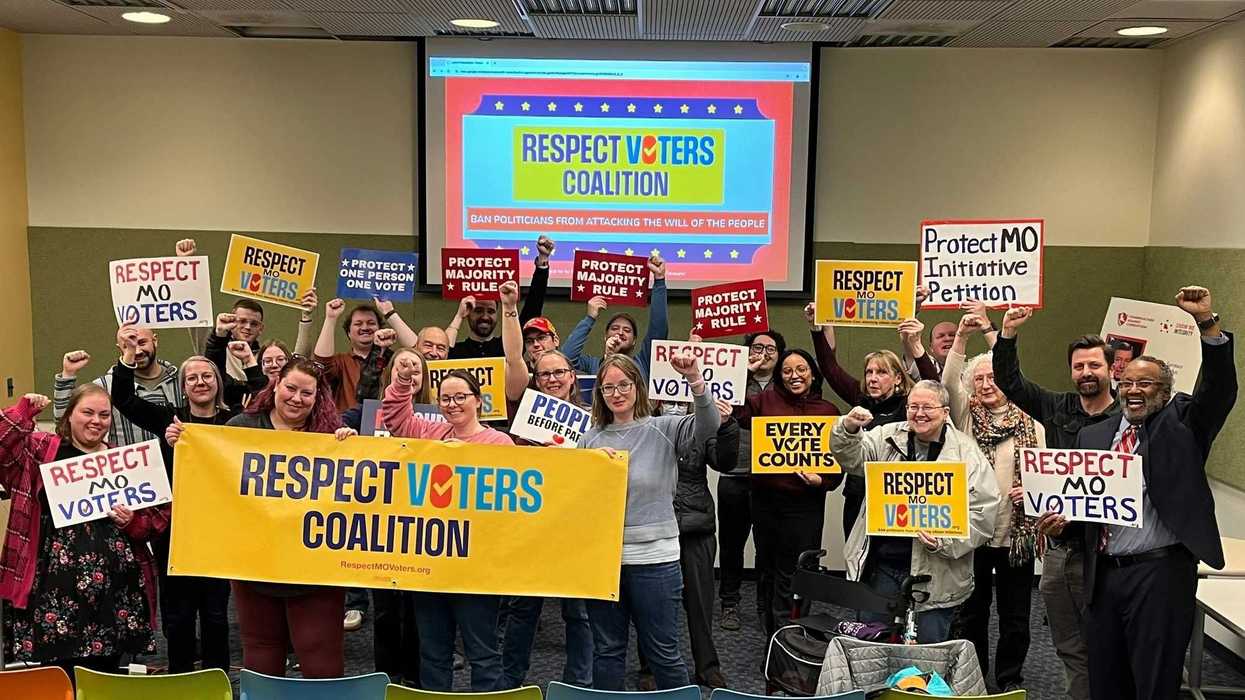
Benjamin Singer has led successful state and local democracy reform campaigns with Republicans, Democrats, and Independents for over a decade. Currently, Benjamin serves as Co-Founder and Campaign Director of Respect Missouri (MO) Voters, a cross-partisan, volunteer-led coalition working to protect the citizen initiative process to build a more ethical, effective government of, by, and for the people.
Our conversation has been edited for clarity and brevity.
Fahey: Tell us about your background. What led you to get involved with Respect MO Voters?
Singer: There are many issues I have always cared passionately about: homelessness, poverty, and energy, to name a few. I realized our government's approach to these problems is dysfunctional because of our broken, corrupted, and unrepresentative political system. So I got involved as a volunteer…and then changed careers.
As the CEO of the Respect Voters Coalition and Show Me Integrity, I now lead a cross-partisan movement to protect the initiative process and secure voting rights for all people, regardless of their political background. I am proud to help lead the passage of major reforms, including the St. Louis Propositions D and R and the Clean Missouri initiative. We have made politics more functional, ethical, and representative through nonpartisan primaries, approval voting, ending gerrymandering, and banning politicians from voting on bills when they have a conflict of interest.
But then something bad happened.
After we passed Clean Missouri, the legislature threw it back on the ballot with trick language to gut it. Missouri is one of 11 states with little to no protections in place to stop politicians from overturning the will of the people. Several additional states have very weak protections. The legislature has actually gutted citizen initiatives 7 times in the last 16 years.
A couple of volunteers then came up with the idea to run an initiative to save initiatives. We surveyed our members, and 81% agreed that this was what we should focus on in 2025-26.
Then Respect MO Voters barnstormed the state and went viral by organizing a mass movement, just like you did with Voters Not Politicians in 2018!
Since then, more states have also gotten fed up with politicians overturning their votes, and we expect 3-4 states to have similar measures on their ballots in 2026.
Fahey: What, specifically, is Respect Missouri (MO) Voters advocating for?
Singer: We are currently gathering signatures on an initiative petition that would, essentially, save the initiative petition process in Missouri. Our proposed ballot measure would: (1) require language on ballots to be clear and accurate, (2) stop politicians from overturning initiatives passed by voters, and (3) protect our 117-year-old freedom of the citizen initiative.
Fahey: What are the ways that the legislature has been attacking the ballot initiative process, and why do you think they are doing it?
Singer: It is simple: politicians want all the power in their own hands. That is why they are trying to take it away from voters.
Earlier this year, the legislature overturned a sick leave policy and minimum wage proposal that Missouri voters had approved by nearly 58 percent. Legislators used the excuse that the voters “didn’t really understand” what they were voting for.
The most recent example came in a special session of the legislature when politicians put an amendment on the 2026 ballot to make initiatives impossible. Instead of a majority of all voters needed to approve a measure, the legislation would require statewide initiatives to pass with a majority in every single Congressional district. This measure would allow a small minority of voters (five percent) to block initiatives with strong statewide support and essentially gut direct democracy.
While these were the actions of a Republican-majority legislature, both parties have attacked initiatives when they have been in power. When Democrats held the majority of the legislature, they didn’t like that voters used initiatives to limit taxes. So those politicians passed a bill to try to make it harder for citizens to use initiatives. Republican Governor John Ashcroft vetoed the bill, saying that “It is through the initiative process that those who do not influence elective representatives may take their cause directly to the people.” Ashcroft was right, and that is why we still have initiatives in Missouri. So it’s no surprise that Respect MO Voters has many Republican, Democratic, and Independent supporters.
Fahey: What is the plan for changing this law, and what step are you at in the process?
Singer: Ballot language has been finalized and approved by the Secretary of State. We are in the process of gathering 300,000 signatures to get the measure on the November 2026 ballot. Over 1200 volunteers have already gathered over 135,000 signatures, and we expect to turn them in at the beginning of May.
Fahey: Does this initiative strengthen the ideals of democracy?
Singer: Absolutely. The initiative petition is direct democracy in action. When the legislature fails to act, the voters themselves can propose and approve measures they desire. In Missouri, those voters have used the process to decrease corruption, keep taxes reasonable, and keep rural hospitals open.
Fahey: Has this issue been addressed in the past, and if so, how? How does your approach differ from previous efforts?
Singer: Arizona passed a very similar measure in the 1990s, and Michigan put it in its Constitution around 1963. In Missouri, we have used the process for 117 years, but there is a history of clashes with the legislature over initiative petition proposals that goes back at least 40 years. The Missouri General Assembly has a history of repealing or altering voter-approved initiatives, which sparked the current push to add protections to the state constitution.
Fahey: Who are the main opponents of your effort, and what are their arguments against it? Who are your main supporters?
Singer: It is politicians versus the people. Politicians are the primary opponents to Respect MO Voters. Witness the fact that they recently passed their own legislation that gutted the initiative petition process. They have termed their ballot proposal “Protect Missouri Voters,” a clear attempt to confuse our supporters of Respect MO Voters. They want all the power in their hands.
Our main supporters are voters. A majority of voters on the left, right, and center support our measure. Voters are tired of the disrespect shown to them by the legislature. We are a cross-partisan organization, all volunteer, with over 1200 volunteers who have turned in signatures so far.
Fahey: What do you currently need the most help with, and how can people get involved? 2
Singer: We need more volunteers and donations. We are about $1.95 million and 150,000 signatures short of our goal to qualify for the ballot. People can visit respectmovoters.org to learn more, volunteer, or donate to our campaign.
Fahey: If you were speaking with a high school student or a new immigrant to our country, how would you describe what being an American means to you?
Singer: I love this question! I gave a TEDx talk on America and our broken elections, where I said that the story of America is this: if we work together and are open to trying new ideas, we can accomplish great things, such as the airplane, the internet, and modern democracy. Those great things include making our democracy work even better.
Katie Fahey is Executive Director of The People.