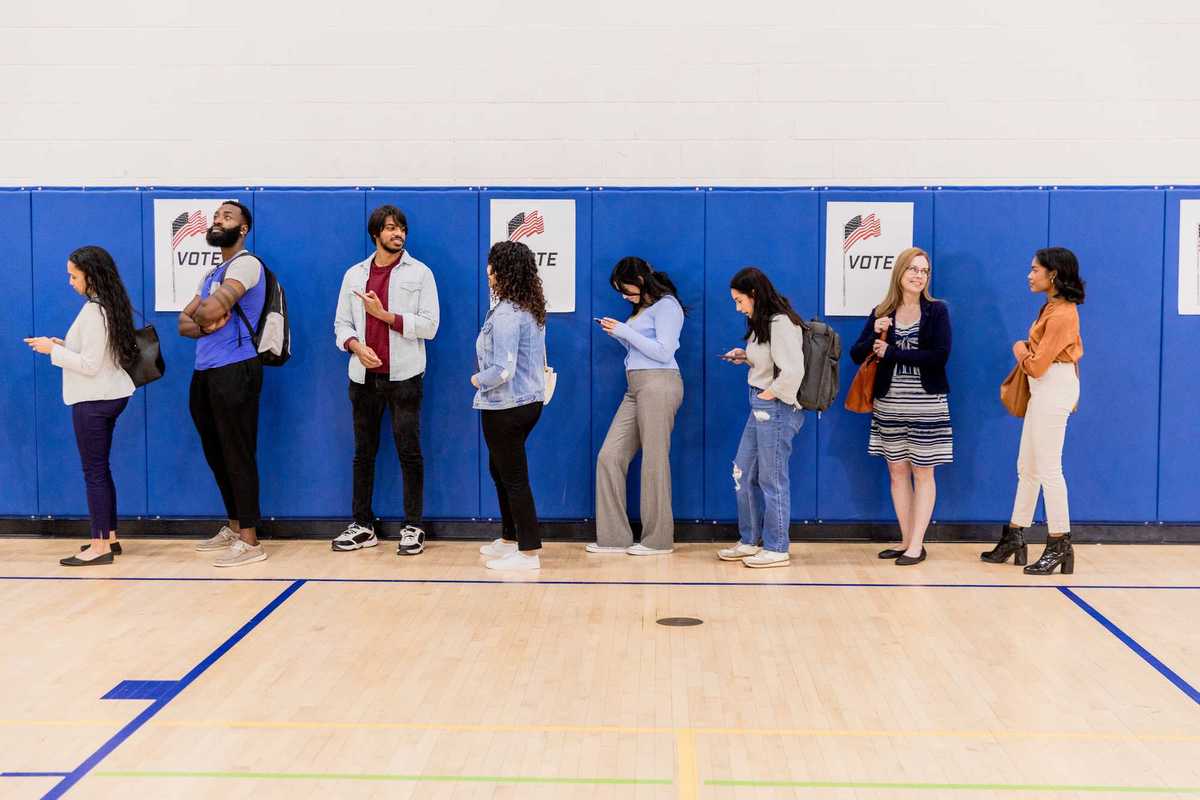
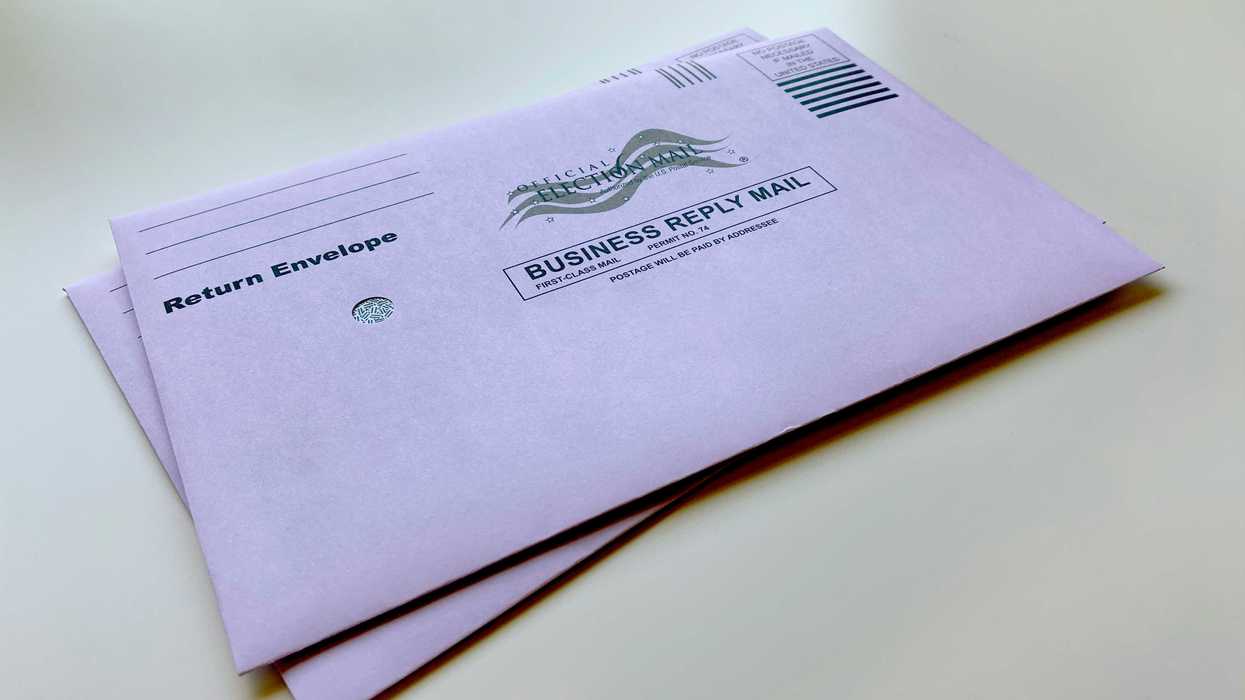
Oregon's primary election was on May 19. Neither of the two major-party candidates in Oregon's 6th Congressional District faced a primary opponent. They'll automatically advance to November's general election ballot, without a single voter really needing to weigh in, without collecting a single petition signature, and without knocking on a single door. The Democratic incumbent represents a party that accounts for 29.75 percent of registered voters in this district. The Republican nominee represents a party with 24.78 percent of the vote. Together, the two parties represent a minority of OR-6's electorate, and both of their candidates are already on the November ballot.
I represent the largest voting bloc in this district. Nearly 40 percent of OR-6's registered voters are unaffiliated, more than either party. These voters have never had a candidate who answers only to them—not to party bosses, party lines, or special interests. I am trying to be that candidate. And I am still on the porch, clipboard in hand, collecting the 5,500 hand-signed paper petitions I will need just to guarantee that my name appears beside theirs in November.
This is the same Oregon that has been a national pioneer in election innovation for over four decades. Oregon approved all-mail voting by a nearly 70 percent margin in 1998. In 2000, it became the first state in the nation to conduct a presidential general election entirely by mail. In 2019, it became the first state to offer free return postage on ballots. Oregon did not stumble into these reforms. Its voters demanded them, its officials championed them, and the rest of the country eventually followed. Oregon's election infrastructure is, by any reasonable measure, among the most forward-thinking in the United States.
And yet: to place an independent candidate on the congressional ballot in Oregon in 2026, you need a pen, paper, a clipboard, and someone willing to open their front door.
Consider that Oregon and the rest of the country already use digital identity verification for highly sensitive matters. Things like opening a bank account, boarding a plane, accessing medical records, filing taxes, signing a lease, applying for a mortgage, and myriad other things. Some airline passengers now clear airport gates through facial recognition without ever showing a boarding pass. The list keeps growing every year. But to demonstrate that a citizen of Oregon wants a candidate on a congressional ballot, you need a pen, paper, and someone willing to open the front door.
The signature requirement is a relic. The world it was designed for no longer exists. And the physical reality of meeting it has become dramatically harder, because the spaces where you could once gather signatures efficiently have largely been closed off.
In an earlier era, the public square was literal, a place where people gathered, where civic life happened in person, where a candidate or a cause could meet voters where they actually were. That square is now digital. It is social media, email, text messages, and online communities. That is where people interact, share information, and engage with the world around them. I can reach a voter online, capture their interest, and have them tell me they want to sign my petition in just a few seconds. But then I have to send someone to their door with a clipboard, because the law requires a physical signature on a Secretary of State-approved form, with hand-printed name, date, and address, including ZIP code, in the space provided, in apparently subjectively legible handwriting, or the signature will not count. The interest was digital, yet the follow-through regressed to analog. We make a U-turn from the 21st century back to the 19th every time we try to collect a valid signature.
Those forms, by the way, are not designed with generosity. The space allotted for each required element is tight enough that missing even one field, or having a single element ruled illegible by the Secretary of State's office, invalidates that signature entirely. The nominal requirement for OR-6 is 3,532 valid signatures from registered voters in the district. In practice, accounting for the inevitable invalids, I need to collect between 5,000 and 5,500 total signatures to be confident of clearing the threshold. And while the certification deadline is August 25, the Secretary of State's office recommends submitting well in advance to allow time for manual review and validation, without specifying how far in advance. We are left to guess.
That lead time and those people-hours of manual review could be eliminated almost entirely by digital identity verification. The same technology that confirms who you are before you board a flight could confirm who you are before you sign a petition. Oregon, of all states, would know how to implement it. Oregon has been implementing election innovation since before most of the country believed it was possible.
The places where you could once gather signatures in volume are also largely inaccessible. Grocery stores, shopping malls, big-box retailers: all privately owned, all within their rights to remove you, and most of them will. I can speak to this from personal experience. What remains is door-to-door canvassing, and in 2026, that means contending with 'No Soliciting' signs on a substantial share of front doors, Ring and Nest cameras on most of the rest, and a reasonable reluctance among most people to open their door to a stranger. The legal mechanism for putting an independent candidate on the ballot now depends almost entirely on strangers opening doors to strangers, at a moment in history when almost nobody does.
None of this is accidental. Ballot access laws were written by the two major parties and serve the two major parties. The barrier to entry is not a neutral inconvenience. It is a structural moat maintained by the same political establishment that benefits from keeping it in place. Professional petition circulator firms exist to solve this problem, and they work, but given an average collection rate of around 12 signatures per hour at a base rate of $20 per hour plus per-signature bonuses, the cost to simply become an option on a ballot for this race runs between $13,000 and $15,000. A party-backed candidate has the party's infrastructure. An incumbent doesn't need to gather signatures at all. The barrier falls hardest on the one category of candidate the system most needs and least wants: the credible, well-qualified political outsider.
Ballot access is only one layer. Campaign finance rules, debate access criteria, media coverage patterns, and electoral infrastructure were all shaped by people with strong incentives to make the system resistant to disruption. Major-party candidates benefit from party fundraising infrastructure, coordinated spending, and institutional name recognition. Independent candidates start with none of that. Oregon's primary was on May 19, but because I am not a party candidate, it was irrelevant to my campaign. I do not get the earned media that comes with a contested primary, the donor energy, or the voter attention. Instead, I have been collecting signatures while the clock runs. My campaign's limited early resources are going toward ballot access rather than voter outreach, advertising, or organizing. The compressed timeline that results, Oregon's primary is among the latest in the country, which means the window between the primary and the general is shorter than almost anywhere else, making an already steep climb even steeper.
There is also a quieter problem, and it may be the most consequential one. For years, conventional wisdom has held that voting for an independent is throwing your vote away. That assumption has shaped behavior at every level: how the media covers independent candidates, how donors evaluate them, how voters think about their own choices. What most voters do not know, because the two major parties have no interest in telling them, is that the electorate has been moving steadily away from both parties for years. Nationally and in Oregon, voters have been registering as unaffiliated in growing numbers, election cycle after election cycle, as the major parties have grown more extreme, more gridlocked, and more loyal to their own institutional survival than to the people they were elected to serve. In OR-6, that trend has produced an electorate in which unaffiliated voters are the largest bloc. The math has already changed. The conventional wisdom has not caught up.
When I gather signatures and talk to voters about these numbers, that independent voters are nearly 40 percent of this district, more than either party, I watch something shift. People did not know. They assumed they were the exception, the outlier, the lone dissenter. Finding out they are the majority changes the calculation entirely. If independent voters in OR-6 vote as a bloc for a candidate who actually represents them, the independent candidate wins. The math works. What has been missing is a candidate worth coalescing around.
My opponent raised $3.3 million in her last campaign. Ninety-three percent came from outside the district she represents. Nearly sixty percent came from outside Oregon altogether, from national PACs, financial industry donors, and D.C. lobbying organizations, some of them foreign government-backed. Her voting record reflects the priorities of national Democratic leadership, not the politically diverse district she represents. She had no difficulty getting on the ballot. She did not need to.
I am a combat veteran with nearly 27 years of military service and a Bronze Star. I am a healthcare executive and a professor at the OHSU-PSU School of Public Health. I founded a nonprofit that helped bring more than 150 Iraqi and Afghan interpreters to safety after their service alongside American forces, a work commended on the floor of the United States Senate by both a Republican and a Democratic senator. I have never held elected office. I have never answered a party caucus. Not a single member of Oregon's current congressional delegation has served in the military. I would be the only one.
People ask why qualified outsiders don't run for Congress. The answer is that the system is not designed to let them through. Ballot access, fundraising requirements, media infrastructure, debate rules: each layer filters candidates with party backing and donor networks, while filtering out almost everyone else. This is not an incidental outcome. The rules were written by people who benefit from keeping outsiders out.
Oregon's 6th is a test case. If the largest voting bloc in this district, voters who are already tired of choosing between two parties they don't trust, can find out that a genuinely strong independent candidate exists and decide to vote for their actual interests, something changes. Not just here. The math supports it. Whether the system allows them to find out in time is a different question.
For now, I'm on a porch with a clipboard, waiting for someone to answer the door — literally.
Jason Faler is a combat veteran, Bronze Star recipient, healthcare executive, and professor at the OHSU-PSU School of Public Health. He is running as an independent candidate for Oregon's 6th Congressional District in November 2026. Learn more at FalerForCongress.com.