


Skip to content
Search

Latest Stories

Follow Us:
Top Stories

The Dems need this redistricting battle

Opinion

The Dems need this redistricting battle

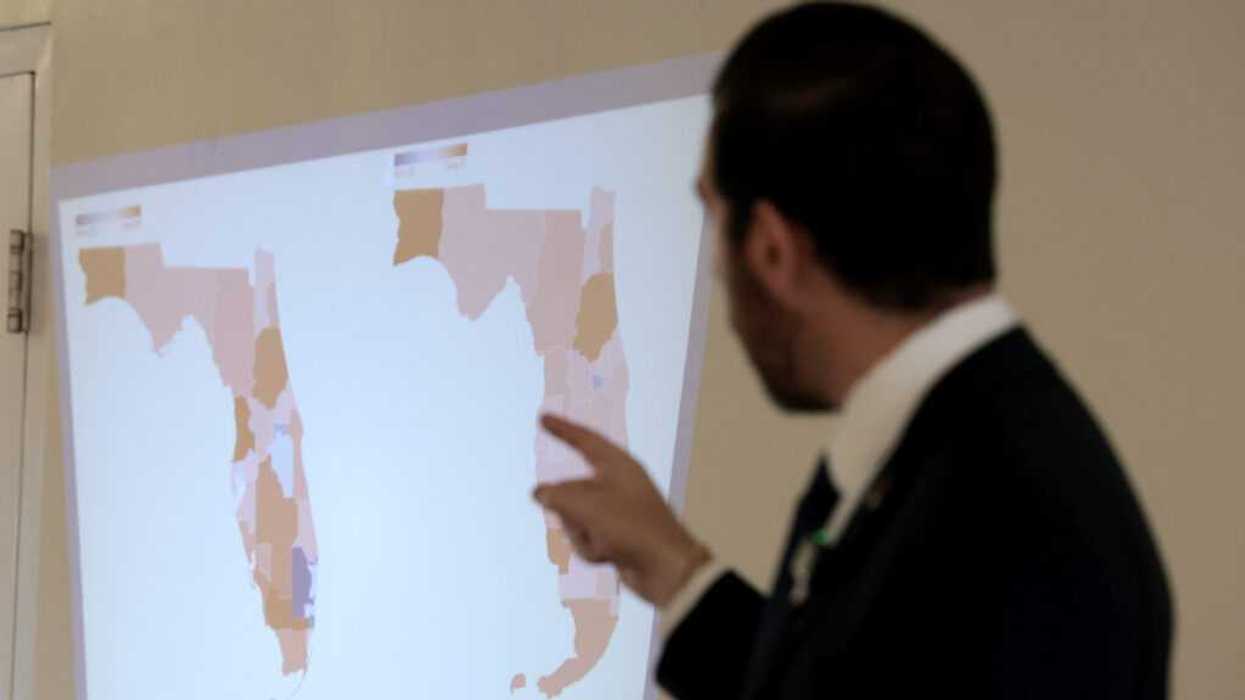
Larkin, Democratic candidate for Congress in Florida’ s 23rd district, speaks during an emergency town hall that he held to address Florida Republicans’ newly approved congressional redistricting map on May 4, 2026, in Coral Springs, Florida. Ron DeSantis announced he signed a redistricting bill that could help Republicans pick up four more House seats.

(Getty Images)

Over the past six months, Democrats have been more than happy to let President Trump be their best campaign ad. From his ill-advised war in Iran to his ill-advised tariffs, his obvious declining mental acuity to his increasing desire to spend taxpayer money on wasteful vanity projects, Dems know that Politics 101 dictates you never interrupt your enemy when he’s making a mistake.

With politicos predicting a midterm election bloodbath for Republicans, Dems were riding high. That is, until Trump unleashed his redistricting wars.


Aware of their inability to win with the current maps, the GOP has been redrawing the country in its image, and potentially marginalizing minority voters in the process. That’s bad — for the left, but more importantly for democracy. Voters should choose their candidates, not the other way around.

But the right’s assault on Black voters in particular may not be the coup they seem to think it is, especially if it unintentionally helps the left shore up one of its most problematic gaps.

In 2016, Donald Trump won his first presidential election largely thanks to white voters, who made up 88% of his coalition. Then, only 1% of his voters were Black.

By 2024, just eight years later, Trump had expanded that coalition considerably, winning 15% of the Black vote, per Pew.

But over on the Democrats’ side, the arrows were moving in the opposite direction. A once-reliable coalition — former President Barack Obama, for example, won 95% of the Black vote in 2008 — has been incrementally leaving the Democratic Party or staying home. In 2024, Kamala Harris won just 83% of the Black vote, down from Joe Biden’s 87% in 2000.

I assume that’s worrisome to the Democratic Party, though we don’t know how worrisome because it has refused to release its 2024 autopsy.

What I do know is Trump and Republicans may have just given them a lifeline they weren’t expecting.

The redistricting forever wars have Republicans carving up predominantly Black majority districts nationwide. On nearly every metaphorical battlefield, the GOP is winning — Trump successfully primaried Indiana state lawmakers who refused to redistrict; the Supreme Court sliced into the Voting Rights Act; Virginia’s supreme court ruled against the Dems’ efforts to redistrict. According to CNN’s redistricting tracker, Republicans could net nine seats in November.

That’s unequivocally bad news for the left, but the unintended consequence of the right’s zeal to rig the maps could send Black voters back to the Dems in numbers a single candidate not named Obama could not.

“Democrats are gonna be able to go into African-American communities and say, ‘Republicans are doing everything they can to take away your political power,’ ” Democratic strategist Ian Russell told Politico. “That’s a really salient message.”

And it could come at a really important time. Turnout among Black voters in the last midterms dropped by nearly 10 percentage points, from 51.7% in 2018 to 42% in 2022, whereas white turnout dropped just 1.5 points. The gap in 2022 was the largest in any election — presidential or midterm — since 2000.

Black voters’ disillusionment with Democrats has been growing, with just 66% self-affiliating with the party in 2023. The Republican war on Black districts could pull them back, at least in the short term.

Looking ahead, Democrats simply don’t have a transformative figure, like an Obama or a Bill Clinton, waiting in the wings to rebuild the Black coalition, but they do have an issue that could motivate it significantly.

If the Dems had a plan to win back this important voting bloc, or the parts of it that left, we don’t know what it was. But the redistricting wars might just be the catalyst they needed, and at the perfect time.

S.E. Cupp is the host of "S.E. Cupp Unfiltered" on CNN.


Read More

How A 2022 Law Changed Election Certification: Assessing the Electoral Count Reform Act

A sign that reads: Voting

E4C

How A 2022 Law Changed Election Certification: Assessing the Electoral Count Reform Act

This nonpartisan policy brief, written by an ACE fellow, is republished by The Fulcrum as part of our partnership with the Alliance for Civic Engagement and our NextGen initiative — elevating student voices, strengthening civic education, and helping readers better understand democracy and public policy.

Key Takeaways

  • The Electoral Count Reform (ECRA) of 2022 modernizes the 1887 Electoral Count Act, which governed how Congress counts Electoral College votes. The original Act has been widely criticized as vague and susceptible to exploitation.
  • The ECRA clarifies that the Vice President’s role is ceremonial, raises the objection threshold to 20 percent of both chambers, and designates governors as responsible for submitting elector certificates.
  • Supporters argue that the bipartisan reform prevents future election disputes and protects democratic stability, while critics contend that it was rushed, doesn’t address deeper election integrity issues, and raises concerns about federalism.
  • The Act reflects bipartisan cooperation but continues debates about federalism and the balance of power between states and Congress.

The Electoral Count Reform and Presidential Transition Improvement Act (ECRA) was introduced by Senator Susan Collins (R-ME) in July 2022 and signed into law by President Joe Biden in December 2022. It is a reform to the Electoral Count Act of 1887 (ECA), a law that governs how Congress counts the Electoral College votes for president every four years. The Act is also a response to President Donald Trump’s efforts to dispute the 2020 presidential election results, which revealed several gaps in the law that could be exploited by a presidential candidate.

Keep ReadingShow less
The Bipartisan War on Independent Voters
A pole with a sign that says polling station
Photo by Phil Hearing on Unsplash

The Bipartisan War on Independent Voters

The Washington Post editorial board penned a bold piece (Bill Cassidy and America’s Increasingly Broken Primary System) in the wake of President Trump’s successful vendetta against the Louisiana Senator. They could have taken the easy route and pointed a finger at the Republicans. Instead, they took issue with both parties and their insatiable appetite to control the rules of the game and punish anyone who steps out of line.

In a media landscape dominated by partisan propaganda, it’s refreshing to read an opinion piece that encourages readers to actually look at what’s happening.

Keep ReadingShow less
Oregon Pioneered Vote-by-Mail. Its Ballot Access Laws Are Still in the Covered Wagon Era.
white printer paper on white table

Oregon Pioneered Vote-by-Mail. Its Ballot Access Laws Are Still in the Covered Wagon Era.

Oregon's primary election was on May 19. Neither of the two major-party candidates in Oregon's 6th Congressional District faced a primary opponent. They'll automatically advance to November's general election ballot, without a single voter really needing to weigh in, without collecting a single petition signature, and without knocking on a single door. The Democratic incumbent represents a party that accounts for 29.75 percent of registered voters in this district. The Republican nominee represents a party with 24.78 percent of the vote. Together, the two parties represent a minority of OR-6's electorate, and both of their candidates are already on the November ballot.

I represent the largest voting bloc in this district. Nearly 40 percent of OR-6's registered voters are unaffiliated, more than either party. These voters have never had a candidate who answers only to them—not to party bosses, party lines, or special interests. I am trying to be that candidate. And I am still on the porch, clipboard in hand, collecting the 5,500 hand-signed paper petitions I will need just to guarantee that my name appears beside theirs in November.

Keep ReadingShow less
Election Officials Warn of Rising Threats As Security Funding Declines Ahead of Midterms

Reps. Laurel Lee (R-Fla) and Terri Sewell (D-Ala) at Wednesday’s House Administration Elections Subcommittee hearing titled, “Examining Best Practices for Strengthening Election Security.”

(Kaitlin Bender-Thomas/MedillNews Service)

Election Officials Warn of Rising Threats As Security Funding Declines Ahead of Midterms

WASHINGTON –Election officials warned lawmakers on Wednesday that threats against election workers and voting systems are escalating even as federal funding for election security remains far below 2020 levels, posing risks ahead of the 2026 midterms.

In 2020, Congress allocated $425 million for election security grants, compared to $15 million in 2025 and $45 million this year. The Trump administration has also proposed a $707 million cut to the CyberSecurity and Infrastructure Security Agency’s fiscal 2027 budget and ended the agency’s election security support for state and local governments.

Keep ReadingShow less