

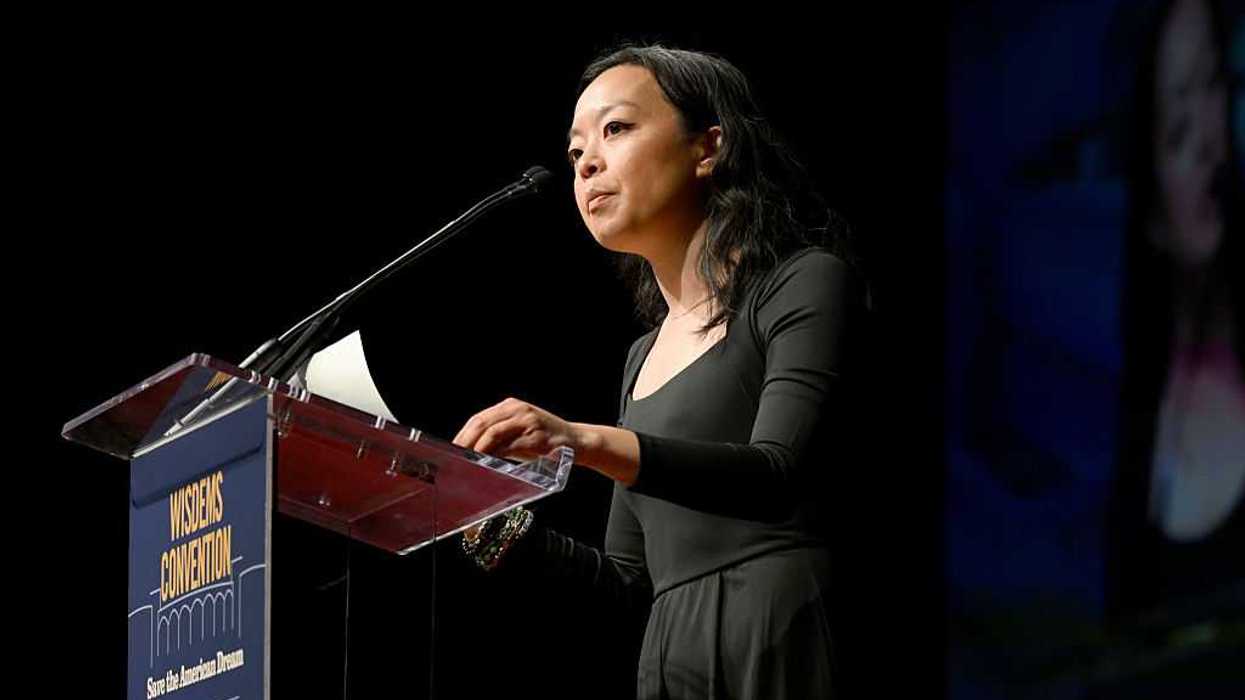

MILWAUKEE, Wis. – Francesca Hong, a democratic socialist, has emerged as the frontrunner in the Democratic gubernatorial primary with fewer than two weeks remaining. But questions remain about whether she can win in a swing state where Democrats are eyeing a possible trifecta in the state legislature this fall.
Hong, 37, is a political outsider with a working-class background. The daughter of Korean immigrants, she grew up in Madison, left college to work as a dishwasher, and worked her way up to become an executive chef. In 2016, she opened a restaurant, which later closed amid economic challenges.
Hong’s experiences in the service industry propelled her to run for office. She ran for Wisconsin’s 76th Assembly District in 2020 after witnessing the effects of the pandemic on workers and small business owners.
In an essay for Bon Appetit in 2020, Hong wrote about navigating the challenges to her restaurant while receiving little to no support from state or federal agencies.
“Why couldn’t our elected officials take on that same leadership? They refused to see that they themselves must adjust the rules and recognize that the game is rigged for the working person,” Hong said in the essay.
Hong went on to win the primary and general election, becoming Wisconsin’s first Asian American state representative. In her campaign for governor, she has continued to frame her candidacy around working-class concerns, especially regarding affordability.
She supports policies such as universal childcare, a public option for health care, paid leave, and a moratorium on new data centers.
“People keep asking if Wisconsin is ready to elect a democratic socialist governor. But in my conversations with voters, people care less about labels and more about ideas, values, and solutions. There's only one majority in Wisconsin, and that's the working class,” Hong wrote in a post on X.
In a Tuesday debate among the Democratic candidates on WISN-12, Hong was asked whether she supported the national platform of the Democratic Socialists of America and about her electability as a democratic socialist. Hong stated she did not support the full platform of the national DSA and was not endorsed by the group.
“What democratic socialism is, is a form of government that puts working-class people first,” Hong said. “The policies that we have been working on, permanent affordability, has broad bipartisan support in every corner of the state.”
Recent polls of Democratic voters show Hong with a commanding lead. A Marquette Law School poll conducted July 22–27 found that 38% of respondents planned to support Hong in the primary. A July 28 StateNavigate poll, sponsored by liberal groups, put that number even higher, at 44%.
However, prominent Democrats have avoided supporting Hong, even as she has remained the frontrunner through a tumultuous series of events. By mid-July, Democratic support appeared to be coalescing behind Lt. Gov. Sara Rodriguez, but campaign finance issues led her to suspend her campaign on July 17. The following day, Milwaukee County Executive David Crowley re-entered the race—having previously stepped aside to support Rodriguez—with an endorsement from Gov. Tony Evers. Then, on July 30, Mandela Barnes ended his campaign after the Milwaukee Journal Sentinel asked him about allegations that he used his position in the party to pursue sexual encounters.
Barnes’ exit could further consolidate Hong’s advantage. Polling on second-choice preferences among his supporters puts Hong at 43%, Crowley at 10%, and Kelda Roys and Joel Brennan at 3% each.
Hong’s growing primary lead has raised concerns among some Democrats about whether her candidacy could hurt the party’s chances of winning statewide in November. In the wake of Crowley’s re-entry, David Axelrod, Barack Obama’s former chief political strategist, voiced his concerns that the party could lose in the general election, posting on X that the Democratic contest in Wisconsin “feels like a slow-rolling car headed for a cliff.”
Republicans are also targeting Hong, depicting her as out of step with Wisconsin voters. Tom Tiffany, the presumptive GOP nominee, has attacked Hong on X for being a “card-carrying socialist.” The Republican Governors Association has also begun airing ads calling Hong “too liberal for Wisconsin” and citing her stances against ICE and the Trump administration’s immigration policies as threats to public safety.
Still, that criticism may not be landing. Several voters contacted through the Hong campaign said they were supporting her despite not identifying as democratic socialists.
Matthew Crowe, 38, the mayor of Menominee and a moderate Democrat, said Hong was not his first choice. But he said the success of candidates like Zohran Mamdani has helped him understand that democratic socialism is distinct from socialism or communism.
“Once you start seeing wins from this kind of a system, it makes it harder to fearmonger on it,” Crowe said. He noted that the Hong campaign reminded him of his own mayoral race, with its focus on what “positive change would look like and breaking away from the status quo.”
Alex Lux, 30, a former Trump voter, first heard about Hong’s campaign in January. Lux, who lives in Brown Deer, said he was impressed by Hong’s willingness to participate in “hands-on governing,” adding that dissatisfaction with the status quo has left voters looking for something different.
“Fran is filling that space with her authenticity, her courage, her direct approach on the issues,” Lux said.
For some conservative voters, Hong’s outsider status makes her more appealing. Sam Thorson, 29, said Hong’s lack of establishment ties makes it easier for some of the conservatives he speaks with to consider supporting her.
“The fact that she's not an establishment candidate is much in her favor. The door is more open to her,” Thorson said.
Lux believes the campaign has “grown far beyond a label.”
“I do believe she will be the winner in November,” Lux said.
The primary will be held on August 11, with the Democratic nominee set to face Tom Tiffany on November 3.
Abbey Osborn is a journalist based in Milwaukee, Wisconsin.