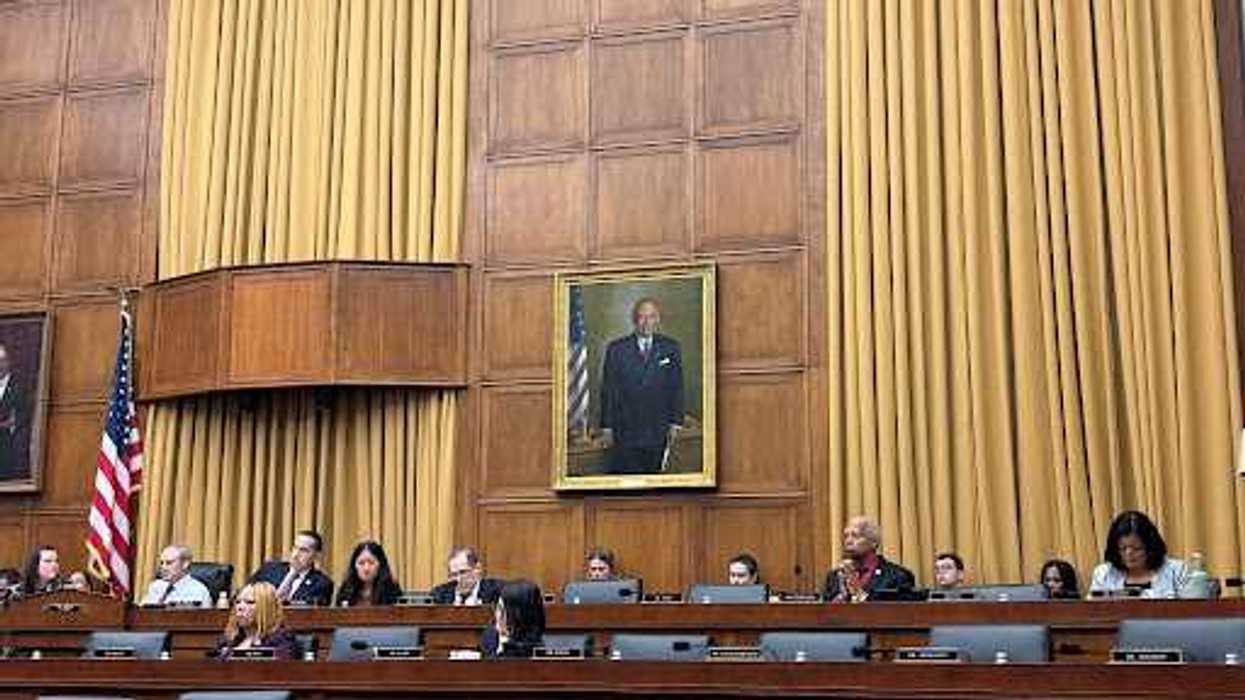
WASHINGTON, D.C. – The House Judiciary Committee held a hearing last Wednesday examining claims that the Southern Poverty Law Center had funded the very hate groups the center aims to dismantle. Tensions were high as Republicans and Democrats fired back at each other. Noticeably absent was a representative from the center, a non-profit that since 1971 has fought for racial justice and against white supremacy.
The hearing came after the Texas Attorney General Ken Paxton announced last Monday that he was investigating the center. The U.S. Justice Department indicted the Southern Poverty Law Center in April for allegedly funneling money to people associated with violent extremist groups. The group has flatly rejected the accusations. While Republicans backed these claims, Democrats viewed the allegations as part of the Trump-backed efforts to hinder “DEI” and other racial justice initiatives.
Chairman Jim Jordan, R-Ohio, opened the hearing by discussing the Justice Department’s claims that the center paid members of white supremacist organizations, like the Ku Klux Klan, millions of dollars over the span of multiple years to manufacture hate and racism.
“[The Southern Poverty Law Center] said, ‘We're going to create the crisis. We're going to manufacture the crisis.’ And by so doing, they became the standard, the source for determining who’s a hate group and who isn’t. And of course, they labeled good, pro-family, conservative organizations as hate groups,” Jordan said.
Jordan’s claims also included assertions that the Southern Poverty Law Center collaborated with the Biden administration and was responsible for funding organizers of the Charlottesville white supremacist rally for the center’s own financial benefit.
The center “went from 51 million annual income to 133 million dollars. Turned out for them, creating hate was more profitable than fighting it. That’s exactly what they did. They ran a scam, they became the standard, they didn’t get prosecuted, and they made a ton of money,” Jordan said.
In a press release after the indictment, the Southern Poverty Law Center denied the allegations. “We are outraged by the false allegations levied against SPLC – an organization that for 55 years has stood as a beacon of hope fighting white supremacy and various forms of injustice to create a multi-racial democracy where we can all live and thrive,” the organization said.
In the hearing, Democrats reiterated this message. Rankin Member Jamie Raskin, D-Md., rebutted against the Republicans in his opening statement.
“For decades, the Southern Poverty Law Center shared information about racist terror plots with the FBI coming from their foreign program. The FBI was happy to receive it, and this practice frequently led to the disruption of dangerous conspiracies by the KKK and neo-Nazi groups to commit violence against synagogues, churches, African Americans, Jews, and other targeted minorities,” Raskin said.
Raskin followed his statement by expressing doubt about the indictment’s claims. His justification included that no civil lawsuits had been filed related to the charges, which Raskin said would be typical in fraud cases.
“What we’re witnessing is a Trump administration fraud on a vast and shocking scale. President Trump has coddled and cultivated the extreme right for as long as he's been in politics. After the infamous ‘Unite the Right’ rally in Charlottesville in August of 2017… Trump could only bring himself to say that there were some very fine people on both sides,” Raskin said.
Tensions during the hearing reached a high point when Rep. Tom McClintock, R-Calif., called out Raskin for this comment.
“I do need to call out the ranking member for deliberately perpetuating the Democrats’ dishonest claim that Donald Trump praised the Nazis at Charlottesville, when he said there were, quote, ‘very fine people on both sides.’ What the ranking member knows, but chose to leave out, is that Trump then said, ‘I'm not talking about the neo Nazis and the white nationalists, because they should be condemned totally,’ unquote,” McClintock said.
McClintock was then interrupted by Rep. Hank Johnson, D-Georgia, who asked to have these words struck from the record. After over five minutes of back and forth, they decided not to have the word taken from the record.
After passionate speeches from both sides, intense questioning sessions and heated moments, the hearing ended after four and a half hours of discussion. Investigations likely will continue in Texas and there is no set court date for the federal indictment.
The hearing ended with Raskin attempting to subpoena Blanche and other officials to testify on President Trump’s recent $1.8 billion fund to compensate people who believe they were targeted by the federal government. The motion was tabled after an 18-17 vote that, like the hearing, was divided.
Olivia Ardito is a graduate student in journalism with Northwestern University's Medill School of Journalism