

This is the first of three parts exploring “Article the First,” the forgotten proposal in the original Bill of Rights. For 237 years, a single, inverted word has created a “semantic illusion,” leading historians and policymakers to misread the founders' intended guarantee of a growing House as a ceiling. This series uncovers the error, tracks its consequences, and explores why reclaiming the founders’ original vision is the path to meaningful representation reform.
Part 1 — The Inverted Word
Rep. Darrell Issa recently introduced a resolution to sunset, by the end of 2026, the only proposal in the original Bill of Rights that was never ratified. He fears that its ratification would swell the House of Representatives to thousands of members. He is right that the amendment is about the size of the House — but, like nearly everyone for 237 years, completely wrong about what it says.
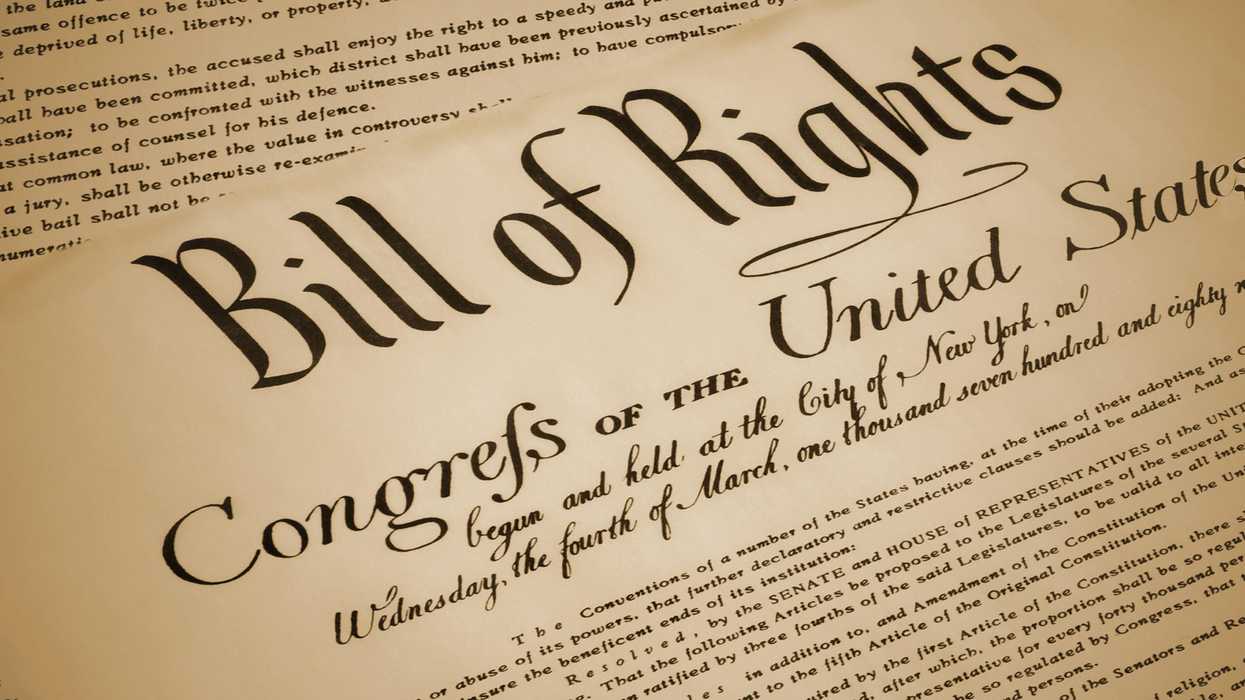
We are taught that the Bill of Rights opens with the First Amendment with its protection of speech and worship. In fact, when Congress sent the Bill of Rights to the states in 1789, it consisted of twelve proposed amendments, and the one we now call the “First Amendment” was actually listed third. The true first — labeled simply Article the first — was never ratified. It wasn’t about liberty or religion at all; it was about arithmetic: How many citizens each member of the House should represent. It was placed first, ahead of speech and worship, because the founders treated the size and closeness of the people’s House as the most basic structural guarantee of all.
Hidden in that amendment is a single word, altered during the waning days of the hectic first session, that turns its whole purpose on its head, and which almost no one notices. And significantly, that unnoticed alteration is the very thing that doomed the amendment’s ratification.
As the House wrote it, the amendment was a guarantee of small districts, and it worked by completing a design the Constitution had left half-finished. The Constitution already set the ceiling: no more than one representative for every thirty thousand. The first Article was intended to supply the matching floor: No fewer than one representative for every fifty thousand, so that a district could never grow too large. Together, the two would have ensured that the House grew with the nation, after each census, so that no representative would ever speak for too many people.
But the enrolled version sent to the states reads “nor more than one Representative for every fifty thousand persons.” When less became more, the floor became a ceiling — a single, inexplicable inversion converted the guarantee of a growing House into a ceiling no one had sought. This left two ceilings, thereby defaulting the minimum House size to what was intended to be a transitional minimum of 200. And for a range of the populations the nation was about to reach, the enrolled text would have imposed a formula so self-contradictory that no apportionment solution would have been mathematically possible — which is why we call it the “defective” version. Yet nearly everyone misreads that defective ceiling as a floor — the very floor the founders intended, the one that would have forced the House to keep growing.
Read literally, the defective clause would let Congress seat anywhere from 200 representatives to roughly 6,600 at today’s population — while requiring nothing beyond the 200. Yet for two centuries, readers have seen its opposite: a floor compelling the House to grow. And not careless readers — the careful ones.
When the National Archives marked the Bill of Rights anniversary in a 2010 press release, it declared that had this amendment passed, there would be “far more than 435 members of Congress — nearly 6,000” — reading the bill’s ceiling as a floor, despite the defective text being reprinted directly above its own words. In 2021, four distinguished scholars, under the imprimatur of the American Academy of Arts and Sciences, made the case for a larger House and cited the amendment as a formula for steady expansion — quoting its “nor more than” language accurately in a footnote while interpreting it as though it read “nor less than.” The constitutional historian they leaned on had read it the same way. So does Rep. Issa’s office today.
What makes the persistence striking is that the correction has never been hidden. Thirty-Thousand.org has been pointing to the inverted word for more than two decades, in pages indexed by every major search engine; the Archives’ statement, the Academy’s report, and Issa’s resolution all came afterward. The illusion survives the correction sitting one click away. It is now so woven into the written record that today’s leading AI models, trained on that record, reproduce the error on request — until the arithmetic is spelled out for them.
This isn’t a failure of intelligence; it’s a quirk of how we read. The amendment builds a drumbeat of floors — “not less than one hundred… nor less than one for every forty thousand… not less than two hundred” — training the eye to expect one more. The final clause arrives in the same cadence, the next ratio in the sequence, with a single four-letter word swapped for another. By the time you reach it, expectation has taken the wheel, and the mind quietly restores “more” to “less.” Psychologists have a name for this — the semantic illusion — but the plain fact is that the sentence reads just as we expect it to, so we never see the word that is actually there.
Why should a 237-year-old wording error matter now? Because the proposal is being read to mean the opposite of what it plainly says — a ceiling mistaken for a floor — and almost no one realizes it. That misreading has hardened into a damaging piece of conventional wisdom: Since the states declined to ratify Article the first, and everyone assumes it mandated a vastly larger House, the larger House itself must be the thing they rejected. It wasn’t. What the states declined was its broken formulation — and mistaking the one for the other has quietly turned an inexplicable defect into an argument against enlarging the House. Yet that long overdue reform is more within reach than two centuries of neglect would suggest.
Investigating the first Article’s defect reveals a real mystery. The amendment twice came within a single state of ratification — and then was abandoned, fading from American memory for two centuries. An amendment that came that close, twice, doesn’t simply vanish. This one did. In Part 2, we’ll follow that defective clause into the state legislatures that had to reckon with it: the hidden arithmetic that made the amendment impossible to implement, the debate in which a little-known state legislator caught what one of the era’s finest minds had missed, and why a reform the country actually wanted was allowed to fail.
First of three parts, condensed from a fuller treatment, “The Enduring Textual Illusion of ‘Article the First,’” at Thirty-Thousand.org.