

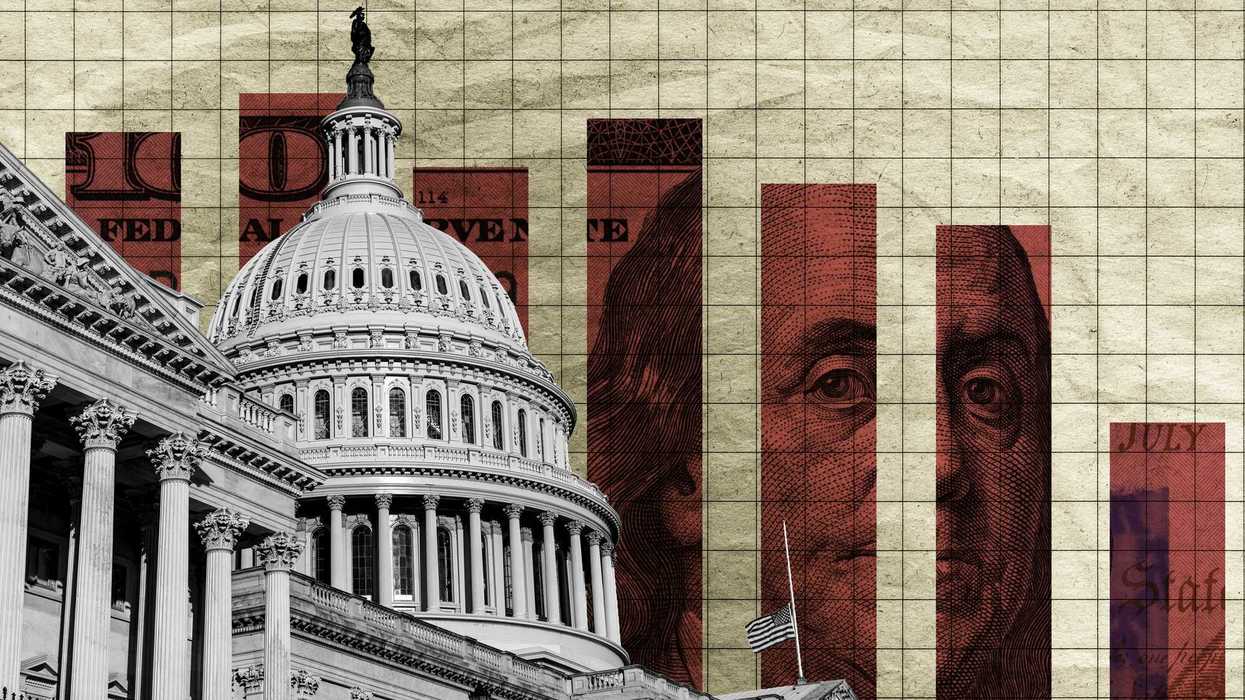

Imagine a household earning $100,000 a year but spending $132,000. It must borrow roughly $32,000 just to get through the year, while nearly $18,000 goes toward interest on previous debts. Its total debt exceeds $570,000 and continues to grow faster than its income.
That roughly describes the federal government's financial position, scaled down to a level most can recognize. In 2026, Washington is projected to collect $5.6 trillion, spend $7.4 trillion and borrow approximately $1.9 trillion. More than $1 trillion will go toward interest, while debt held by the public will slightly exceed the nation's entire annual economic output. (Congressional Budget Office).
The comparison is imperfect—unlike a household, the federal government can levy taxes, issue currency and refinance its obligations indefinitely. While the United States is not about to go bankrupt, the analogy captures what more optimistic appraisals of the national debt often ignore: A borrower can remain wealthy and creditworthy while gradually losing control over how its income is used.
That loss of control is the real danger. Every dollar of interest is unavailable for rebuilding infrastructure, improving schools, confronting climate change, strengthening national defense or recovering from the next natural disaster. The debt may never produce the dramatic collapse predicted by fiscal alarmists, but it can quietly erode the government's capacity to pursue the nation's goals.
No previous administration is blameless, but the current administration has sharply worsened the trend. Trump's "One Big Beautiful Bill," enacted in 2025, reduced federal revenues far more than it reduced spending. The Congressional Budget Office initially estimated that the law would add $3.4 trillion to federal deficits over ten years, or approximately $4.1 trillion including interest cost. CBO's latest projections place the legislation's total contribution to deficits at $4.7 trillion after accounting for its economic effects and related interest costs.
The war with Iran adds another, less predictable burden. Reuters reports that Trump administration officials told senators that the first six days alone cost at least $11.3 billion. That figure excluded the preceding military buildup and some of the costs of deploying troops, repairing damaged facilities and replacing equipment. The final price will depend on the war's duration, the weapons used and the continuing American military presence in the region.
These commitments are not comparable in scale. The Big Beautiful Bill Up to a poin,will add trillions to projected deficits; the war's direct costs are measured in tens of billions. But they reflect the same troubling pattern: Washington continues to undertake expensive commitments without raising sufficient revenue or identifying credible offsets. The country is not merely living with old debts; it is creating expensive new ones.
Some argue that America can manage this debt because it remains a wealthy country. Up to a point, they are correct. The United States does possess vast private assets, an enormous economy and the ability to borrow in its own currency. But the nation's wealth and the federal government's finances are not the same thing. Most of the country’s wealth is in private hands—individuals and businesses. The government can draw upon it only by raising taxes, something Congress has shown little appetite for.
The larger question, therefore, is not whether the United States possesses enough wealth to cover its debts. It is how much of the federal budget will be consumed by servicing them. CBO projects that rising interest costs will drive much of the growth in federal deficits over the next decade. Meanwhile, discretionary programs, which finance most government activities outside entitlement programs such as Social Security and Medicare, will continue to shrink relative to the size of the economy.
This is how debt can paralyze a government without bankrupting the country. Congress may still be able to borrow, but more of each year's revenue will already be committed before lawmakers begin debating national priorities. The government will have less flexibility to pursue new initiatives or adapt to changing needs. Even routine investments in transportation, scientific research, education and environmental protection will become harder to sustain.
To be clear, borrowing can serve productive ends. Debt incurred for infrastructure or research can strengthen the country's future capacity, while emergency borrowing can preserve it during a crisis. The deeper problem is borrowing for present commitments without deciding in advance how they will be paid for.
The Trump administration's fiscal choices illustrate this problem. It has prioritized tax reductions, defense, border security, immigration enforcement and the war with Iran. Some of these policies may produce economic or security benefits, but the same CBO report cited earlier projects that their combined budgetary effects will increase deficits overall. Tariff revenue offsets part of the cost, but not all of it.
A Democratic Congress would not necessarily be able to reverse these priorities while Trump remained president. It could block new initiatives, conduct oversight and use appropriations to redirect spending, but its legislation would face a presidential veto. The administration could also resist implementing congressional priorities. The Government Accountability Office concluded that several agencies violated the Impoundment Control Act in 2025 by withholding appropriated funds..
Reducing the debt will ultimately require some combination of additional revenue, limits on tax breaks, restraint in approving new commitments and carefully designed changes to major spending programs. The debt represents political choices made without sufficient candor about their true cost. If those choices continue, future generations will still retain the formal power to set national priorities. They will simply have fewer meaningful choices left to make.
Robert Cropf is a professor emeritus of political science at Saint Louis University.