




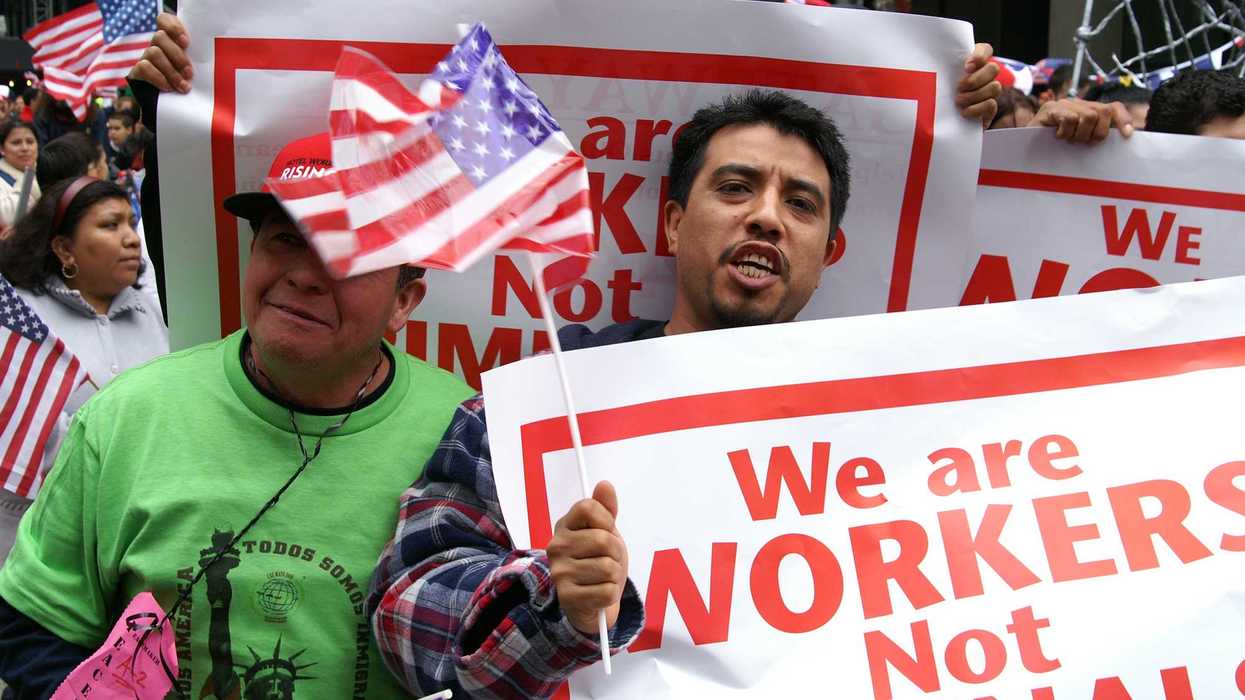

From a political economy perspective, supply-side economics relies on immigrant scapegoating to divert public attention from the structural inequality and wage stagnation caused by its own policies.
By shifting the blame for economic anxiety away from corporate deregulation, underfunded public services, and upward wealth distribution onto a vulnerable out-group, proponents of supply-side policies can protect their core economic agenda.
Deflecting Accountability for Wage Stagnation
Supply-side policies prioritize cutting corporate taxes, reducing labor unions' power, and weakening labor regulations to stimulate production. When these policies lead to stagnant real wages for the working and middle classes, political rhetoric frequently shifts to frame the issue as a "supply and demand" labor crisis caused by immigrants stealing jobs or depressing wages. This rebrands structural inequality as a migration crisis, neutralizing demands for corporate accountability or minimum wage hikes.
Masking the Deficits of Underfunded Public Goods
A central tenet of supply-side economics is the reduction of government spending and the shrinking of the welfare state. When local infrastructure—such as public schools, healthcare facilities, and affordable housing—deteriorates due to chronic underinvestment, immigrants are weaponized as a convenient scapegoat. Blaming a surge of newcomers for "draining public finances" or crowding hospitals shields austerity-driven budgets from public backlash. It reframes a crisis of state capacity and governance into a crisis of border control.
Splintering Multi-Ethnic Labor Solidarity
For supply-side capitalism to maximize profits, it must keep labor costs low. A unified working class threatens profits through collective bargaining and demands for stronger safety nets. Scapegoating immigrants creates sharp social divisions between native-born and foreign-born workers. This disunity prevents collective labor advocacy, keeping workers fighting each other for perceived scarce resources rather than uniting to challenge policies that favor the top 0.01%.
Sustaining an Exploitable, Subsidized Underclass
Paradoxically, while supply-side rhetoric publicly demonizes immigrants, the economic model actively profits from them. Maintaining a highly securitized, hostile immigration system forces millions of undocumented immigrants to live in constant fear of deportation. This fear ensures they are highly compliant, hesitant to report workplace abuse, and willing to accept unlivable wages. The political act of scapegoating creates a permanent, legally precarious underclass that functions as a direct labor subsidy for sectors like agriculture, construction, and hospitality.
Weaponizing "Trickle-Down" Failures as Status Loss
When the promised prosperity of trickle-down economics fails to materialize for the vast majority of the population, voters experience severe economic insecurity and status anxiety. Populist strategies aligned with supply-side interests capitalize on this fear. Instead of explaining complex macroeconomic transformations (like automation or financial deregulation), they offer a simplistic, emotionally resonant villain: the immigrant. This redirects legitimate class anger toward people with the least systemic power to change the economy.
Path Forward: Shift to a Unity Narrative
Expose the distraction: Clearly articulate how elite-funded rhetoric uses division to distract from corporate deregulation, tax cuts for the wealthy, and wage stagnation.
Highlight shared interests: Emphasize that working-class citizens and immigrant laborers both strive for fair wages, affordable healthcare, and strong community infrastructure.
Frame it as "Top vs. Bottom": Reframe the political conflict away from "Horizontal" divisions (citizen vs. immigrant) to "Vertical" realities (working class vs. self-interested elite).
Champion Kitchen-Table Economics
Focus on corporate accountability: Connect local economic struggles directly to corporate monopolies, union-busting tactics, and offshoring, rather than migrant labor.
Promote universal labor standards: Argue for strict penalties for employers who exploit undocumented workers to undercut local wages, which protects all workers.
Demand fair taxation: Keep public attention on tax codes that allow ultra-wealthy individuals and corporations to pay lower effective rates than working families.
Build Multi-Racial, Working-Class Coalitions
Organize locally: Bring diverse communities together through labor unions, tenant organizations, and community advocacy groups to fight for collective material gains.
Demystify immigration: Use clear, data-driven messaging to show how immigrants contribute to local tax bases, sustain rural economies, and support social safety nets like Social Security.
Empower trusted messengers: Utilize faith leaders, local small business owners, and labor organizers to deliver messages that cut through partisan media echo chambers.
Hugh J. Campbell, Jr., CPA, is a Governance, Risk & Compliance (GRC) professional and a student of W. Edwards Deming, the American statistician often credited as the catalyst for the Japanese economic miracle after WWII.














The President Invited Iran to Bomb My Home