
The rest of the world is beginning to hedge against the United States.
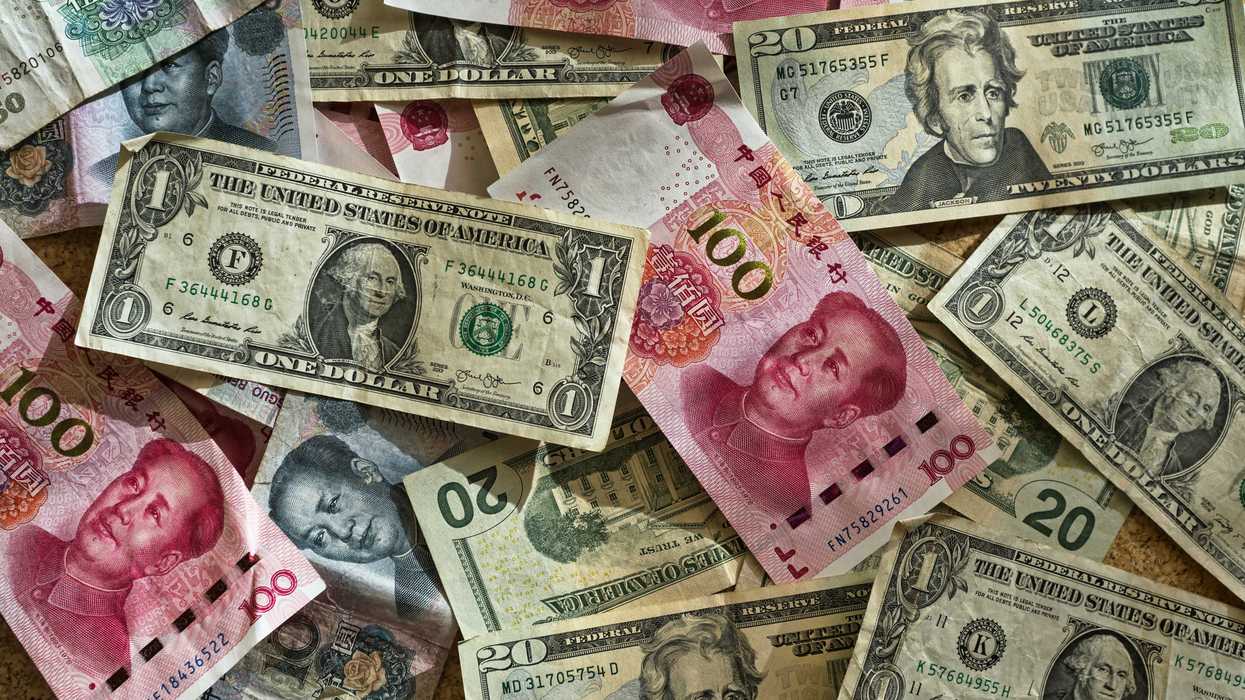
The New York Times recently reported that global investors are balking at U.S. bonds and that foreign governments are pulling their gold out of American vaults. This month the Dutch central bank moved much of its North American gold out of the United States. In March the Bank of France took 129 tons out of the Federal Reserve Bank of New York. Norway’s sovereign wealth fund, the largest in the world, plans to cut its holdings of Treasuries. Last year Christine Lagarde, president of the European Central Bank, said erratic policymaking in the United States was setting the stage for a “global euro moment.”
Erratic is the right word. Allies, investors and adversaries increasingly have to ask how long an American policy will last.
Americans tend to treat that as our own problem. It is not. The United States is too large economically, militarily and financially for instability in Washington to stay inside our borders.
Start with what our whiplash costs everyone else.
The pattern is familiar. Since 1984, the Mexico City Policy, which bars certain recipients of U.S. foreign aid from performing or promoting abortion, has been imposed and rescinded along party lines; it has been in effect for 23 of the past 42 years. The United States joined the Paris climate agreement in 2016, left in 2020, rejoined in 2021 and left again this past January. We spent more than five years negotiating the Trans-Pacific Partnership with 11 other nations, signed it in 2016 and walked away the next year. The other 11 went ahead without us.
Americans can disagree about every one of those policies. That is not the point. Other countries build factories, supply chains, alliances and aid programs around commitments they expect to endure. Increasingly, they must plan for the possibility that our commitments will not.
That uncertainty does measurable, significant damage. International Monetary Fund researchers found that economic-policy uncertainty reduces output, consumption and investment; that about two-thirds of that damage spills over from uncertainty abroad; and that shocks originating in the United States hit Europe and the Western Hemisphere hardest.
Germany shows where that leads. Germany’s central bank estimates that U.S. tariffs and the uncertainty surrounding them will cost the country about three-quarters of a percentage point of growth by the end of 2027. That damage lands on an economy that shrank in 2023 and 2024 and grew just 0.2 percent last year.
The damage is not just economic. A study of German regions published in The Economic Journal found that import competition pushed voters toward nationalist parties while rising exports pulled them back, and that the net effect later showed up as support for the far-right Alternative for Germany party. American tariffs are now another shock to the export side of that equation. This month the AfD won nearly 44 percent of the vote in Saxony-Anhalt, more than twice its 2021 share. Among other things, the AfD wants Germany, one of our most important NATO allies, to end its support for Ukraine and build closer ties with Russia.
The stakes become even higher when policy swings involve war and peace.
In 2015, the United States and five other powers reached a nuclear agreement with Iran that capped uranium enrichment at 3.67 percent. That agreement was a political commitment rather than a Senate-ratified treaty. In 2018, the Trump administration withdrew. By 2021, Iran was enriching uranium to 60 percent. In 2025, American bombers struck its nuclear sites. This year, the United States and Israel went to war with Iran, severely disrupting shipping through the Strait of Hormuz and driving energy prices sharply higher worldwide.
Reasonable people can disagree about whether the Iran deal was wise. But a nonproliferation framework that may disappear after the next election is a weak foundation for long-term planning. It gives an adversary an incentive to factor American elections into its strategy.
Yemen follows the same pattern. Washington backed the Saudi-led war against the Houthis, later restricted some of that support, restored parts of it and then ended U.S. support for Saudi offensive operations. It designated the Houthis a Foreign Terrorist Organization, revoked that designation within weeks and restored it four years later. Last year’s 52-day American bombing campaign cost well over $1 billion. This month the Houthis seized Yemen’s Red Sea coast and strategic positions near the Bab el-Mandeb Strait, giving them new leverage over one of the world’s most important shipping routes.
Those costs come back to us.
Foreign investors commit capital for decades, not presidential terms. A company deciding whether to build a factory, pharmaceutical plant, energy project or data center in the United States needs confidence that the rules will hold long enough for the investment to pay off.
A Federal Reserve staff analysis published in June found that higher tariffs helped push trade and economic-policy uncertainty to record highs in 2025, and warned that elevated uncertainty could work against efforts to attract foreign direct investment because firms may delay investment when they cannot tell how long tariffs will last. Earlier Federal Reserve research found that the rise in trade-policy uncertainty in 2017 and 2018 predicted a 1 to 2 percent decline in aggregate U.S. investment.
Our chief global economic and military competitor, China, offers a sharp contrast in industrial policy. It made advanced manufacturing a national priority a decade ago and adopted a plan for new-energy vehicles running from 2021 through 2035. A staff report for the U.S.-China Economic and Security Review Commission found that the technologies in which China met most of its targets benefited from consistent, long-term government support. In 2025, China produced 70 percent of the world’s electric cars and more than 80 percent of its battery cells, according to the International Energy Agency.
We go back and forth. In 2022, Congress expanded federal incentives for electric vehicles and battery production without a single Republican vote; the vice president broke a 50-50 tie in the Senate. In 2025, Congress ended the electric-vehicle purchase credits without a single Democratic vote; the vice president again broke a 50-50 tie in the Senate. Reuters has documented the layoffs, delays and cancellations that followed across America’s emerging “Battery Belt.”
The security costs come home too. In 2023 and 2024, a single American aircraft carrier group fired 290 Standard missiles and Tomahawks in self-defense and strikes against Houthi targets. Those operations put extraordinary pressure on American missile stocks: in 15 months, Navy ships expended more air-defense missiles against the Houthis than they had in the previous 30 years combined. American forces have now fought Iran directly. And allies uncertain about American commitments have reason to hedge. This month the European Union invited Canada, our closest neighbor and one of our two largest trading partners, to become an "associate member." Trust lost that way is hard to rebuild, even if the next administration changes course.
The common problem in all of these examples is not any particular policy. It is that one national government serves two political coalitions with fundamentally different views of trade, energy, climate, foreign aid and America’s role in the world. When control changes, policy changes with it — often dramatically.
That is the problem an American Union could address.
In prior essays, I have proposed reorganizing the United States into an American Union of two sovereign democratic republics, one predominantly red and one predominantly blue, that would retain a common defense, a common currency, an integrated market and freedom of movement.
Each republic in an American Union would likely govern a more politically cohesive electorate. Voters would still throw out incumbents. Policies would still evolve. But the changes should be narrower and more incremental, because the distance between each republic’s competing coalitions would be far smaller than the distance between Red and Blue America today. Over time, each republic should be able to hold its course longer.
Red and Blue America would not have to agree. Blue America could remain in the Paris Agreement. Red America could keep the Mexico City Policy. Each could set its own course on energy and industry. What would change is that the world would know where each republic stood, and could count on it not completely reversing itself from one election to the next.
That greater stability could pay off at home. Foreign companies could invest with greater confidence that the rules underlying long-term investments would not reverse after the next election. Allies could make plans around more durable commitments. And adversaries would have less reason to assume they could simply wait us out.
Political disagreement is inevitable and often manageable. Political whiplash on the scale of the United States is not. When we export uncertainty, the world absorbs it, and sends much of it back to us as lost investment, stronger competitors, weaker alliances and more dangerous conflicts.
An American Union could help break that cycle.
Jordan Karp is a lawyer and writer based in New York with a keen interest in American political culture, institutional reform, and civic life.