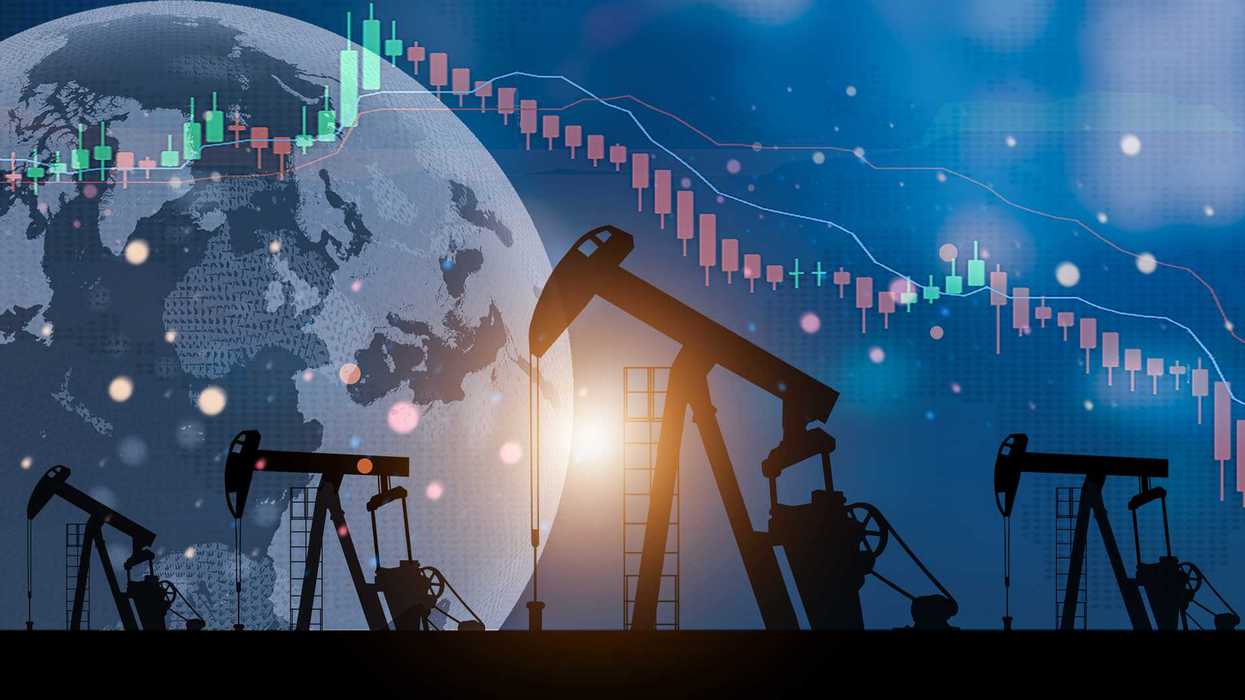

On September 14, American oil executives delivered some alarming news. “The great oil crisis is here.”
As the Wall Street Journal explained, “Commercial fuel stocks around the world have been depleting for more than six months, and strategic crude reserves can’t be tapped much further. Attacks last week shut down a crucial crude pipeline in Saudi Arabia that bypassed the Strait, stranding at least 2.5 million barrels a day from an already tight global oil market….”
This is more than just bad news about gasoline or heating oil prices. A great oil crisis will touch every aspect of American life, driving prices up and confidence in the economy down.
America may have large oil reserves, but the market for crude oil is global. And no matter how much the Trump Administration might want to, it is not possible to pull up the drawbridges and insulate us from the disruptions that are to come.
A report from Georgia Tech University explains that “Even though U.S. petroleum production often exceeds our consumption, we are not insulated from disruptions in global oil supply because oil is a globally traded commodity…’If supply is restricted anywhere in the world, prices will rise everywhere, including in the U.S.’”
As the global energy crisis deepens, there is plenty of blame to go around, and much of it belongs to the president's reckless adventurism. But the great oil crisis should be a reminder that no matter how much we try, we cannot retreat from the world.
It should alert us to the dangers of a short-term outlook, the kind of outlook that leads government officials to ignore present dangers and future possibilities. While China and other countries have been investing in various forms of green energy, we have doubled down on fossil fuels.
An article published last February in The Guardian noted that “For the second time in three years, the report showed the manufacture, installation and export of batteries, electric cars, solar, wind and related technologies accounted for more than a third of China’s economic growth.” At the same time, President Trump and his colleagues have launched what Columbia Law Professor Michael Gerrard labels a “multi-pronged attack on renewable energy.”
“The Biden Administration had rightly seen a massive expansion of clean energy…as key to moving away from fossil fuels and fighting climate change. But Mr. Trump denies that climate change is a serious problem and works to expand both the supply of and demand for fossil fuels.”
And all Americans are now paying the price.
“After decades of planning and building neighborhoods primarily around automobiles,” a Brookings Institution report argues, “most households have no easy alternatives to driving long distances. The result is a real strain on household budgets, and the impacts will be most pronounced for residents of more sprawling metro areas and rural places, lower-earning households that must continue to drive, and people who fit into both categories.”
But the pain is being felt elsewhere as well. Europeans are feeling it too, and on September 16, The Times reported that “Now, Saudi Arabia, running out of options…is facing the prospect of a severe energy crisis with global implications,” which is “unprecedented.”
Fifty years ago, we faced another unprecedented energy crisis, and the result was not pretty. Fuel shortages, gas lines, and a pervasive sense of powerlessness.
After Israel and its Arab neighbors went to war, with the United States supporting Israel, “members of the Organization of Arab Petroleum Exporting Countries (OAPEC) reduced their petroleum production and proclaimed an embargo on oil shipments to the United States and the Netherlands, the main supporters of Israel….(T)he embargo and limitations on oil production continued, sparking an international energy crisis.”
Moreover, “As it turned out, Washington’s earlier assumption that an oil boycott for political reasons would hurt the Persian Gulf financially turned out to be wrong, as the increased price per barrel of oil more than made up for the reduced production.”
One result was the emergence of an interest in renewable energy. But the United States never went all in.
And the political ripple effects were far-reaching. Meg Jacobs argues that “Long lines at gas stations and soaring inflation eroded public trust in federal leadership, contributing to a broader cultural shift from New Deal liberalism toward skepticism of government regulation.”
Today, we have a president who seems unconcerned about the oil crisis. In his 2025 inauguration speech, President Trump promised that the energy mantra for his administration would be “We will drill, baby, drill.” He followed that up by issuing an executive order declaring a national energy emergency.
According to the World Economic Forum, “The move was followed by a directive that aimed to roll back regulations on the oil and gas sector, and accelerate drilling and pipeline development.”
And in March 2026, after the start of the war in Iran, as ABC News observed, “Trump predicted a short-term bout of elevated oil prices, calling it a ‘small price to pay’ for ‘Safety and Peace.’” When he has not been peddling that line, the president has taken to blaming oil companies. In June, he said, “They made too much money, too much money. Chevron, too much money. Exxon Mobil, too much…”
On September 13, he even blamed the Ukrainians for disruptions in the energy supply and the high price of diesel fuel because of their attacks on Russian oil refineries.
Here, as in other areas, the president does not seem to grasp the grim reality that oil executives are ringing the alarm about.
Listening to the president, one is reminded, as Salon’s Troy Farrah argues, of “Tinkerbell, the ‘Peter Pan’ character who could be resurrected from death by audience participation, i.e. belief in fairies.” The president has tried to lull Americans into a world in which “Just saying and believing something will happen will make it happen…”
As the oil crisis unfolds and life gets even more difficult for millions of people, we have the chance to open our eyes and try to come to terms with the world as it is. Hard choices lie ahead, and Americans will have to reject Trump’s Tinkerbell politics if we hope to avoid calamity.
Austin Sarat is the William Nelson Cromwell professor of jurisprudence and political science at Amherst College.