
Overview
The Republican Party’s long game to reduce administrative state entitlement spending centers on creating a debt crisis to provide an excuse for limiting such spending. It may soon pay off. That strategy involved a quarter-century of engineered tax cuts responsible for the stunning rise in sovereign U.S. debt, threatening an eventual economic crisis.
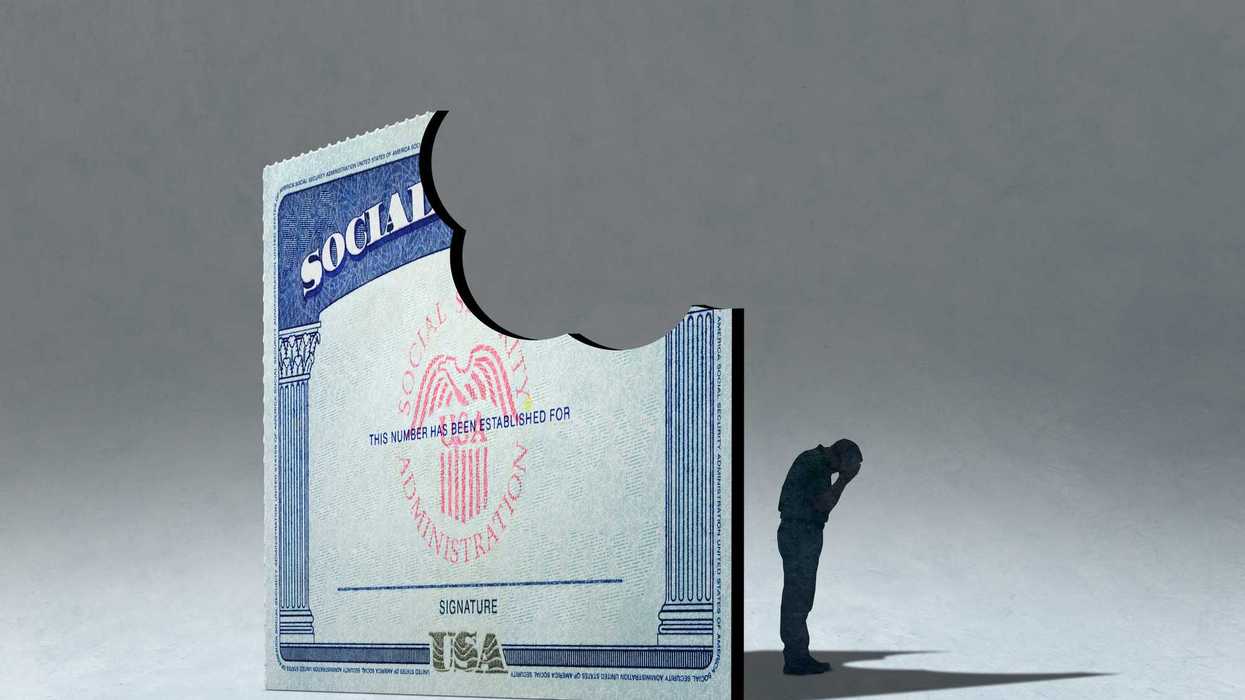
Social Security benefits are projected under current law to be automatically cut in 2032. And Medicare benefits are projected to be automatically cut in 2033. Congressional Republicans intend for those automatic cuts to occur, opposing new taxes to prevent cuts. And they are using the ballooning national debt as an excuse to also oppose new general revenue spending to prevent benefit cuts.
Few voters are aware of these looming automatic benefit cuts. But they are a compelling opportunity for Democrats to dramatize their support for current benefit levels of Social Security and Medicare.
Hobbling the Administrative State
Five Republican tax cuts for elites since 2002 supplemented by tax evasion and eroded tax enforcement caused Federal tax revenues to decline by 2.4% of GDP during 2002-2026 compared to 1995-2001. Budget deficits jumped. That missing revenue is why Republicans are borrowing 29 cents of every $1 the government spends – ballooning the national debt year after year.
To build public support for cutting entitlements, billionaires and Republicans are gaslighting voters, misrepresenting the source of that debt. Instead of tax cuts, Medicare and Medicaid are demonized in the Republican bluebook Project 2025 as “principal drivers” of the national debt: “our deficit problem is a Medicare and Medicaid problem.”
The Looming Entitlement Crisis
Social Security and Medicare are the largest entitlement programs, making them juicy targets for Republican elites. And opportunity beckons. If insolvent, current law requires an automatic 24% annual benefit reduction for the 75 million Social Security participants beginning in 2032 - an $18,400 annual reduction for a typical couple. And it requires a 12% cut in annual Medicare (hospital) reimbursements beginning in 2033 - raising out-of-pocket costs for 75 million Medicare patients.
These automatic reductions are catnip for Congressional Republicans. They can cut entitlements by simply sitting on their hands, refusing to raise taxes or spending to replenish the Social Security and Medicare trust funds. To obfuscate the cuts they actually make, Congressional Republicans mislabel their benefit reductions as “rooting out waste.”
At gravest risk is Medicare because Party elites since Reagan have been ideologically opposed to “socialized” medicine. For some time, Republican budgets have whittled down Medicare while gradually replacing it with for-profit private health insurers (Medicare Advantage) that deny care and provide lower quality care at a higher cost.
For Social Security, Republicans propose raising the retirement age to 69 from 67 which would reduce lifetime benefits 8%. Yet, 78% of respondents to a June 2026 Quinnipiac survey specifically opposed raising the retirement age to 70. Moreover, their proposed changes are too meager in any event to avoid trust fund insolvency and benefit cuts for Social Security and Medicare.
An Ace-in-the-Hole
That Republican stratagem is risky because Congressional Democrats have an ace-in-the-hole.
A question buried deep in a September 2026 survey of Senate battleground states found that support for reforms to sustain current Social Security benefits jumped from 49% to 91% once voters learn about the pending automatic cuts. In addition, Medicare is also extremely popular, with 85% of Americans opposing any benefit cuts.
Entitlement Reforms
These data suggest that advocating reforms to sustain these two entitlements is a promising major Democratic Party theme.
For Social Security, Democrats embrace The Roosevelt Institute and Biden administration’s proposed reforms. First, despite virtually all real income growth in recent decades flowing upward, the social security payroll-tax exempts income from wages above $184,500. That cap could be eliminated, a move supported by 85% of respondents surveyed by the American Association of Retired Persons. Second, the payroll tax could be expanded to tap non-wage income from sources favored by the wealthy that are presently exempt – large inheritances, corporate profits and capital gains.
Democrats also support reforms establishing a solid fiscal foundation for Medicare. As proposed by President Biden, for instance, the net investment income tax and Medicare payroll tax could be increased on incomes above $400,000. And a host of Republican tax cuts for high earners and corporations in 2017 and 2025 can be reversed. Other Democratic reform proposals would reduce the drain on the Medicare program by the unreliable Medicare Advantage program managed by private insurance firms illegally “upcoding.” They habitually over-charge Medicare for medical procedures by misclassifying enrollee ailments as sicker than they are. Finally, since Medicare reimburses health providers at about half of current private provider prices, a gradual expansion of Medicare (perhaps lowering the eligibility age to 62) would be a powerful weapon to lower health care costs nationwide.
All these Democratic entitlement reforms would be popular and obviate the need for benefit cuts.
Stewards of Social Security and Medicare
Democrats and Republicans are offering different solutions to the Social Security and Medicare debt crises. Partisanship aside, their solutions reflect how each Party perceives the role of government, the Administrative State and entitlement spending.
At the moment, surveys suggest that voters support Democratic plans to prevent the benefit cuts favored by Republicans. A major reason is that health care has emerged as the leading 2026 domestic concern, with 68% of independent voters worried about its cost. Some 35% of these swing voters trust Democrats to control health care costs compared to just 15% who trust Republicans. They also trust Democrats to manage the future of Medicare by a margin of 37% - 15%. And some 44% of these pivotal voters say health costs will have a “major impact” on which party’s candidate they support.
Independents also trust Democrats more than Republicans by an 11 percentage point margin to handle Social Security concerns.
Since FDR, Democrats have been stewards of Social Security and Medicare. Reflecting that responsibility, they should make preventing automatic benefit cuts an election issue.
George Tyler is a former deputy assistant treasury secretary and World Bank official. He is the author of books including Billionaire Democracy and What Went Wrong.