
Skip to content
Search

Latest Stories

Follow Us:
Top Stories

Trump's Perversion of U.S. History

Opinion

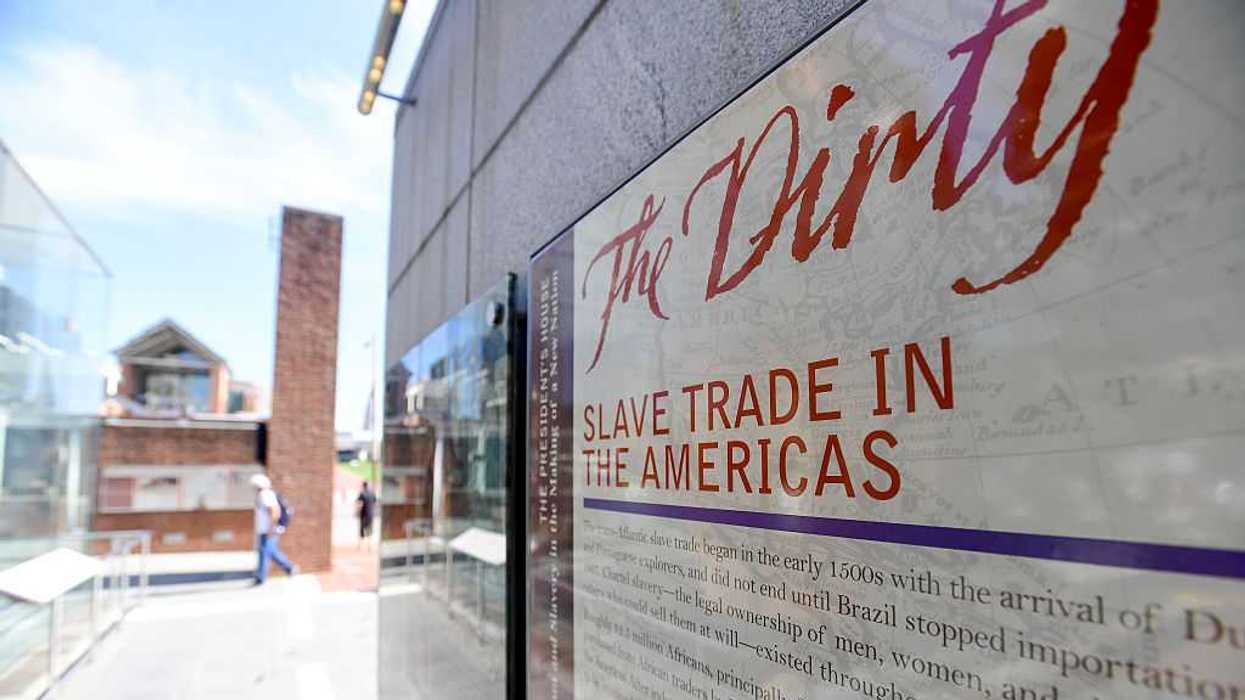
A display entitled 'The Dirty Business of Slavery' at the President's House on August 9, 2025 in Philadelphia, Pennsylvania.

Tourists inspect a display entitled 'The Dirty Business of Slavery' at the President's House on August 9, 2025 in Philadelphia, Pennsylvania.

Getty Images, Matthew Hatcher

One more example of Trump's broadcasting fake news and lies is his confrontation with American history.

In his Executive Order, "Restore Truth and Sanity to American History," Trump stated that there has been "a concerted and widespread effort to rewrite our Nation’s history, replacing objective facts with a distorted narrative driven by ideology rather than truth." He has, among other things, instructed the National Park Service and a variety of museums and other sites to remove all information that "inappropriately disparage Americans, past or living." This includes information about slavery, the treatment of Native Americans, and a host of other subjects.


While it may make some people uncomfortable or angry to have these subjects raised officially in public, they do just state the facts. The purpose of history is not to make people comfortable; it is to learn from the past. As usual, it is instead Trump who is "replacing objective facts with a distorted narrative driven by ideology rather than truth."

This is not, as he says, "a revisionist history," it is rather, "calling a spade a spade." It is only revisionist in the sense that, in the past, neither the government nor many institutions were interested in telling the truth of our history to the American public; what they provided was a whitewashed version of history.

That attitude ended decades ago, and the truth has been out ever since. Slavery was a horrific experience. Many Founding Fathers, including Washington and Jefferson, were slave holders. A host of inhumane actions were taken against the Native American inhabitants of our country. And the list goes on.

As usual, Trump clothes his lies with the aura of fighting for truth, when, in fact, he is perverting the truth through outright lies or misinformation by providing information only on what made America great and omitting information about troublesome aspects of American history.

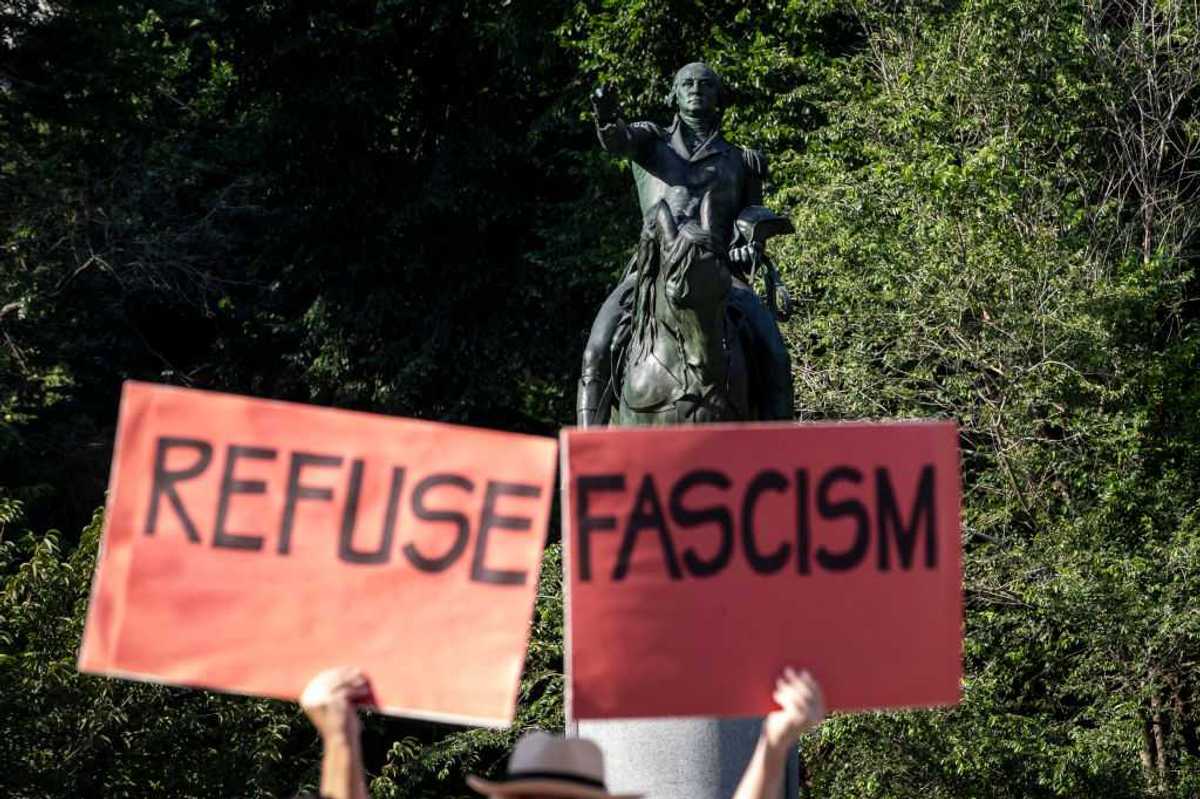
What is, however, almost as troubling as Trump's playing up to his white supremacist supporters, is that Black leadership organizations, organizations with moral authority (i.e., churches), and people themselves have not raised their voices, not just in objection or condemnation but in massive displays of disapproval through public non-violent demonstrations. Yes, there have been ongoing demonstrations about the actions of ICE, but they have been disappointingly small; e.g., thousands marched in Manhattan, but there should have been hundreds of thousands.

Has Trump effectively put the fear of his wrath in so many people and organizations that few will stick their neck out to speak out against him and his MAGA allies? Have people come to feel that Trump will get away with anything he wants to do (the Supreme Court has consistently allowed him to continue his actions while cases are proceeding slowly through the courts), so that they feel there is no reason to make the effort to oppose him?

How would Martin Luther King Jr. have reacted to recent events? Would he have stood at the sidelines and just voiced his despair? It's great that the American bishops of the Catholic Church and several American cardinals came out with forceful statements rebuking Trump's efforts, but those statements contained no call to action by anyone, whether politicians or the people.

Demonstrations would unlikely change Trump's direction, but they would provide evidence both to America's silent majority as well as the world that Trump is acting in ways that are decidedly un-American and that are only supported by his base. And by so doing, it would increase the likelihood that at last some Republican legislators will speak their mind, if only to ensure that they are re-elected this November.

As citizens of this republic, it is ultimately our responsibility—not the politicians'—to insure that our democracy and our history remain intact.


Ronald L. Hirsch is a teacher, legal aid lawyer, survey researcher, nonprofit executive, consultant, composer, author, and volunteer. He is a graduate of Brown University and the University of Chicago Law School and the author of We Still Hold These Truths. Read more of his writing at www.PreservingAmericanValues.com


Read More

Solidarity Without Borders: Civil Society Must Coordinate Internationally to Protect Democracy and Rights

People standing, holding letters that spell out "courage."

Photo provided

Solidarity Without Borders: Civil Society Must Coordinate Internationally to Protect Democracy and Rights

Across every continent, marginalized communities face systematic, escalating threats wherever democracy comes under attack. In the United States, Black Americans confront voter suppression and attacks on our history. Across the Americas, immigrants and racialized communities face racial profiling and assault by immigration enforcement. In Brazil and across South America, Indigenous peoples endure environmental destruction and rising violence. In Europe, Roma communities, immigrants, and refugees experience discrimination and hostile policies. Across Africa, the Middle East, and Asia, members of marginalized ethnic and religious communities face state violence, forced labor, and the denial of basic human rights. In every region of the world, members of the LGBTQ+ community face discrimination and threats.

These are not random or isolated acts of oppression. When considered together, they reveal something more sinister: authoritarianism is becoming increasingly more connected and coordinated around the world. This coordination specifically targets the most vulnerable because authoritarians understand that it is easier to manipulate a divided and fearful society. Attacking those who are most marginalized weakens the entire democratic fabric.

Keep ReadingShow less
A Party That Seeks to Nationalize and Control Elections Has Entered Fascist Territory

Donald Trump’s call to “nationalize” elections raises constitutional alarms. A deep dive into federalism, authoritarian warning signs, and 2026 implications.

Getty Images, Boris Zhitkov

A Party That Seeks to Nationalize and Control Elections Has Entered Fascist Territory

I’m well aware that using the word fascist in the headline of an article about Donald Trump invites a predictably negative response from some folks. But before we argue about words (and which labels are accurate and which aren’t), let’s look at the most recent escalation that led me to use it.

In Trump’s latest entry in his ongoing distraction-and-intimidation saga, he publicly suggested that elections should be “nationalized,” yanking control away from the states and concentrating it at the federal level. The remarks came after yet another interview in which Trump again claimed, without evidence, that certain states are “crooked” and incapable of running fair elections, a familiar complaint from the guy who only trusts ballots after they’ve gone his way.

Keep ReadingShow less
Building Power to Advance Inclusive Democracy: The Pro-Democracy Narrative Playbook
Picture provided

Building Power to Advance Inclusive Democracy: The Pro-Democracy Narrative Playbook

Around the world, including here in the United States, evidence shows that authoritarians are dominating the information ecosystem. Orchestrated, well-resourced, and weaponized narratives are being used to justify repression and delegitimize democratic principles and institutions. At the same time, the word “democracy” has been appropriated and redefined to protect certain freedoms granted only to certain people and to legitimize unchecked power. These actors have learned from each other. They borrow from a shared authoritarian playbook to blend traditional propaganda with digital-age disinformation techniques to reshape public perception. The result is an environment in which democratic norms, institutions, and basic freedoms are under a coordinated, sustained attack.

Yet even as these threats grow, democracy advocates, journalists, election workers, civil society organizations, and everyday citizens are stepping up—often at great personal risk—to protect democratic rights and expose repression. They have been doing all of this without the benefit of a research-based narrative or the infrastructure to deploy it.

Keep ReadingShow less
As America Turns 250, It’s Time to Begin Again
selective focus photo of U.S.A. flag
Photo by Andrew Ruiz on Unsplash

As America Turns 250, It’s Time to Begin Again

I know so many people are approaching America’s 250th anniversary with a sense of trepidation, even dread. Is there really anything to celebrate given the recent chaos and uncertainty we’ve been experiencing? Is productively reckoning with our history a possibility these days? And how hopeful will we allow ourselves to be about the future of the nation, its ideals, and our sense of belonging to something larger than ourselves?

Amid the chaos and uncertainty of 2026, I find myself returning to the words of the writer and civil rights activist James Baldwin. Just as things looked darkest to Baldwin amid the struggle for civil rights, he refused to give up or submit or wallow in despair.

Keep ReadingShow less