
Skip to content
Search

Latest Stories

Follow Us:
Top Stories

The Bipartisan War on Independent Voters

Opinion

The Bipartisan War on Independent Voters
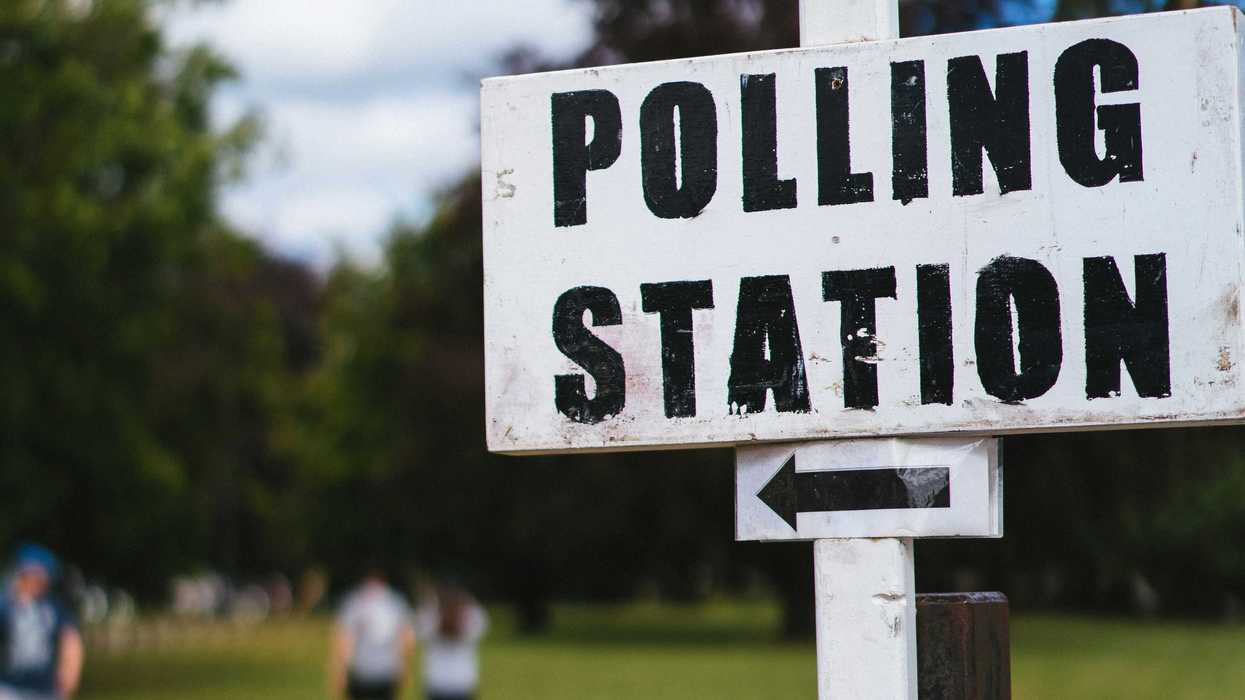
A pole with a sign that says polling station
Photo by Phil Hearing on Unsplash

The Washington Post editorial board penned a bold piece (Bill Cassidy and America’s Increasingly Broken Primary System) in the wake of President Trump’s successful vendetta against the Louisiana Senator. They could have taken the easy route and pointed a finger at the Republicans. Instead, they took issue with both parties and their insatiable appetite to control the rules of the game and punish anyone who steps out of line.

In a media landscape dominated by partisan propaganda, it’s refreshing to read an opinion piece that encourages readers to actually look at what’s happening.


The Democrats have gotten a pass on the issue of open primaries for years. For the most part, the media has bought in on (and propagated) the myth that when it comes to voting, the Republicans are into voter suppression while the Democrats stand solidly behind voting rights.

I wish we lived in such a simple world.

If you actually look at what’s happening in the country, both the Democrats and the Republicans are systematically attacking the right of independent voters - now 45% of the electorate - to fully participate. The Democrats are leading the charge in DC, Massachusetts, New York, Maryland, California, and Nevada, places where independent voters are surging. In Massachusetts, for example, 65% of registered voters have opted for “independent” on their voter registration form and 70% of state legislators run unopposed, but the Mass. Democratic Party strongly opposes the current effort to enact an all candidate primary system. And the Democratic Party of Maryland insists that Governor Wes Moore didn’t really mean it when he spoke out in favor of letting one million independents participate in Maryland primary elections.

Not to be outdone, the Republicans are on the warpath in Colorado, Tennessee, South Carolina, Alabama and Texas, where they are advancing bills and lawsuits to force voters to join a party if they want to participate in (taxpayer funded) primary elections. In Tennessee, the GOP legislature posts these signs on every poll in the state. No wonder primary turnout is 14% while general election turnout is 64% in the Volunteer State.
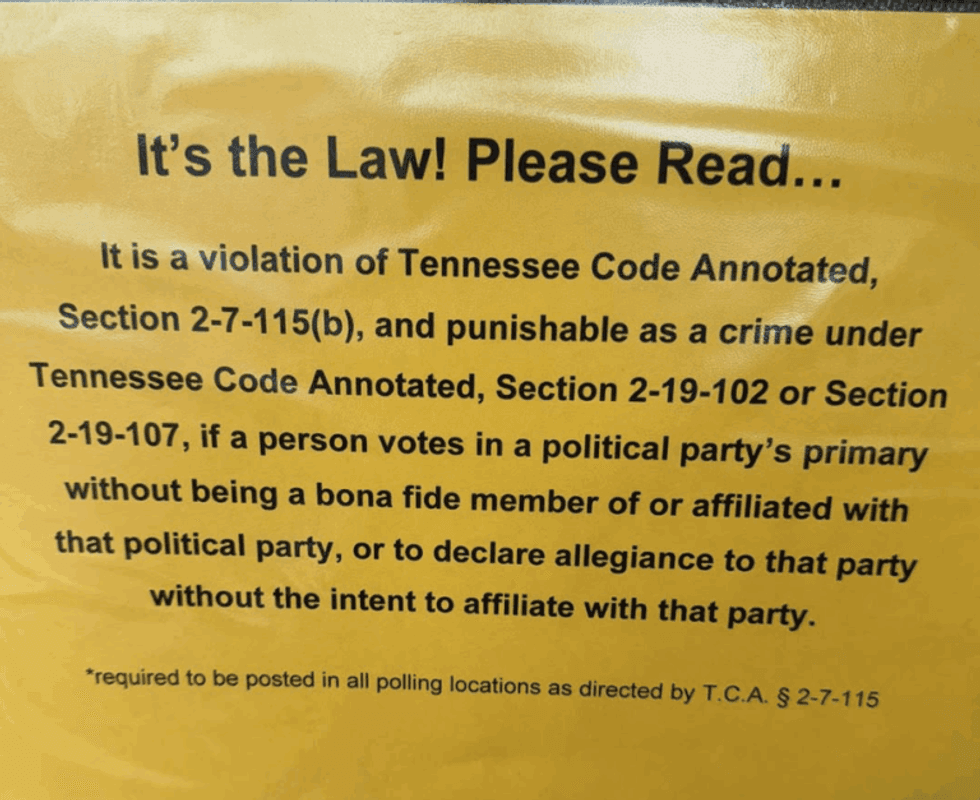
Both parties work overtime to rig the rules in their favor. But for some reason, the media has bought into this myth that the Republicans are the bad guys and the Democrats are the good guys, when in fact both parties, in different states and in different ways, lock the system down through gerrymandering and closed primaries. They definitely don’t want independent voices participating, and they want to make sure that their elected officials are completely loyal to the party, that they’re not going to represent their people that put them in there, but the party apparatus that gets them elected.

The other aspect of the Post editorial worth noting is more philosophical.

America is a competitive place. Good or bad, it’s a feature of our culture. And we Americans are accustomed to competition increasing as you get closer to naming a winner. Many people tune into the NBA playoffs, March Madness or the Olympics only after the preliminary rounds are over. That’s how competition works.

But the Democrats and Republicans have turned competition completely on its head. In 90% of America, competition actually decreases after the first round. The general election is an afterthought, predetermined by gerrymandering and other factors. For most of us, all the competition is in the primary - round one - and most of us are not paying attention and participating.

It’s a sorry state of affairs. And the open primaries movement has our work cut out for us.

We need to enact open and nonpartisan primaries in states that are closed. We need to defend open primaries from attacks from both major parties. And we have to educate the American people that voting in round one is how to exercise power. We can’t wait until November to make our voices heard. In most races, the game is up.

John Opdycke is the president of Open Primaries, a national election reform organization.


Read More

Oregon Pioneered Vote-by-Mail. Its Ballot Access Laws Are Still in the Covered Wagon Era.
white printer paper on white table

Oregon Pioneered Vote-by-Mail. Its Ballot Access Laws Are Still in the Covered Wagon Era.

Oregon's primary election was on May 19. Neither of the two major-party candidates in Oregon's 6th Congressional District faced a primary opponent. They'll automatically advance to November's general election ballot, without a single voter really needing to weigh in, without collecting a single petition signature, and without knocking on a single door. The Democratic incumbent represents a party that accounts for 29.75 percent of registered voters in this district. The Republican nominee represents a party with 24.78 percent of the vote. Together, the two parties represent a minority of OR-6's electorate, and both of their candidates are already on the November ballot.

I represent the largest voting bloc in this district. Nearly 40 percent of OR-6's registered voters are unaffiliated, more than either party. These voters have never had a candidate who answers only to them—not to party bosses, party lines, or special interests. I am trying to be that candidate. And I am still on the porch, clipboard in hand, collecting the 5,500 hand-signed paper petitions I will need just to guarantee that my name appears beside theirs in November.

Keep Reading Show less
Election Officials Warn of Rising Threats As Security Funding Declines Ahead of Midterms

Reps. Laurel Lee (R-Fla) and Terri Sewell (D-Ala) at Wednesday’s House Administration Elections Subcommittee hearing titled, “Examining Best Practices for Strengthening Election Security.”

(Kaitlin Bender-Thomas/MedillNews Service)

Election Officials Warn of Rising Threats As Security Funding Declines Ahead of Midterms

WASHINGTON –Election officials warned lawmakers on Wednesday that threats against election workers and voting systems are escalating even as federal funding for election security remains far below 2020 levels, posing risks ahead of the 2026 midterms.

In 2020, Congress allocated $425 million for election security grants, compared to $15 million in 2025 and $45 million this year. The Trump administration has also proposed a $707 million cut to the CyberSecurity and Infrastructure Security Agency’s fiscal 2027 budget and ended the agency’s election security support for state and local governments.

Keep Reading Show less
The Election-Litigation Complex
person holding white and red box

The Election-Litigation Complex

Since Bush v. Gore in 2000, election litigation has become a routine feature of American democracy. A few months ago, the Supreme Court made our litigious habit easier to indulge.

In Bost v. Illinois State Board of Elections, the Court expanded who could sue to challenge election procedures (candidates no longer had to demonstrate individualized harm to bring a case). This ruling, likely to stoke litigation, lands in a country already losing faith in its electoral system and amid increasing pressure on the judiciary.

Keep Reading Show less
The Dems need this redistricting battle

Larkin, Democratic candidate for Congress in Florida’ s 23rd district, speaks during an emergency town hall that he held to address Florida Republicans’ newly approved congressional redistricting map on May 4, 2026, in Coral Springs, Florida. Ron DeSantis announced he signed a redistricting bill that could help Republicans pick up four more House seats.

(Getty Images)

The Dems need this redistricting battle

Over the past six months, Democrats have been more than happy to let President Trump be their best campaign ad. From his ill-advised war in Iran to his ill-advised tariffs, his obvious declining mental acuity to his increasing desire to spend taxpayer money on wasteful vanity projects, Dems know that Politics 101 dictates you never interrupt your enemy when he’s making a mistake.

With politicos predicting a midterm election bloodbath for Republicans, Dems were riding high. That is, until Trump unleashed his redistricting wars.

Keep Reading Show less