

Skip to content
Search

Latest Stories

Follow Us:
Top Stories

In Two Months, Trump’s Cabinet Has Lost Three Women

Kristi Noem and Pam Bondi were ousted by the president. Now the Labor Secretary Lori Chavez-DeRemer, who has been embroiled in scandals, is resigning.

News

​Secretary of Labor Lori Chavez-DeRemer.

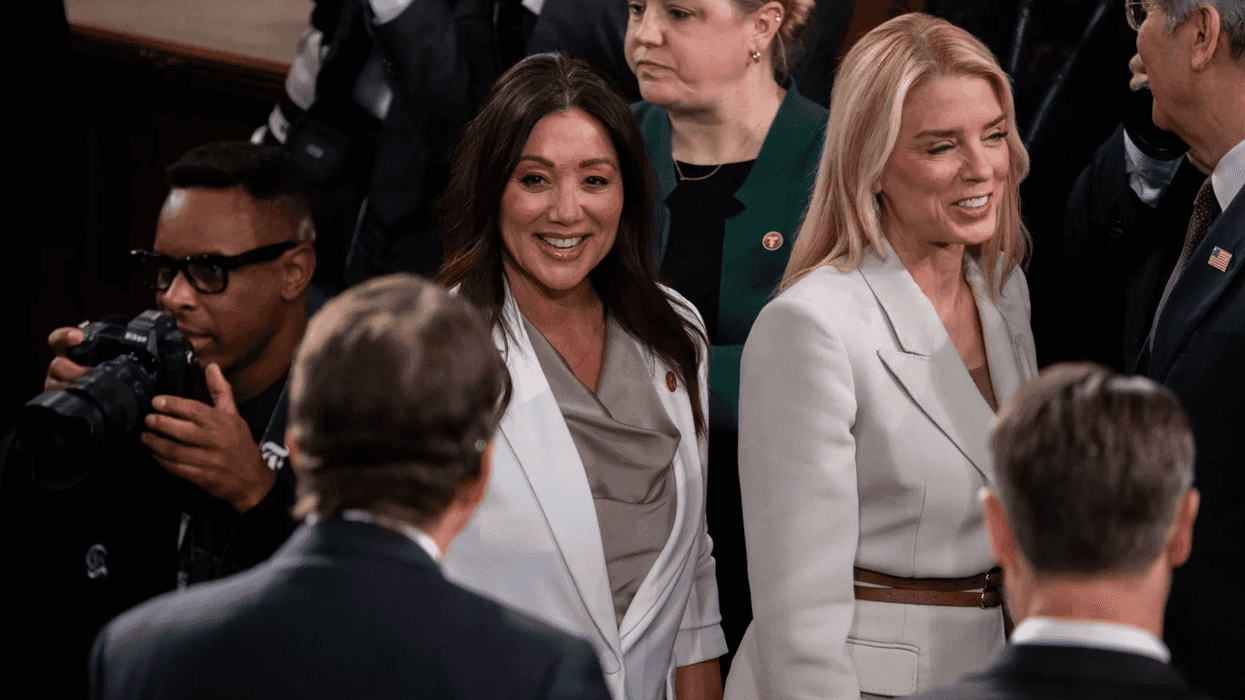
Secretary of Labor Lori Chavez-DeRemer arrives to the chambers of the U.S. House of Representatives ahead of President Trump's State of the Union address on February 24, 2026. (Nathan Posner/Anadolu/Getty Images)

Nathan Posner/Anadolu/Getty Images

President Donald Trump’s second Cabinet was never exceptionally diverse from the start. And in the past two months, three women have been fired or resigned.

The first to go, on March 5, was ex-Homeland Security Secretary Kristi Noem, the face of the Trump administration’s mass deportation agenda. Then, less than a month later, Trump ousted former Attorney General Pam Bondi. And on Monday, embattled Labor Secretary Lori Chavez-DeRemer announced her resignation.


“Labor Secretary Lori Chavez-DeRemer will be leaving the Administration to take a position in the private sector,” White House communications director Steven Cheung said in a statement. “She has done a phenomenal job in her role by protecting American workers, enacting fair labor practices, and helping Americans gain additional skills to improve their lives.”

Chavez-DeRemer, a former Republican congresswoman from Oregon, has found herself embroiled in several scandals and was the subject of an internal misconduct investigation during her time leading the Labor Department. Chavez-DeRemer had been one of two Latinx Cabinet secretaries, along with Secretary of State Marco Rubio.

Only 17 percent of Trump’s second-term Cabinet nominees were non-White, according to a 2025 Washington Post analysis. But compared with his last term, more women have been in Cabinet and other high-level roles: Women initially made up 37 percent of his second-term Cabinet, up from 17 percent. Trump also tapped Susie Wiles as the first woman to serve as White House chief of staff.

Former President Joe Biden’s Cabinet was the most diverse in history: 48 percent of those who served in his Cabinet were non-White, and 45 percent were women.

All three women former Cabinet members had received public blowback for various aspects of their performance in their roles. Noem’s Department of Homeland Security drew nationwide outrage for its aggressive approach to immigration enforcement in major cities, especially after federal immigration officials shot and killed two U.S. citizens, Renee Good and Alex Pretti, in Minneapolis.

Bondi received bipartisan criticism and scrutiny for the Department of Justice’s handling of its files related to Jeffrey Epstein, though Trump’s impetus for firing her was reportedly that he was frustrated about the DOJ not moving aggressively enough to prosecute his political foes.

Chavez-DeRemer was the subject of an internal investigation into allegations of fraud and misconduct at the department, The New York Times reported. They included complaints of a toxic work environment from staffers who said they were asked to perform personal errands for Chavez-DeRemer and her husband, Dr. Shawn DeRemer, who was reportedly banned from the Labor Department’s headquarters for making unwanted sexual advances toward women staffers.

Investigators also reviewed personal texts from Chavez-DeRemer, her father and her husband to young women staffers at the department, including requests to bring her alcohol on trips, The Times reported.

Deputy Labor Secretary Keith Sonderling will take over as acting head of the department, according to Cheung.

While Trump’s Cabinet has been remarkably more stable than in his first term, the jobs of a number of other high-ranking officials have been rumored to be in trouble.

Tulsi Gabbard, a former Democratic congresswoman from Hawaii who switched parties and became part of the MAGA coalition, was confirmed last year as the nation’s chief intelligence official. She is the only Pacific Islander member of Trump’s Cabinet. The Guardian reported that Trump was asking advisers whether he should replace Gabbard after she declined to denounce a deputy, Joe Kent, who resigned over his disagreements over the U.S. war with Iran.

The women remaining in Trump’s Cabinet are Gabbard; , Agriculture Secretary Brooke Rollins;, Education Secretary Linda McMahon; and Kelly Loeffler, head of the Small Business Administration.

FBI Director Kash Patel and Commerce Secretary Howard Lutnick have both also drawn criticism and speculation that their jobs were on the line.

Trump has, at times, sidelined women and not punished men in his administration who have found themselves in hot water. He initially nominated Rep. Elise Stefanik of New York as his ambassador to the United Nations, but withdrew her nomination amid concerns over Republicans’ narrow House majority.

After his national security adviser, Mike Waltz, added a journalist to a Signal group chat where he and other top Trump administration officials were discussing military operations, Waltz was fired from his post last spring but instead took the position of UN ambassador. Rubio has since been serving as the acting national security adviser.


In Two Months, Trump’s Cabinet Has Lost Three Women was originally published by The 19th and is republished with permission.



Read More

American flag on a military uniform

Amid rising tensions with Iran, critics warn Trump-era military policies, discrimination, and leadership decisions are weakening U.S. readiness and national security.

adamkaz/Getty Images

Uncle Sam Wants You—Just Not Women or People of Color

As Trump’s War in Iran causes unprecedented global volatility, revealing significant weaknesses in our military, the President and his Secretary of War can’t seem to stop playing the politics of prejudice. A year ago, without explanation, Hegseth fired the first ever female Chief of Naval Operations and the chairman of the Joint Chiefs of Staff, a Black man. The latter was an F-16 pilot who once said in a recruitment commercial: “When I’m flying…You don’t know…whether I’m African American…You just know I’m an American Airman, kicking your butt.” Turns out when he wasn’t flying his boss figured out his race and kicked him off his post. Now, Hegseth has interfered with promotions for over a dozen Black and female senior officers across all branches, including blocking four outstanding Army officers–two Black men and two women–from becoming one-star generals. What was presented as "anti-woke" posturing is clearly little more than a thinly-veiled and targeted culture war. These racist, sexist, superficial “leaders” gotta go.

The war against wokeness is morally and strategically wrong, distracting us all from real missions. Instead of swiftly ending an ill-defined, illegal, indefinite war with Iran (that is not going well, to say the least) or addressing an ongoing manpower shortage, Hegseth went out of his way to unilaterally stop the advancement of four diverse officers with long careers of “exemplary service,” despite questionable legal authority to do so and against the counsel of the Secretary of the Army. Allegations of racial and gender bias are apropos, but it’s also just plain stupid. Roughly 43% of active duty troops are people of color while their leadership is overwhelmingly white, and women are leaving the military at a rate 28% higher than men. At a time when the military could use all the talent it can get, why is Hegseth keeping competent leaders from leading and disqualifying and disenfranchising over half the talent pool?

Keep Reading Show less
America at 250: Patriotic Lament From Her Darker Sons

As the United States nears its 250th anniversary, Rev. Dr. F. Willis Johnson explores the nation’s founding contradictions, enduring racial inequalities, and the ongoing struggle to align democratic ideals with reality.

Getty Images

America at 250: Patriotic Lament From Her Darker Sons

As the United States approaches its 250th birthday, the nation confronts a moment that should stir both celebration and sober reflection. A quarter millennium is no small achievement in the long arc of human governance. Republics have faltered far sooner. Yet anniversaries, especially ones of this magnitude, are not merely commemorations of survival. These observances are invitations to take inventory. Thus, demanding that we ask not only what we have built, but what we have become.

The American story is told in two intertwined registers. One is triumphant: a daring rebellion reshaping political thought, expanding liberty. The other is quieter and often suppressed: a republic professing universal rights while sanctioning human bondage, preaching equality but benefiting only a select few. In our 250th year, we are invited to see these two narratives as inseparable, each shaping and challenging the other.

Keep Reading Show less
Liberty and Justice for Some

Stephanie Toliver examines book bans, transgender rights in Kansas, the impacts of ICE detentions, and the history of conditional equality in America’s schools, libraries, and churches.

Getty Images, Catherine McQueen

Liberty and Justice for Some

Late February brought two stories that most Americans filed under separate categories. In Kansas, the state government invalidated the driver's licenses and birth certificates of transgender residents, erasing legal identities with the stroke of a pen. In New York, a Columbia University neuroscience student named Ellie Aghayeva was taken from her campus apartment by federal agents who misrepresented themselves to get through the door and held by ICE until the city's mayor personally petitioned for her release. Different people, different states, different mechanisms. The same message: for some of us, the promises of this nation were always conditional.

And yet, many Americans hold onto the lie of equality because acknowledging the truth would mean that the foundational promise we have repeated since childhood — liberty and justice for all — was never meant for all of us. It is far easier to accept comfortable fictions than to reckon with a truth that destabilizes everything you thought you knew. That meritocracy is real. That all are equal. That the documents we carry and the institutions we enter will protect us the same way they protect everyone else. But for many of us, there was never a fiction to hold onto. We were born into the conditions the lie was designed to obscure.

Keep Reading Show less
Two individuals Skiing in the Milano Cortina 2026 Winter Paralympic Games.

Oksana Masters of Team United States celebrates after winning gold in the Para Cross Country Skiing Sprint Sitting Final on day four of the Milano Cortina 2026 Winter Paralympic Games at Tesero Cross-Country Skiing Stadium on March 10, 2026 in Val di Fiemme, Italy.

Getty Images, Buda Mendes

The Paralympics Challenge Everything We Think We Know About Sports

If you’re a sports fan, you likely watched coverage of the 2026 Winter Olympics in Milano Cortina. But will you watch the Paralympics when approximately 665 athletes are expected in Italy to compete in the Para sports of alpine skiing, biathlon, cross-country skiing, ice hockey, snowboarding, and wheelchair curling?

The Paralympics, so-called because they are “parallel” to the Olympics, stand alone as the globe’s premier sporting event for elite athletes with disabilities. According to the International Paralympic Committee, 4,400 disabled athletes competed in the 2024 Paris Summer Games in track and field, swimming, and twenty other sports.

Keep Reading Show less