



WASHINGTON –Election officials warned lawmakers on Wednesday that threats against election workers and voting systems are escalating even as federal funding for election security remains far below 2020 levels, posing risks ahead of the 2026 midterms.
In 2020, Congress allocated $425 million for election security grants, compared to $15 million in 2025 and $45 million this year. The Trump administration has also proposed a $707 million cut to the CyberSecurity and Infrastructure Security Agency’s fiscal 2027 budget and ended the agency’s election security support for state and local governments.
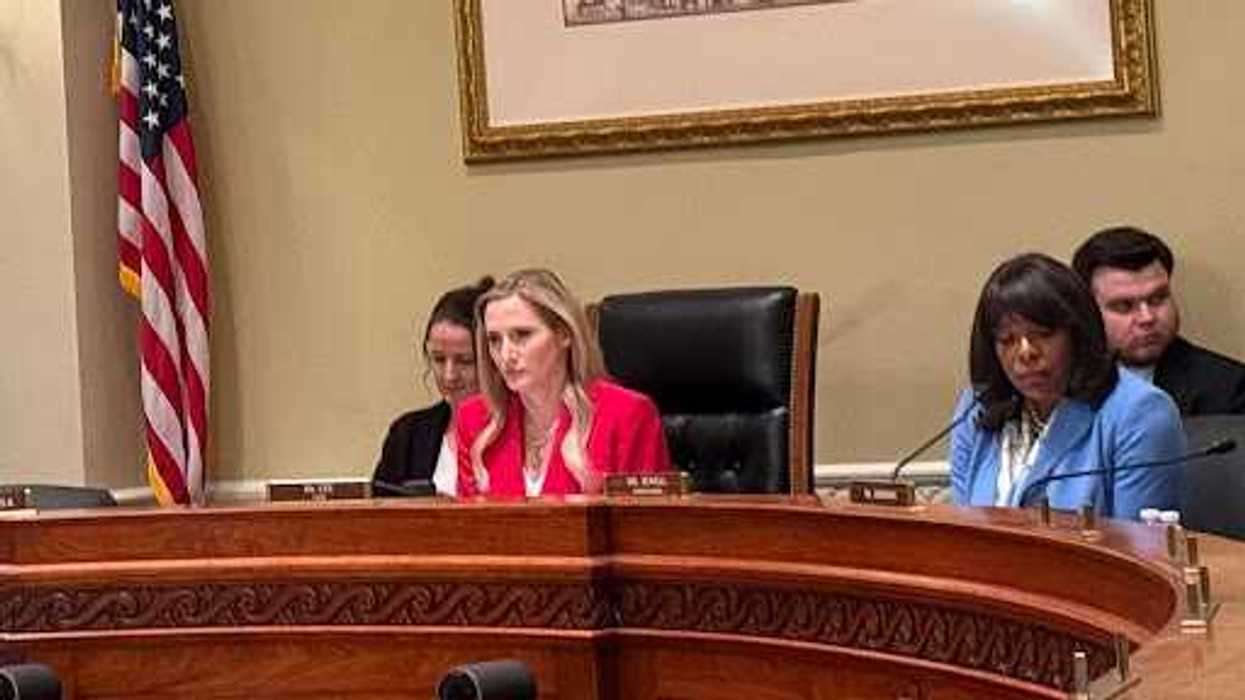
These concerns were raised during a House Subcommittee on Elections hearing on election security. Thomas Hicks, chairman of the Election Assistance Commission, which distributes federal funds to states and territories to improve election administration, said election workers across the country have faced phishing attacks, bomb threats, and swatting incidents — false emergency reports intended to trigger large police responses at polling locations.
Hicks cited a 2024 poll that found 38 percent of local election officials have experienced threats, harassment or abuse because of their jobs, and more than half said they knew someone who left the profession due to safety concerns. He also referenced a recent incident in Pennsylvania where an explosive device detonated near a polling place.
“For the United States to continue to be a world leader in election best practices, the federal government must support and invest in our election infrastructure,” Hicks said.
While lawmakers on both sides agreed on the need for secure, trusted elections, they disagreed over whether the greater threat is noncitizen voting or underfunded election infrastructure.
Throughout the hearing, Republicans largely focused on noncitizens illegally casting ballots and called for stricter voter identification requirements, even though studies show cases of noncitizen voting are extremely rare. Democrats, however, contended that election offices need more funding.
Rep. Terri Sewell, D-Ala, said the election security grants appropriated under the Help America Vote Act have helped states improve voting systems, but she argued that more is needed amid the growing security threats. She criticized the Trump administration’s spending, citing a new $1.8 billion fund to compensate people who believe they were unfairly targeted by the Justice Department.
“Congress has the responsibility to act before vulnerabilities become a crisis,” Sewell said. “The cost of prevention is far lower than the cost of repairing public trust.”
Sewell asked Hicks how the decline in election security funding is manifesting across states.
“The officials that I've talked to have said that they are going to have to cut back on a few things in order to ensure that things remain safe and secure for the elections moving forward,” Hicks replied.
Sewell then directed her line of questioning to Christy McCormick, vice chair of the Election Assistance Commission.
“Ms. McCormick, I know that we appropriated about $45 million in 2026, and I'm hearing from lots of secretaries of state that that's simply not enough, and directly from election administrators that that's simply not enough,” Sewell said. “What are you seeing is going undone because of the decrease in the amount of funding?”
McCormick explained that the $45 million must be distributed among all 50 states and the territories, and agreed with Sewell that it works out to be roughly $250,000 per state.
“It’s a minimum amount of money and states can’t use that money to do things like purchase new voting systems, which a lot of them are in the position of needing to do at this point,” McCormick said.
She added that states also cannot use these funds for other security priorities, such as training personnel or improving physical and cybersecurity.
“All of that costs money, right?” Sewell asked.
“Yes, it does,” McCormick responded.
But the hearing grew even more contentious when Rep. Mary Miller, R-Ill., raised concerns about noncitizen voting and accused Democrats of opposing election integrity measures.
“We all know the Democrats want to cheat by not passing the SAVE America Act,” Miller said.
The SAVE Act is a Trump-backed bill that would require people registering to vote in federal elections to provide documentary proof of U.S. citizenship, such as a U.S. passport or birth certificate. It passed the House but stalled in the Senate, lacking the 60 votes needed to overcome a filibuster.
Miller pressed Hicks on what the Election Assistance Commission is doing to ensure noncitizens are not voting in U.S. elections.
Hicks pushed back both times, reiterating that the Election Assistance Commission does not oversee voter eligibility.
“The EAC does not run elections, so we can’t do anything to ensure that. That’s a state issue,” he said.
Miller quickly challenged this, saying, “You should be taking steps, though, to mitigate illegal voting by noncitizens.”
Miller argued that if election officials want additional federal funding, then the federal government should be able to impose stricter voter identification and citizenship requirements.
This debate among lawmakers comes as a recent POLITICO poll found that over one-third of Americans believe the 2026 midterms are likely to be “stolen,” while one in four do not expect the elections to be fair. But there’s little consensus on the cause of this distrust, with Republicans citing voter fraud and Democrats pointing to voter suppression.
During the hearing, Sewell argued that disinformation and Republican-led redistricting efforts have undermined public trust in elections.
“Our president and his allies have…widely spread debunked conspiracy theories and false claims that are designed to undermine our collective belief in democracy,” Sewell said, referring to the administration’s repeated false claims that the 2020 election was rigged.
Sewell also cited the recent Supreme Court ruling that weakened the federal Voting Rights Act, arguing that it will erase Black political representation at all levels of government.
Some Republicans, however, argued that administrative mistakes also erode trust in elections.
Rep. Greg Murphy, R-NC, called out a recent ballot error in Maryland, where officials had to reissue over 500,000 mail-in ballots after some voters received ballots for the wrong party’s primary. He asked Donald Palmer, former commissioner of the Election Assistance Commission, about the incident.
“It’s a lot, sir,” Palmer said. “It’s a huge mistake.”
Murphy argued that such incidents show why election reform is necessary.
“It just shows that there are problems with our election system,” Murphy said. “It’s okay to question it. It’s okay for us to do due diligence on these types of things.”
Kaitlin Bender-Thomas is a graduate journalism student at Northwestern University and a reporter for the Medill News Service.










The President Invited Iran to Bomb My Home