

Skip to content
Search

Latest Stories

Follow Us:
Top Stories

Nevada pro-democracy groups condemn SAVE Act

News

Nevada pro-democracy groups condemn SAVE Act

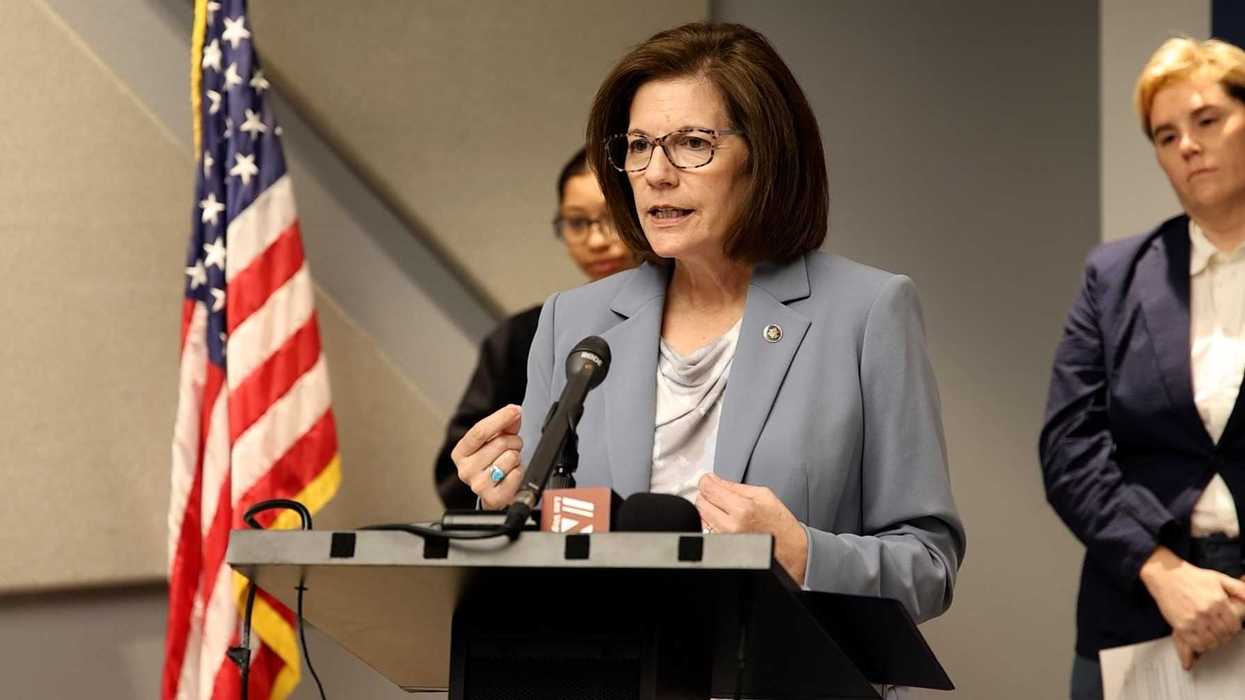
Sen. Catherine Cortez Masto, D-Nev., speaks at a press event about free and fair elections. A recent study from MIT ranked Nevada second in the nation for quality of election administration, based on measures of accessibility and security.

(Battle Born Progress)

President Donald Trump has made passing the Safeguard American Voter Eligibility Act a top priority before the midterms but supporters of safe and fair elections in the Silver State said it would be a disaster for democracy.

The bill, which purports to combat noncitizen voting, would make it much harder to register to vote. It passed the U.S. House but is stalled in the Senate.


Sen. Catherine Cortez Masto, D-Nev., said the bill also directs the states to turn their voter lists over to the federal government.

"It gives the Department of Homeland Security information about our voter rolls that the department has been trying to get across this country for the last several months," Cortez Masto explained. "Because they want to be able to go through those voter rolls and decide for themselves who's eligible to vote and who's not.

In a recent social media post, Trump reiterated calls for severe restrictions on mail-in voting, claiming elections are rigged. Nevada mails a ballot to all registered voters, and state data show 45% returned them via mail in the 2024 primary. The Safeguard American Voter Eligibility Act would require people who want to register to vote or update their registration to present either a birth certificate or a passport in person at the county elections office.

Lisa Lynn Chapman, research manager for the advocacy group Battle Born Progress, said the in-person requirement would be a big barrier for people with mobility issues.

"This is very personal to me," Chapman explained. "I can't walk for long distances, nor can I stand for more than about two minutes. It makes it almost impossible for me to be able to vote because I can't stand in those lines."

Trump also wants people to have to present a photo ID when they vote and in most states, a driver’s license, real ID or student ID would not be sufficient.

Kerry Durmick, Nevada state director for the nonprofit All Voting is Local Action, said the expense and hassle of getting a passport or birth certificate would keep a lot of people from the polls.

"Half of American citizens do not have a passport," Durmick pointed out. "There are also 69 million women who don't have a birth certificate that matches their current legal name, and there are more than 21 million citizens who don't have either of these documents readily available."

Trump also issued an executive order directing the Postal Service to send mail-in ballots only to people on a new, nationally approved voter list. Nevada’s Attorney General Aaron Ford has refused to turn over the data and the issue is now in court.

Nevada pro-democracy groups condemn SAVE Act was originally published by the Public News Service and is republished with permission.

Suzanne Potter is a journalist with 30 years of experience as a reporter for TV, radio and print news.


Read More

How A 2022 Law Changed Election Certification: Assessing the Electoral Count Reform Act

A sign that reads: Voting

E4C

How A 2022 Law Changed Election Certification: Assessing the Electoral Count Reform Act

This nonpartisan policy brief, written by an ACE fellow, is republished by The Fulcrum as part of our partnership with the Alliance for Civic Engagement and our NextGen initiative — elevating student voices, strengthening civic education, and helping readers better understand democracy and public policy.

Key Takeaways

  • The Electoral Count Reform (ECRA) of 2022 modernizes the 1887 Electoral Count Act, which governed how Congress counts Electoral College votes. The original Act has been widely criticized as vague and susceptible to exploitation.
  • The ECRA clarifies that the Vice President’s role is ceremonial, raises the objection threshold to 20 percent of both chambers, and designates governors as responsible for submitting elector certificates.
  • Supporters argue that the bipartisan reform prevents future election disputes and protects democratic stability, while critics contend that it was rushed, doesn’t address deeper election integrity issues, and raises concerns about federalism.
  • The Act reflects bipartisan cooperation but continues debates about federalism and the balance of power between states and Congress.

The Electoral Count Reform and Presidential Transition Improvement Act (ECRA) was introduced by Senator Susan Collins (R-ME) in July 2022 and signed into law by President Joe Biden in December 2022. It is a reform to the Electoral Count Act of 1887 (ECA), a law that governs how Congress counts the Electoral College votes for president every four years. The Act is also a response to President Donald Trump’s efforts to dispute the 2020 presidential election results, which revealed several gaps in the law that could be exploited by a presidential candidate.

Keep Reading Show less
The Bipartisan War on Independent Voters
A pole with a sign that says polling station
Photo by Phil Hearing on Unsplash

The Bipartisan War on Independent Voters

The Washington Post editorial board penned a bold piece (Bill Cassidy and America’s Increasingly Broken Primary System) in the wake of President Trump’s successful vendetta against the Louisiana Senator. They could have taken the easy route and pointed a finger at the Republicans. Instead, they took issue with both parties and their insatiable appetite to control the rules of the game and punish anyone who steps out of line.

In a media landscape dominated by partisan propaganda, it’s refreshing to read an opinion piece that encourages readers to actually look at what’s happening.

Keep Reading Show less
Oregon Pioneered Vote-by-Mail. Its Ballot Access Laws Are Still in the Covered Wagon Era.
white printer paper on white table

Oregon Pioneered Vote-by-Mail. Its Ballot Access Laws Are Still in the Covered Wagon Era.

Oregon's primary election was on May 19. Neither of the two major-party candidates in Oregon's 6th Congressional District faced a primary opponent. They'll automatically advance to November's general election ballot, without a single voter really needing to weigh in, without collecting a single petition signature, and without knocking on a single door. The Democratic incumbent represents a party that accounts for 29.75 percent of registered voters in this district. The Republican nominee represents a party with 24.78 percent of the vote. Together, the two parties represent a minority of OR-6's electorate, and both of their candidates are already on the November ballot.

I represent the largest voting bloc in this district. Nearly 40 percent of OR-6's registered voters are unaffiliated, more than either party. These voters have never had a candidate who answers only to them—not to party bosses, party lines, or special interests. I am trying to be that candidate. And I am still on the porch, clipboard in hand, collecting the 5,500 hand-signed paper petitions I will need just to guarantee that my name appears beside theirs in November.

Keep Reading Show less
Election Officials Warn of Rising Threats As Security Funding Declines Ahead of Midterms

Reps. Laurel Lee (R-Fla) and Terri Sewell (D-Ala) at Wednesday’s House Administration Elections Subcommittee hearing titled, “Examining Best Practices for Strengthening Election Security.”

(Kaitlin Bender-Thomas/MedillNews Service)

Election Officials Warn of Rising Threats As Security Funding Declines Ahead of Midterms

WASHINGTON –Election officials warned lawmakers on Wednesday that threats against election workers and voting systems are escalating even as federal funding for election security remains far below 2020 levels, posing risks ahead of the 2026 midterms.

In 2020, Congress allocated $425 million for election security grants, compared to $15 million in 2025 and $45 million this year. The Trump administration has also proposed a $707 million cut to the CyberSecurity and Infrastructure Security Agency’s fiscal 2027 budget and ended the agency’s election security support for state and local governments.

Keep Reading Show less