


Amid growing polarization in America, Belfast has been on my mind.
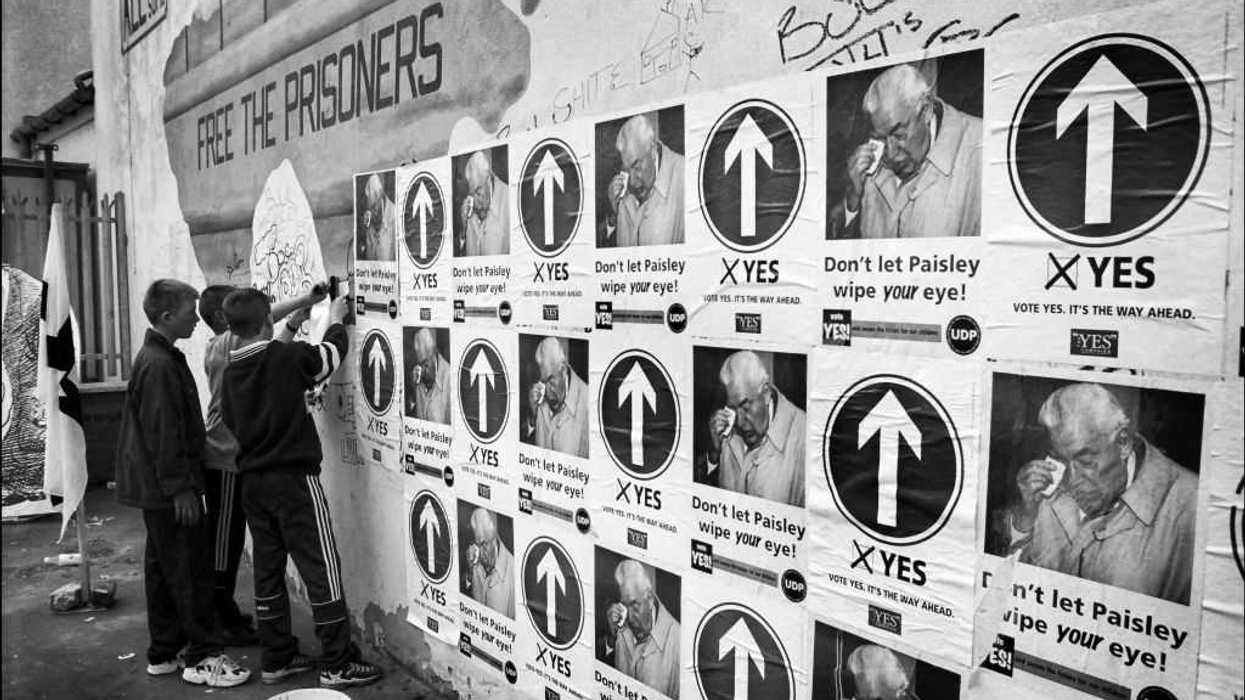
Growing up in the 1990s, the name “Belfast” was synonymous with conflict and war, as pro-British Protestants and pro-Irish Republic Catholics fought for decades with guns, bombs, and murderous attacks. Following the Good Friday Agreement of 1998, which largely put to rest “The Troubles” in Northern Ireland, today the city (and all of the six counties making up Northern Ireland) has made tremendous strides to put aside civil strife.
The two communities still have their differences, but today they fight with words and legislative initiatives in the democratic process–not with violence.
Two months ago, I visited Northern Ireland with the Carter Center, and its partner on the ground, Rethinking Conflict, to study The Troubles as a paradigm for polarization in America.
- YouTube youtu.be
Over the course of a week, we met with those who had been deeply involved both with the decades-long conflict and its peaceful resolution, including top government officials, journalists, religious leaders, and more than a few fighters from both sides who had spent years in prison, as well as victims whom the violence had touched directly.
We heard repeatedly that, from their perspective, the toxic polarization currently plaguing America looks like Northern Ireland’s early Troubles era in the early 1970s and into the 1980s. And another thing we heard: Once the violence starts, it is very hard to stop. That isn’t to say we in America have arrived in a Belfast-like scenario yet, but those voices of Northern Ireland recognized the contours of conflict and urged us to pull back from the brink before it is too late.
Here are some of the lessons we learned that felt most applicable to our situation at home.
First: Dialogue starts out of public view, with quiet conversations. We heard from political leaders and clergy involved in the Good Friday Agreement negotiations: If there had been social media during the Northern Ireland peace talks, they would have never reached the Good Friday Agreement. Why? Social media inflames the base and makes compromise difficult. We heard often that trust only comes through meaningful engagement, not straw-man diversions—and that engagement with one’s opponents does not equal endorsement or capitulation.
Second: We heard a similar refrain from those involved in the intimate violence who took the chance for peace that the Good Friday Agreement offered, and yet were denounced as traitors or sell-outs: The opposition is in front of you; the enemy is behind you. It takes real political, religious, and civic leadership to back down the mob mentality of the base and true character to back down those who seek to inflame passions for their own political gains or myopic fears.
Third: This seems counterintuitive, but: You can have justice, or you can have peace. You can’t have both. We often hear in America the phrase, “no justice, no peace,” so it was fascinating to hear these concepts being treated as opposite ends of the binary spectrum, but in the eyes of those of Northern Ireland, to hold onto the purity of justice meant that the compromise of peace could not be attained. If the price of real peace and cessation of violence is amnesty achieved in the negotiation process, and that lets a convicted perpetrator of violence out of prison, that is the heavy but valuable price for peace and the chance to move forward.
Fourth: Expect what is realistic, not what is perfect. Everyone we talked to said that the peace in Northern Ireland remains far from perfect, but compared to the alternatives, nobody wants to resume the fighting. The sentiment was shared often: Compromise is hard, but an imperfect peace is better than a raging war.
Fifth: The United States had been seen as a force for good. We heard repeatedly about the appreciation for the role of the United States in fostering the peace agreement through dogged negotiation, soft power, and real investment to bring the warring sides to a modicum of understanding and bring about a cessation of violence. We also noted a dismay at the recent turn towards isolationism and retreat in our nation. The loss of hard-won soft power by the United States is a tragedy in many corners of the globe.
A Belfast favorite son, C.S. Lewis, said: “Between no hope and a little hope lies an ocean of opportunity.” Those voices from Northern Ireland gave me a unique perspective on their conflict, and its mirror in the restive state we have here in America. We still have a significant opportunity to stave off the worst-case scenarios, but that will take real engagement and good faith efforts on all sides of American society so that we don’t find ourselves down a similar troubled path.