



DETROIT — Rep. Jim Clyburn of South Carolina, a top Black House Democrat, was making the case for a moderate politician running on boosting jobs and manufacturing. Six years ago, it was to crowds in his home state, arguing that Joe Biden was the best positioned to win in a general election. This time, it was on a stage in Detroit, for a candidate in one of 2026’s most hotly contested Senate primaries.
“I know what it takes to energize Democratic voters. I know she has what it takes to energize Democratic voters, and we need that,” Clyburn said alongside Rep. Haley Stevens, a candidate for U.S. Senate in Michigan, at a Teamsters hall in Detroit on Friday before the two rallied alongside Gov. Gretchen Whitmer.
Stevens, a moderate House lawmaker elected to a House district in the Detroit suburbs in 2018, is running against Abdul El-Sayed, a former public health official and progressive backed by Sen. Bernie Sanders. The Tuesday primary for the seat held by retiring Democratic Sen. Gary Peters is critical to Democrats’ long-shot hopes of taking back the Senate.
Clyburn argued that Stevens would defeat likely Republican nominee former Rep. Mike Rogers by more votes, and so nominating her was necessary to thwart potential meddling in the midterms by President Donald Trump, who attempted to overturn his 2020 election loss in the state.
“With what’s going on in this country, we have got to make sure that this Democratic turnout in November is too big for Trump to rig,” he told reporters. “That’s what’s at stake here.”
Both sides expect a close race, though an independent poll from Emerson College released Thursday showed El-Sayed leading Stevens by 15 points, 54 to 39 percent. The race between Stevens and El-Sayed has largely been framed as a battle between the centrist and progressive wings of the party and as a major test for pro-Israel groups like AIPAC, whose more than $30 million in outside spending in favor of Stevens has become central to El-Sayed’s case against her.
 Rep. Haley Stevens speaks at the Michigan Democratic Party Endorsement Convention in Detroit, Michigan on April 19, 2026. (Andrew Roth/SIPA/AP)
The race is all of those things, but it’s also the latest iteration of Democrats’ debate about what makes a candidate electable — a quality Democrats prioritize even as no one can agree on what, exactly, electability is, and many argue it discounts candidates who aren’t White men. Both sides have also accused the other of making identity-based critiques.
The elusive idea of electability has shaped each of the past three presidential elections: After Hillary Clinton, the first woman major party presidential nominee, lost to President Donald Trump in 2016, Democrats nominated Biden as the safest bet to beat Trump. And then after Biden’s public implosion in a June 2024 presidential debate, former Vice President Kamala Harris navigated the double standards and expectations of being the first Black woman and South Asian major party nominee during her truncated and ultimately unsuccessful campaign.
The result in Michigan has major implications for the electability conversation in the wide-open 2028 Democratic presidential primary, in which Michigan is set to play a starring role as one of the first six states to vote in the Democratic primary and as a critical battleground state in the general election.
“The urgency to beat Trump, I think, really hypercharged this back in 2019 and 2020,” Tré Easton, vice president at the Searchlight Institute, a Democratic think tank, said in an interview earlier this month. “I think because that urgency will be lessened, that there’ll be some breathing room to actually interact, engage and interrogate: ‘What do we actually stand for as a party, what are our values, and who do we trust to actually be our standard bearer?’ in what’s going to be, I think, a change election.”
Both Stevens and El-Sayed are framing themselves as Davids vs. Goliaths, going up against broader outside forces working against them and counting them out. In Stevens’ case, it’s the online critics she dubs the “cool kids on the internet” and “coastal elites,” a term most often deployed by Republicans, who are mocking her Michigan accent and discounting her appeal. El-Sayed has framed himself as an insurgent underdog going up against not just Stevens, but AIPAC and the other corporate interests.
El-Sayed, who would be the first-ever Muslim U.S. senator, is self-deprecating on the campaign trail, joking he has a name “tailor-made” for politics that has “sounds coming out of parts of people’s throats they don’t know they have.”
But he was serious when he took on the question of electability at an intimate meet-and-greet with voters hosted at the house of a supporter in Davison, a suburb of Flint. He invoked W.E.B DuBois’ idea of the double consciousness. He recalled a man in a rural and deep-red area who didn’t like him because he was Muslim, but was voting for him because he was running on universal health care. And he argued that dismissing him as unelectable is an insult to the voters of Michigan.
“When most people say I’m not electable, what they’re pointing at is my name and my faith in a state that elected Barack Obama twice,” El-Sayed later told The 19th in an interview.
“Turns out, electable candidates actually have to build movements, and the fact that she has not and is making up for it with the $60 million in character attacks that AIPAC is driving into our politics says a lot about who’s more electable in a general election,” he added.
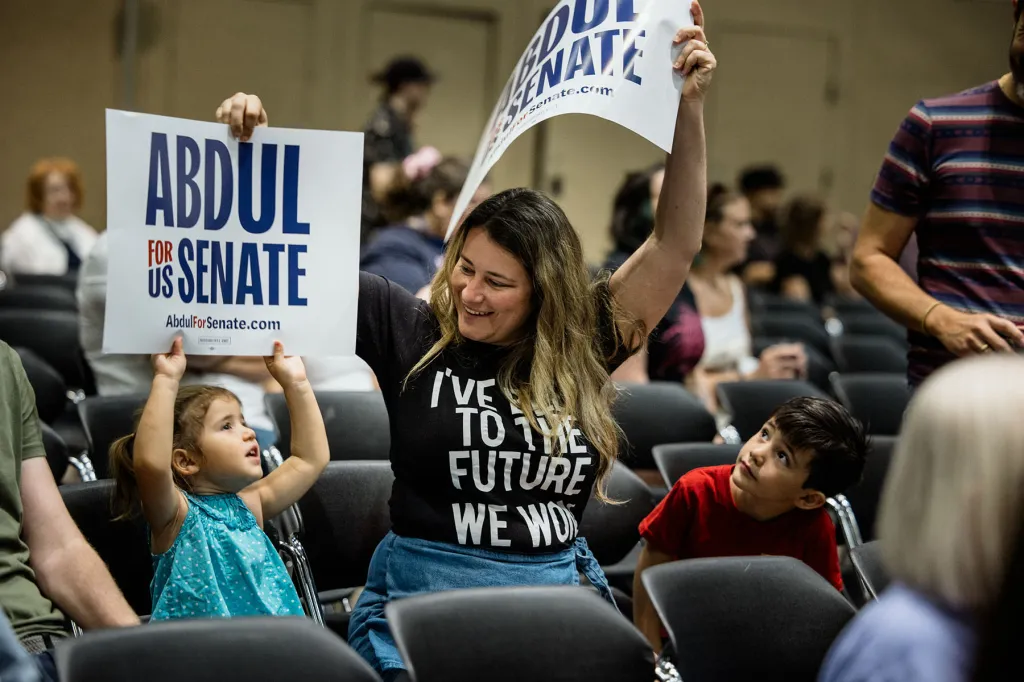 Cecelia Terraza, 36, and her children, Maya, 3, and Rio, 5, hold signs during a rally for Dr. Abdul El-Sayed in Lansing Center, Michigan on July 19, 2026. (Rosem Morton for The 19th)
Stevens is arguing that nominating El-Sayed would be too risky due to his stances and because of recently leaked audio of Rogers saying he thought he’d be “in good shape” if El-Sayed were the nominee. She’s also argued that El-Sayed hasn’t been transparent enough about his personal finances; he released a financial disclosure on Monday.
“We need to ask him: what else is he hiding?” she said in the debate. “What will Republicans uncover in the general election that they will use against him?”
El-Sayed, by contrast, says the outside spending is “a crutch” that undercuts Stevens’ electability claim.
“I’d be happy to have no outside spending at all on my behalf if it meant that $60 million wasn’t spent against me,” he said in the spin room following the debate. “What would this race be? And then you have the audacity to say you’re electable? Let’s get serious.”
The Senate primary has turned increasingly contentious in the final stretch, with online feuds between the two candidates’ camps spilling out into real life. It’s also taken on explicitly gendered and racial overtones even as many Democrats have largely turned away from explicit appeals to identity politics in the wake of the party’s 2024 election loss.
The AIPAC-affiliated super PAC United Democracy Project, which has spent over $30 million backing Stevens, has aired ads and sent out mailers asserting El-Sayed has “a pattern of disrespecting women,” a claim El-Sayed disputes and that fact-checks from local outlets have found is misleading and takes his past statements out of context.
“I’ve worked in public health where all of my coworkers, all of the deputies I’ve ever had in public health were women, and if there was a history of that, you would have heard about it,” he told The 19th.
Voters supporting El-Sayed also saw the AIPAC-funded ads as unconvincing. Dana Creighton, a 53-year-old graduate student in gender studies from Manchester who attended an El-Sayed rally and canvass launch in the Detroit suburb of Ferndale on Saturday, described the environment as a “a shitshow” and El-Sayed as “more of a feminist than Haley Stevens.”
“I missed the part where critiquing a woman’s policies is sexist,” she said. “He criticized a political decision.”
El-Sayed has also faced attacks based on his faith and ethnicity. At the Stevens event Friday, Farmington school board member Angie Smith sparked a firestorm when she told local reporter Sam Robinson that El-Sayed’s campaign was alienating other groups by “speaking Arabic” and putting “Arabic music” on. Stevens’ campaign denounced her remarks, and Smith later apologized.
“They always use this word around me: ‘dangerous,’” El-Sayed told the crowd in Ferndale. “I always wonder, why would you call someone like me dangerous? It’s not like people who look like me have ever been called dangerous. It’s not like you’re falling into a well-worn groove that’s been around for 25 years, calling people who look like me with names like mine dangerous.”
Stevens and her supporters have also charged his other criticisms of her as being gendered.
“It was offensive to hear my opponent say I can’t string together two sentences,” Stevens told reporters on Friday, referring to comments El-Sayed made in an interview with Semafor earlier this month. “I certainly did that on the auto rescue. I certainly have been doing that as I’ve been standing up to Trump’s abuses of power and our energy company that’s just raising rates right now.”
Stevens, who served as chief of staff on the federal rescue of the U.S. auto industry following the 2008 financial crisis before being elected to a seat in the Detroit suburbs in 2018, is a policy wonk and self-described “manufacturing geek” running a campaign hyper-focused not on national celebrity, she says, but on Michigan.
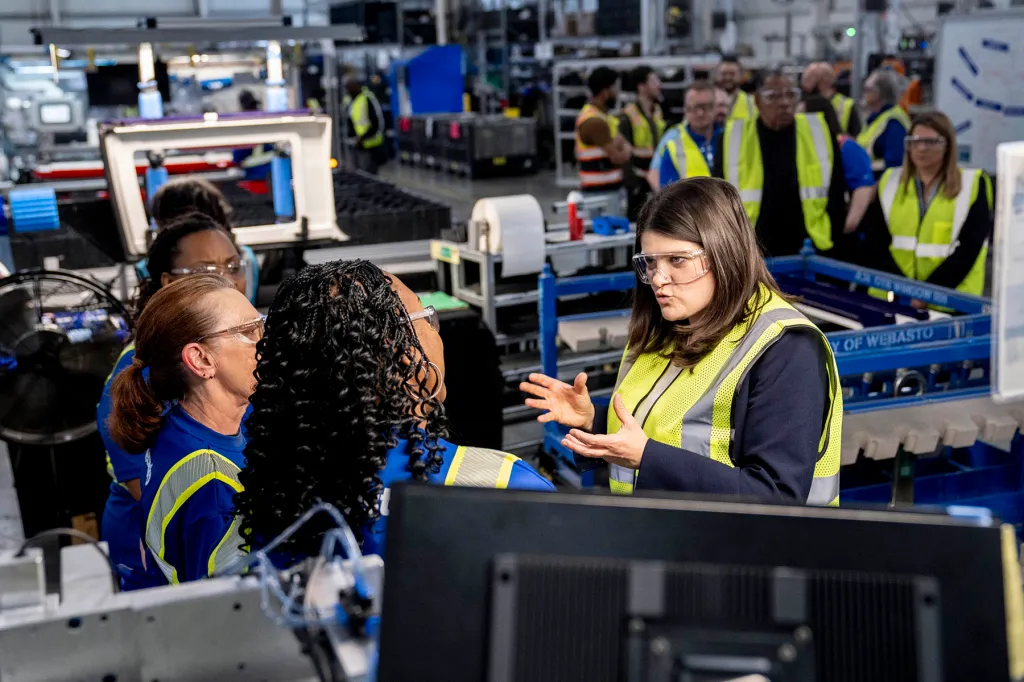 Rep. Haley Stevens talks to women working on the line as she tours the Webasto Plymouth Plant on May 1, 2026 in Plymouth, Michigan. (Sarah Rice/Getty Images)
Speaking to reporters before the first of two visits to Black church services Sunday, Stevens lit up with excitement as she told a reporter from The Economist about her 100-page-long legislation aiming to lessen U.S. dependence on critical minerals from China.
And when The 19th asked her what she thought the “cool kids on the internet” and “coastal elites” were missing about the race, Stevens said Michigan is a “unique” state as one of the few in the nation whose economy is reliant on domestic manufacturing, making its voters especially sensitive to high energy prices and tariffs.
“Nobody here in Detroit and throughout Michigan is making fun of the way I sound,” she added. “They are telling me that their bills are too darn high, that they deserve better, particularly in the halls of power, that we need to be understood.”
Stevens’ supporters, including some of the Black local elected officials who have endorsed her, see her as the most electable choice to beat Rogers.
“I’m a centrist Democrat. I’m a moderate Democrat, and I’m proud of that fact,” Detroit Council Member Scott Benson told reporters outside Plymouth United Church of Christ on Sunday. “That’s what we need to be competitive in the state of Michigan. Those views, [El-Sayed’s] views, they are very well-accepted in other places, but when we have a purple state, I’m not sure that’s going to play well here.”
Matt Grossman, head of the Institute for Public Policy and Social Research at Michigan State University, said that argument isn’t completely unfounded.
“There is a long-standing, small but real benefit for more moderate candidates in general elections — everybody believes that about the other party but not about their own party,” he said. “There is also a benefit for previously elected politicians.”
Michigan has a long history of electing pragmatic, results-focused Democratic women in the mold of Whitmer, who defeated El-Sayed in the 2018 Democratic primary for governor; former Sen. Debbie Stabenow; Rep. Debbie Dingell; and former Rep. Barbara Lawrence, whom Stevens counts as one of her mentors.
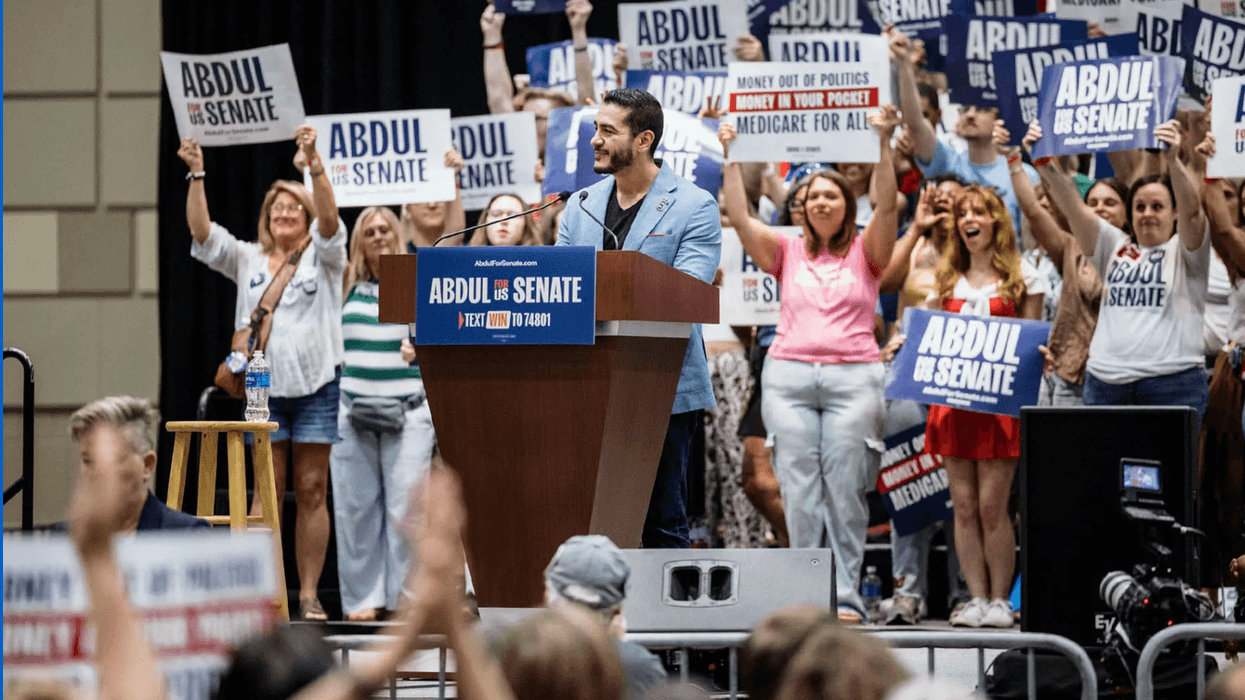
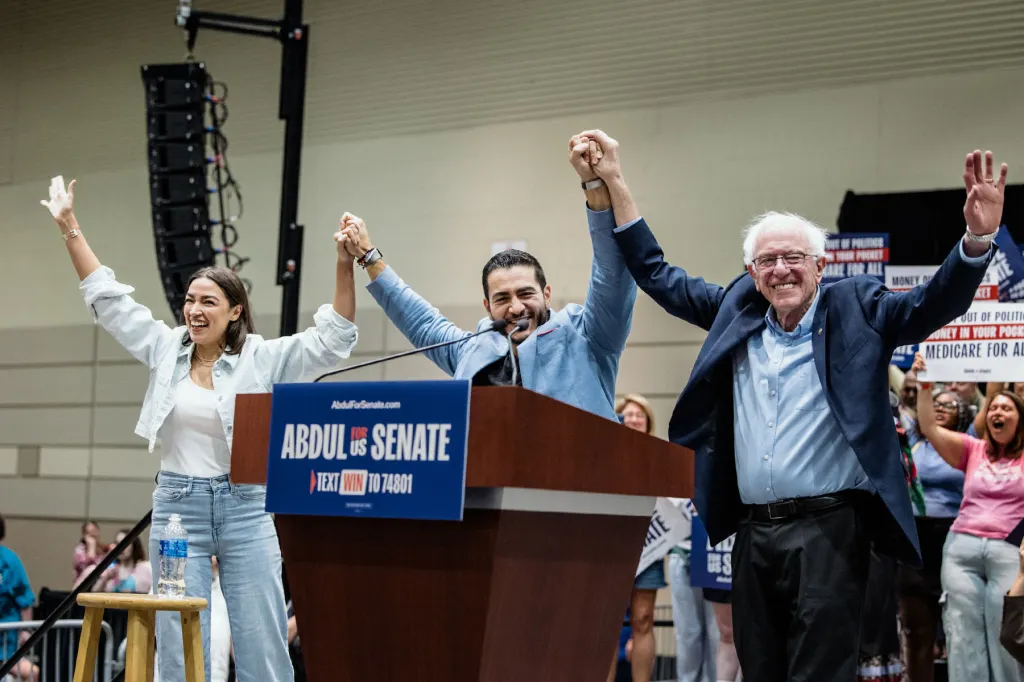 The crowd cheers as Rep. Alexandria Ocasio-Cortez, Senate candidate Dr. Abdul El-Sayed and Sen. Bernie Sanders raise their hands during the “People vs. the Powerful” rally at the Lansing Center in Lansing, Michigan, on July 19, 2026. (Rosem Morton for The 19th)
But the broader trends benefiting more moderate candidates, Grossman noted, don’t necessarily apply in every single election.
And this year’s Senate contest comes amid widespread discontent and anger among the Democratic base with its leadership, heightened skepticism toward the role of corporate money in politics, opposition to data centers and souring sentiment toward Israel after its yearslong war in Gaza — all factors that have powered El-Sayed.
El-Sayed’s run is the first big test of whether the ascendant left can win statewide in a battleground state.
And national progressives see it as critical in an existential fight against AIPAC and corporate influence, with major progressive figures like Sens. Elizabeth Warren of Massachusetts and Chris Van Hollen of Maryland hitting the campaign trail with El-Sayed. In interviews in Davison, Warren and Van Hollen said they saw the race as much bigger than a contest between El-Sayed and Stevens.
“I’ve known Abdul for a long time, but the key here is the scam in all of it. This outside spending is fundamentally dishonest,” Warren told The 19th of the outside groups opposing him.
“The outfits that are putting millions and millions of dollars into this race want to own a senator, and they know they can’t own Abdul, so they’re throwing everything they’ve got into blocking him.”
Who Is Electable? Michigan’s Senate Primary Asks a Familiar Question. was originally published by The 19th and is republished with permission.









The President Invited Iran to Bomb My Home