
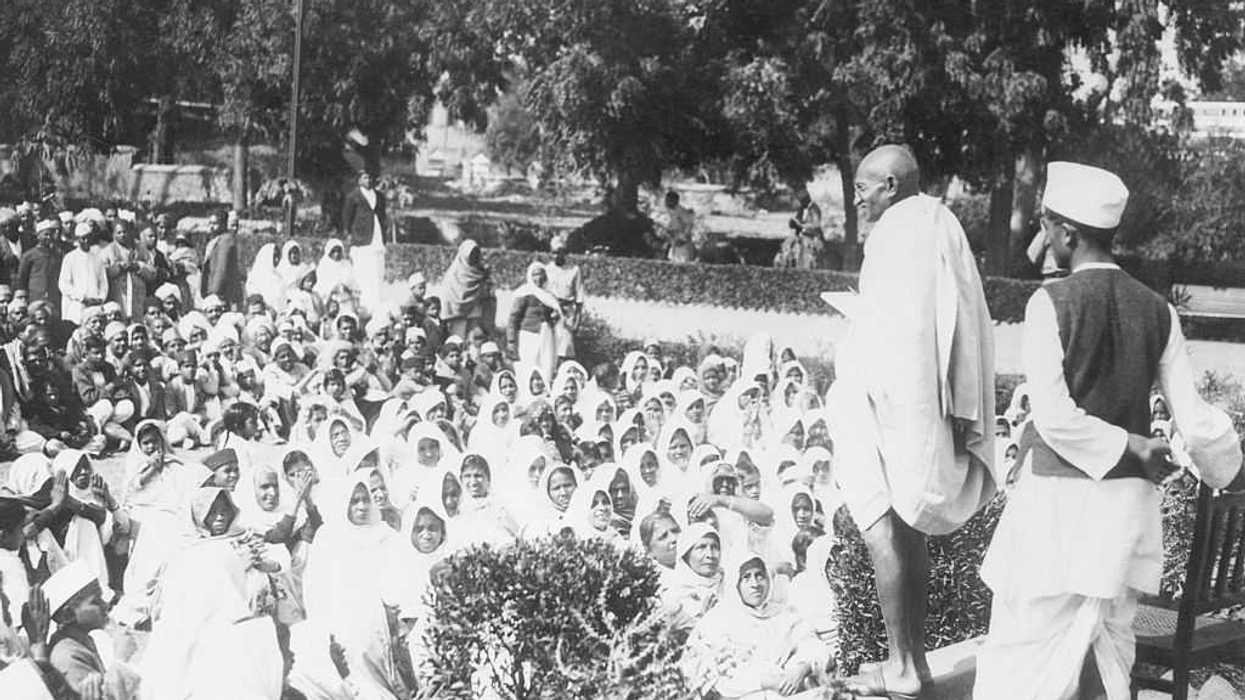

In 2007, the United Nations gathered to declare an International Day of Non-Violence. It fittingly chose Gandhi’s birthday, October 2nd, for the occasion: a day to affirm “the universal relevance of the principle of non-violence” and strive toward a common culture of tolerance and understanding.
The resolution passed by consensus, co-sponsored by 140 member nations. Each attested to what nearly everyone believes: that they—their culture, their country, their party, their movement—want peace.
Of course, for Gandhi, that desire wasn’t contingent. Even in the bloody struggle for Indian independence, non-violence for him and his most loyal followers was non-negotiable. Their resistance would be peaceful no matter what their enemy chose to do.
For the rest of us, non-violence is often what we aspire to somewhere down the line. It sits on the other side of something, or someone, who must be dealt with first—whether because of their own violence, or because we won’t tolerate the idea of a peace that includes them. Sometimes that hoped-for peace involves more than mere non-violence. It’s a world complete with the other things we all want, and that the UN’s member nations have agreed on in the past: happiness, human rights, clean drinking water, friendship, justice, the eradication of poverty.
The more we believe that this future is within our reach—and the worse we believe those who stand in its way to be—the more extreme the actions we’re willing to justify to get there.
“We live in a world of abstractions, of bureaus and machines, of absolute ideas and of crude messianism,” Albert Camus wrote in 1946, having just witnessed the world tear itself apart. “We suffocate among people who think they are absolutely right, whether in their machines or in their ideas.”
In Neither Victims nor Executioners, Camus lamented that those who advocated for violence did so because they were unable to truly imagine other people’s death—that in an industrialized age in which people had become removed from reality, they lost the ability to understand the consequences of what they advocated for. He couldn’t have imagined a world of algorithms that reinforced certainty in narratives, or of media that created an illusion of insight while severing the humanity of those on the screen. Nor could he have foreseen how the descendants of some participants in the apocalyptic war he had witnessed would become so comfortable, and view its bloodshed as so foreign, that they would not only come to view non-violence as inadequate, but as something that stands in the way of the kind of peace they want.
By 1947, India had achieved independence. There were other factors at play, not the least of which was the war, but Gandhi’s non-violence movement could be considered a success. He had been adamant that his approach hadn’t meant shying away from a fight. “On the contrary,” he wrote, “the non-violence of my conception is a more active and real fight against wickedness than retaliation whose very nature is to increase wickedness.”
But the empire he waged his peaceful struggle against was not the Nazi regime, nor was it the Iranian theocracy of today. The British Empire could be brutal in its rule, but there was something there that could be appealed to. Not long before Gandhi’s own time, it had launched sweeping efforts to vaccinate against smallpox in India and fought a costly campaign at sea to eliminate the slave trade worldwide. It had also pioneered limits on the power rulers held over subjects. Its government answered to voters, and its voters read the newspapers of a free press that publicized the government’s shortcomings. What worked against this enemy has its limits when used against others.
The Supply of Pretexts
Today in the West, the dismissal of non-violence is justified by drawing equivalences between our domestic enemies and those for whom peaceful confrontation has only meant easy prey. The insistence that those who stand in the way of our ideal peace are as bad as Nazis or murderous theocracies goes further than justifying extreme measures. It distorts the whole moral landscape, as reality is sacrificed to preserve our narratives and maintain a certainty in our own goodness even as we opt for violence.
It starts with the concept of violence itself. Structural violence, epistemic violence, silence as violence—all serve to rationalize the use of actual violence in response. Where the demand for a pretext for violence exceeds the supply of it, substitutes have been found by inflating the very meaning of the word. There’s also the inflation of the supply itself. Through sensationalism and selective coverage, the public is often left vastly overestimating the prevalence of the real thing.
Gandhi had been open about his hatred for the system the British had set up in his country. He also hated aspects of the caste system that Hindus had long maintained. But he insisted that he did not hate people. “No human being is so bad as to be beyond redemption,” he wrote, “no human being is so perfect as to warrant his destroying him whom he wrongly considers to be wholly evil.” That belief in the fallibility of all human beings informed Gandhi’s non-violent approach. For those who prefer the alternative path in their pursuit of peace, that view is inverted.
The enemy as an evil oppressor requires innocent victims; an innocent victim is one whose violence is justified. Whether the oppressor is society itself or society is under siege by evil, the outcome is the same: murder becomes understandable, then reasonable, then necessary. The man who guns down a businessman on the street becomes a folk hero. A terror group that intentionally slaughters civilians becomes a resistance movement. Call immigration an invasion, and any cruelty becomes self-defense.
Gandhi refused to hold all Englishmen responsible for the actions of the empire, just as he refused to condemn his fellow Hindus for the caste belief that regarded some people as untouchables. In rationalizing the pursuit of peace by extreme means, the very concept of the individual becomes a casualty. For a Manichaean worldview that splits the world into good and evil—those who share a specific vision of a peaceful future, and those who don’t—all that matters is the group one belongs to.
An Imperfect Peace
“From Right to Left, everyone, with the exception of a few swindlers, believes that his particular truth is the one to make men happy,” Camus wrote. “And yet the combination of all these good intentions has produced the present infernal world.” He could see that we couldn’t arrive at the perfect ideals we all desire, “however lofty and necessary, whether happiness or justice or liberty,” by simply eliminating those who stood in the way. Gandhi knew that beyond defeating enemies, this pursuit would require power. Because that power ultimately rests on violence, he wasn’t interested: “By its very nature, non-violence cannot ‘seize’ power, nor can that be its goal,” he said. “But non-violence can do more; it can effectively control and guide power without capturing the machinery of government. That is its beauty.”
If we truly want to attain peace, as all of us seem to do, then what we need isn’t power. Peace requires protection from power—perfection requires power without limits. The liberalism of the West was built on those kinds of limitations, and on the recognition that we were willing to live in an imperfect peace rather than shed blood for the chance at a perfect one.
We don’t need to be Gandhis, incapable of hatred and willing to lie down before the violence of the state. But as new generations of peace-loving idealists turn away from liberalism and non-violence, we should heed his warnings that while violent means might bring temporary victories, the evils they bring are permanent.
At the root of his philosophy were the deeply held beliefs that all life is sacred, and that while one should be willing to sacrifice oneself for the good, one must never sacrifice others. Without beliefs like these, peace—even the imperfect kind—will always be on the other side of someone.
Nick Xavier Smith is a former U.S. Army officer and the author of the forthcoming book The Good Guy Problem. He writes about extremism, liberalism, and human nature on his Substack.
Editor's Note: This piece was updated on 10/29.