




America has always redrawn the boundaries of belonging.
What counts as "us" has never been fixed. The lines have shifted over time, sometimes slowly and sometimes painfully, but they have always shifted.
I was reminded of this recently after joining a social media group centered on Southern Italian identity. Many of the posts focused on discrimination against southern Italians in both Italy and the United States around the turn of the twentieth century. Some of the stories were familiar. Others were new to me. Yet I remember hearing similar conversations as a child in the 1960s, listening to older relatives describe what it meant to be Italian in America before Italians were fully accepted into the American mainstream.
That acceptance was not automatic.
The original American establishment largely defined itself through an Anglo-Protestant lens. English ancestry, Protestant Christianity, and northern European roots formed the cultural core of what was considered "real" American identity. Groups that arrived later often found themselves standing outside that circle.
The Irish experienced this. So did Jews, Slavs, Greeks, and Italians.
Southern Italians arrived during a period of industrial upheaval, urban overcrowding, and rising nationalism. They were often portrayed as poor, uneducated, overly Catholic, or culturally incompatible with the existing American order. The 1891 lynching of eleven Italian immigrants in New Orleans remains one of the largest mass lynchings in American history, yet it occupies little space in our national memory.
Many southern Italians also carried another burden before reaching America: the divide between the north and the south of Italy. Following Italian unification, some northern intellectuals portrayed southern Italians as culturally and even racially inferior. Pseudoscientific theories claimed that southern Italians were less "European" than their northern counterparts, sometimes emphasizing Mediterranean or African influences in southern ancestry. Today, these theories are rightly discredited, but at the time, they shaped perceptions on both sides of the Atlantic.
Yet something changed.
The children and grandchildren of these immigrants learned English, served in the military, entered the professions, moved into the suburbs, and increasingly married outside their ethnic communities. Over time, the boundaries of the accepted American identity expanded to include them.
That tells us something important about America. The country has repeatedly absorbed groups once viewed as outsiders and folded them into the larger national identity. The process is rarely immediate, and it is never purely moral. It is shaped by economics, politics, military service, intermarriage, and demographic change.
Most importantly, it is shaped by a society's need to define who belongs.
That instinct is ancient. Every civilization creates an inner circle. Citizen and foreigner. Believer and infidel. Insider and outsider. Human beings organize themselves into groups because belonging provides order, trust, and a sense of shared purpose.
America is no exception.
Today, we often speak as though racial and ethnic categories are fixed and permanent. History suggests otherwise. The boundaries of the American mainstream have shifted repeatedly. Groups once viewed with suspicion gradually became accepted parts of the national fabric. Each transition felt controversial in its own era. Each later became normalized.
That raises an important question: what categories that seem permanent today will appear fluid a century from now?
Hispanic Americans may be experiencing a similar transition. The label encompasses people with diverse histories and backgrounds, many of whom are gradually being incorporated into the broader American identity through the same forces that shaped earlier immigrant groups: mobility, intermarriage, and cultural integration.
Black America represents a different story. Its identity was forged through slavery, segregation, and a shared historical experience unique to the United States. Yet even here, new generations of immigrants, multiracial families, and evolving cultural identities continue to challenge older frameworks.
At the same time, a new form of tribalism may be emerging. Increasingly, Americans divide themselves less by ancestry and more by education, ideology, geography, religion, and class. The old ethnic walls are weakening even as new cultural walls rise in their place.
Perhaps that is why so many of our debates feel unsettled. America no longer fully agrees on what binds us together. Is it ancestry? Shared values? Constitutional principles? Economic opportunity? Culture? Some combination of all of them?
A healthy society must balance two competing realities. It must preserve enough shared identity to maintain trust and cohesion, while remaining flexible enough to absorb new people and new influences. Too rigid, and societies fracture through exclusion. Too fluid, and they fracture through the loss of any common story at all.
That tension may be one of the defining challenges of modern America.
As I think back on those stories from older relatives decades ago, I realize they described more than just prejudice. They were describing the slow process of crossing a boundary into acceptance. They understood something many of us have forgotten: belonging is rarely automatic. It is negotiated across generations.
The club changes. The boundaries move. The arguments repeat themselves. Only the names are different.
Joe Palaggi is a writer and historian whose work sits at the crossroads of theology, politics, and American civic culture. He writes about the moral and historical forces that shape our national identity and the challenges of a polarized age.








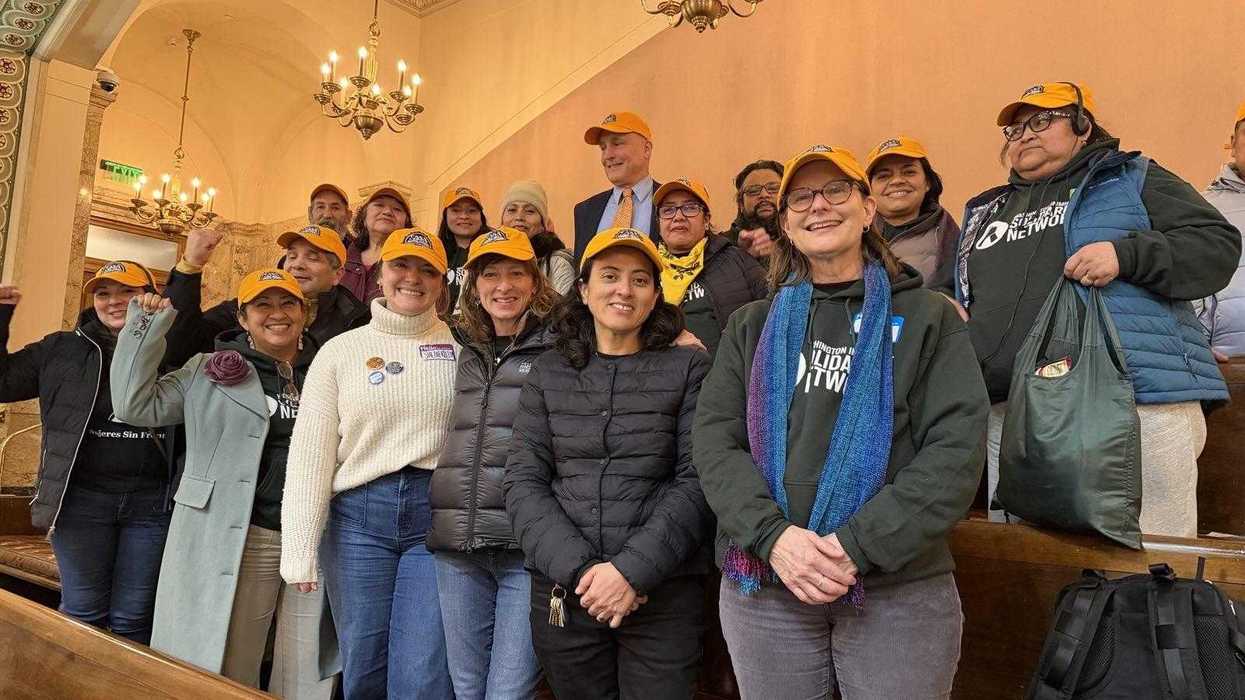
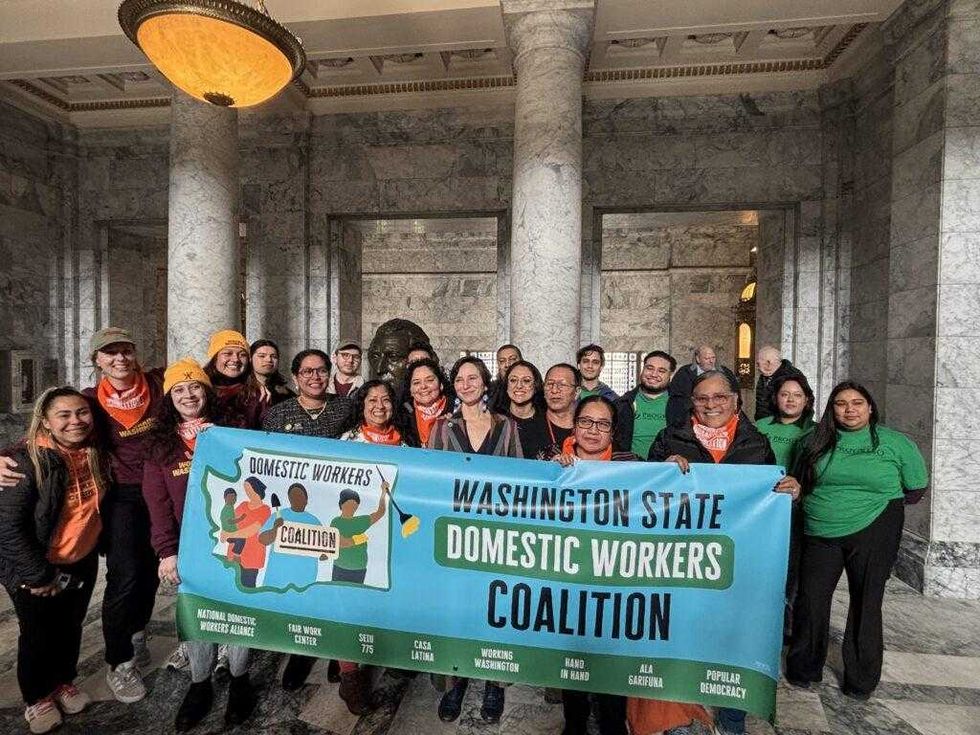 State Sen. Rebecca Saldaña, center, stands with members of the Washington State Domestic Workers Coalition at the state Capitol on Feb. 28, 2026. The Domestic Workers Bill of Rights passed in the House that day, before being signed into law in March. (Photo courtesy of Casa Latina)


The President Invited Iran to Bomb My Home