



Lawmakers are seeking the release of an immigrant woman who says that — despite pleading for help after experiencing bleeding and severe pain, indications of a possible miscarriage — she has received limited medical care in detention.
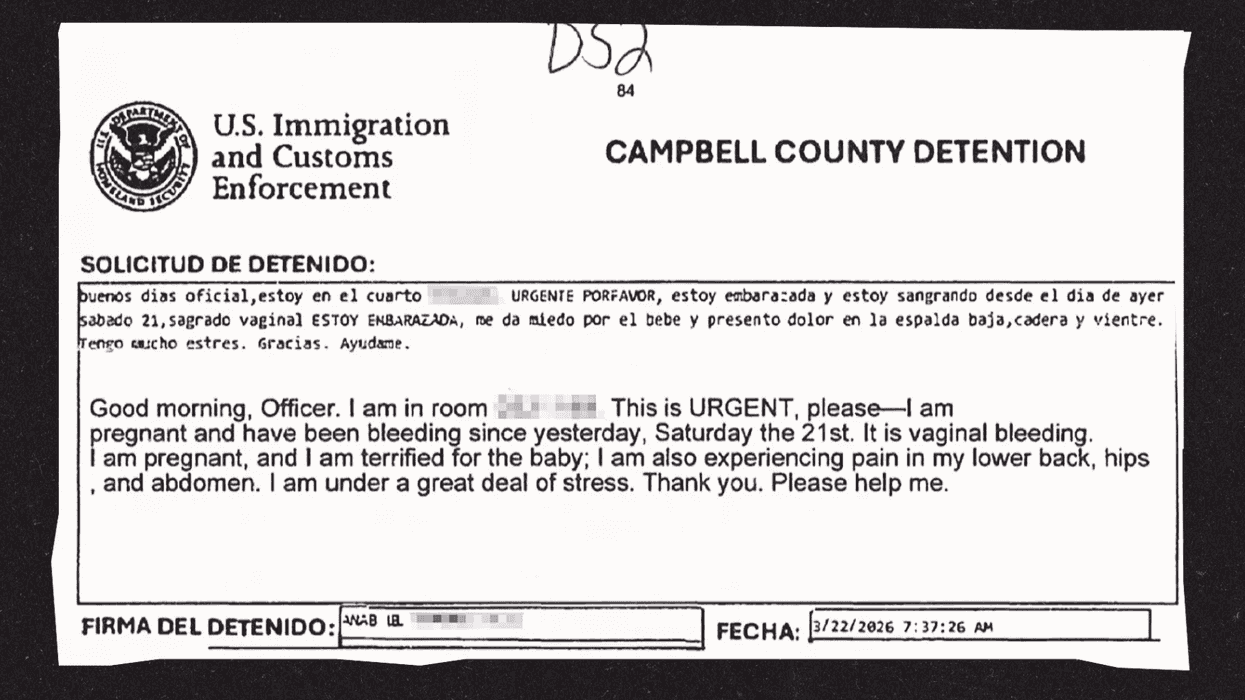
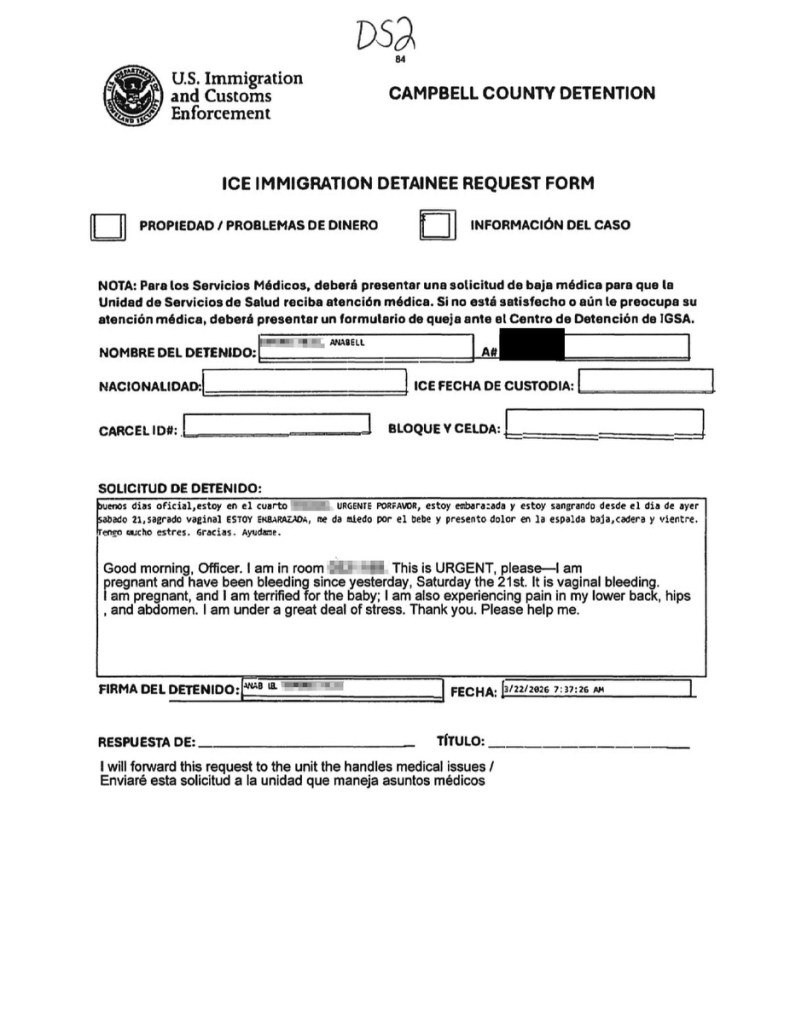
“This is URGENT, please. I am pregnant and have been bleeding since yesterday, Saturday the 21st. It is vaginal bleeding. I am pregnant, and I am scared for the baby; I am also experiencing pain in my lower back, hips and abdomen. I am under a great deal of stress. Thank you. Please help me,” she wrote in Spanish in an emergency medicine request in late March that was shared with The 19th.
The woman was taken to a nearby hospital that day, where she was admitted for a suspected miscarriage. There, she was told she was not pregnant and that her pregnancy hormone levels challenged the idea that she had been. Despite repeated requests, neither the lawmakers pushing for the woman’s release nor her attorney have been able to access or review her medical records, leaving her in the dark about what actual care she may have received and what could have happened to her pregnancy, including whether she had a very early miscarriage.
Anabell, who asked through her lawyer that her last name be withheld due to safety concerns, met Monday with Democratic Reps. Gwen Moore of Wisconsin and Delia Ramirez of Illinois. The lawmakers visited Kentucky-based Campbell County Detention Center after hearing complaints alleging that the center had provided inadequate medical care.
Neither Immigration and Customs Enforcement nor the Department of Homeland Security responded to a request for comment about Anabell’s medical care, medical records and the availability of prenatal care at the facility.
The visit came months after the Department of Homeland Security, in the face of public pressure, released data showing that almost 500 pregnant, nursing or postpartum people had been detained between January 2025 and mid-February of this year; at the time, DHS reported that 16 miscarriages had taken place in detention facilities. Anabell’s suspected miscarriage would not have been included in that count.
DHS has come under heavy scrutiny for its treatment of pregnant, nursing and postpartum detainees, with multiple women saying they received poor or limited health care, had minimal follow-up for potential pregnancy complications, and struggled to acquire records of any medical care provided while in detention facilities. The department, which oversees ICE, has said the agency gives detainees “the best healthcare many of these individuals have received in their entire lives.” Federal policy says that DHS should detain pregnant, postpartum and nursing individuals only in limited circumstances.
Anabell tested positive for pregnancy on two separate tests after she arrived at the detention center; then, weeks later, she began to cramp and bleed, according to her lawyer and her own account as told to the two lawmakers. Federal policy dictates that women of childbearing age should typically be provided with a pregnancy test upon being detained in case they may require special food or medical care.
Anabell’s account, which has not been publicly reported, comes less than 100 days before an election in which voters appear increasingly dissatisfied with Republicans’ approach on immigration policy.
Federal policy dictates that detainees with a positive pregnancy test should be taken for a visit with a qualified medical professional — such as a doctor or a nurse practitioner — within 72 hours. Anabell told her lawyers and lawmakers that she received no medical prenatal care and was not provided with prenatal vitamins.
Anabell also told her lawyer that at one point, when she moved holding cells, she was tasked with carrying her mattress and a heavy bin with her personal belongings. Copies of several meal stickers affixed to her food throughout the month of March, shared with The 19th by her lawyer, show that the agency was offering a modified diet: “Special Diet Details: Medical Diet. Pregnancy/High Protein.”
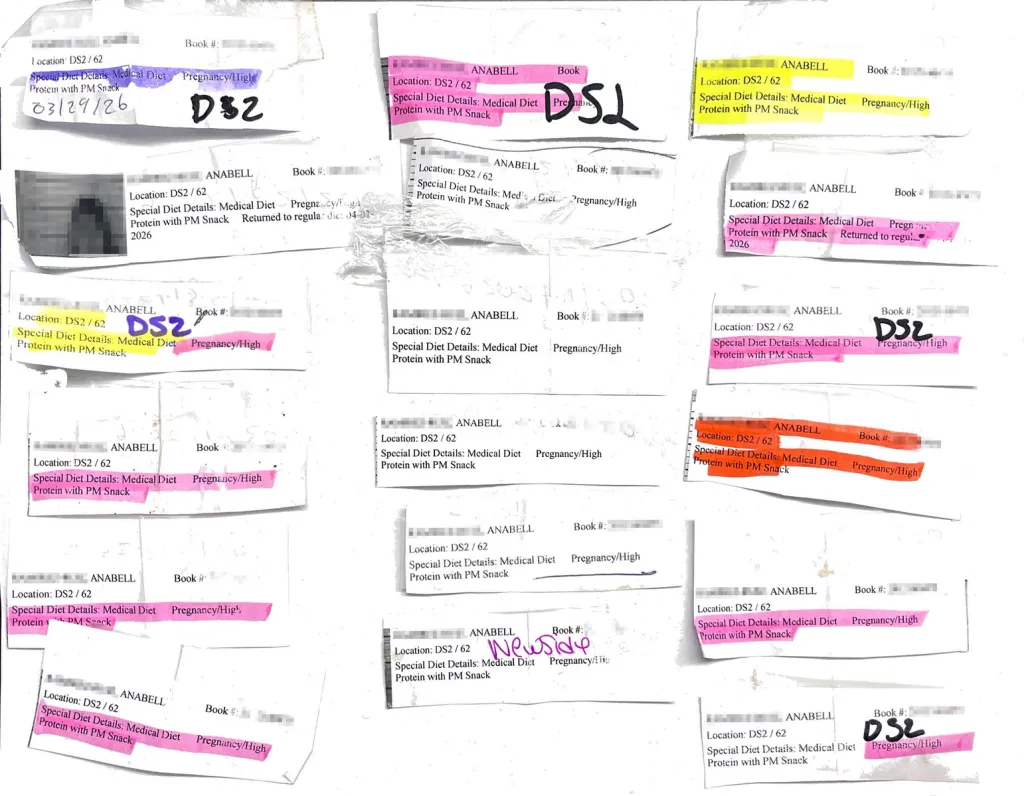 Copies of several meal stickers affixed to Anabell’s food throughout the month of March, shared with The 19th by her lawyer, show that the Immigration & Customs Enforcement (ICE) agency was offering a modified diet. (National Immigrant Justice Center)
Anabell immigrated to the United States from Nicaragua in 2022 and settled in Milwaukee, where, her lawyer said, she was working in food service. She is petitioning for asylum in the United States; her claim for asylum was scheduled for a hearing last week before it was postponed because of scheduling issues.
It’s still unclear what, exactly, happened to Anabell. When her bleeding began, Anabell told her lawyer and the lawmakers, she was given sanitary pads. At the hospital, they cast doubt on if she had been pregnant. Typically, people who experience a miscarriage have elevated hormone levels for several weeks afterward, which Anabell did not have. Ten days later, she was taken back to the hospital where her lawyer said she received pain medication. Her lawyer said she has not received medical care since, despite continuing to experience pain, numbness, vomiting and hair loss.
Anabell’s lawyers have made requests for her medical records to both ICE and the detention facility, and neither of those requests has been fulfilled. Reps. Moore and Ramirez also drafted a medical release form signed by the detainee and presented it to the facility Monday; they have not yet received the records, either.
“We don’t have any access to her medical records. They keep sort of passing us back and forth,” said Colleen Ward, a lawyer with the National Immigrant Justice Center who is representing Anabell. “She hasn’t been able to see her records and it leaves questions for her about what kind of medical care she needs and what actually is going on in her body. She’s had this very traumatic, very painful experience, and she has these ongoing symptoms. There’s a real denial in the jail that any of this even happened.”
People detained by ICE are legally entitled to records of any medical care provided while they are in federal custody, and DHS says it provides medical records to any detainee who requests them. But formerly detained women and immigration attorneys alike have called the process of obtaining those records cumbersome, and in some cases functionally unworkable.
“Her attorney can’t get the medical information, and Anabell herself can’t get the medical information. In the meantime, they’re denying that she had a miscarriage. She has since been in pain, back pain, and they tell her that if she needs any medical treatment, she needs to go to the commissary and buy some pain medication,” Moore said in an interview after the visit.
Without medical records, it’s difficult to say what may have happened to Anabell, including whether her bleeding may have been a delayed symptom of a much earlier, undetected miscarriage, said Amanda Heffernan, a longtime nurse-midwife and professor of midwifery at Seattle University. But had Anabell received regular health care — including a doctor’s visit upon her positive pregnancy test and possibly a follow up a few weeks later — it would likely have been easier to assess what actually happened to her and follow up appropriately.
 Data released by the Department of Homeland Security shows that almost 500 pregnant, nursing or postpartum women had been detained between January 2025 and mid-February of this year. (National Immigrant Justice Center)
“You’ve decided you’re going to detain pregnant people? You’re responsible for providing proper care, but the system isn’t designed for the consistency and promptness that proper care requires,” Heffernan said.
Already, numerous women have said that they received inconsistent or inadequate prenatal care while in ICE detention — including when experiencing pain or bleeding.
Moore and Ramirez described an emotional and complicated scene when they visited with Anabell on Monday.
“We asked, could we just please have a typical weekly menu to see the offerings, and that was not provided,” Moore said. “In a room that they called a kind of a triage for medical problems, they had a dirty mattress on it, and they told me that it was not dirty; it was just stained.”
Ramirez introduced a resolution in December calling on the Trump administration to permanently reinstate policies protecting pregnant immigrants and to closely monitor reproductive health care quality and access across all detention facilities.
“Watching Anabell walk into that room and fall into the arms of Congresswoman Moore weeping just was really heartbreaking for me,” Ramirez said. “Today is a perfect example why this legislation is so incredibly important.”
Lawmakers Push for Immigrant Woman’s Release and Medical Records After Suspected Miscarriage was originally published by The 19th and is republished with permission.













The President Invited Iran to Bomb My Home