

Skip to content
Search

Latest Stories

Follow Us:
Top Stories

Trump needs to get ready for the blowback

Opinion

Trump needs to get ready for the blowback

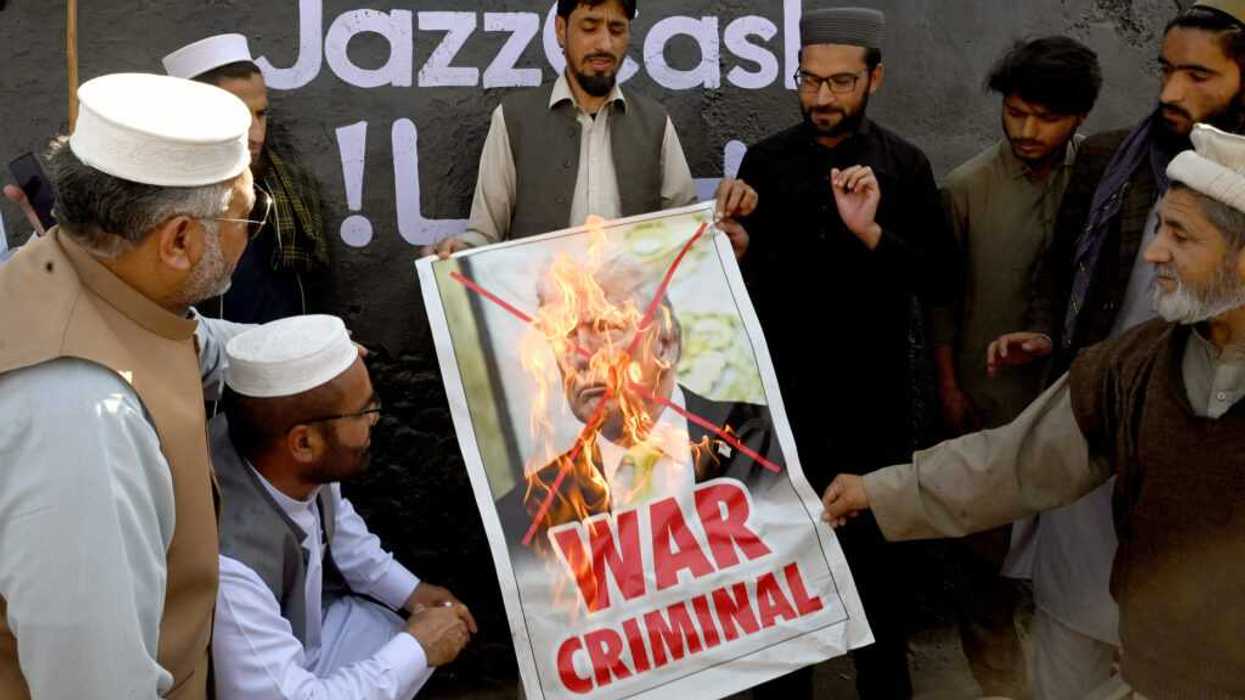
Activists and supporters of the Jamaat-e-Islami party burn a poster of U.S. President Donald Trump during an anti-U.S. and Israel protest in Peshawar on March 2, 2026, after the death of Iran's supreme leader Ayatollah Ali Khamenei amid US-Israel strikes.

(Abdul Majeed/AFP/Getty Images/Tribune Content Agency)

is a special kind of folly to make long-term predictions amid the fog of war. Nobody knows how Operation Epic Fury will end. But there are already a few things we can celebrate and condemn.

On the celebration side: The professionalism and courage of the American military stand out. So does the just demise of Ayatollah Khamenei, amid scores of his murderous henchmen. Other things worth celebrating are merely possibilities at this point. If the nearly half-century of Iranian repression at home and terrorism abroad is poised to end, along with Iran’s nuclear ambitions, that would be cause for monumental celebration. And whether you celebrate it or not, it would be a massive addition to Donald Trump’s presidential legacy.


On the other hand: This is no way for a constitutional republic to go to war. The ever-changing rationales, the failure to consult Congress, and Congress’ refusal to demand consultation and authorization, is an outrage no matter how this war ends. If the war and its aftermath are deemed successful, there will still be a price to pay as our system of checks and balances will seem to future presidents as even more of a dead letter. Conversely, if this ends in disaster, one could see a renewed effort to restore that system to prevent such calamities in the future.

Everything unfolding in and above Iran depends on the consequences, intended and unintended, of one man’s unilateral decision to launch a war. In short, we’re all on blowback watch.

Opponents of toppling the mullahcracy have relied on no argument more than the specter of blowback. This is the always reasonable concern that the unintended consequences of an action will be worse than taking no action at all. The term originated in 1950s-era CIA, but the idea goes back at least to Thucydides. As former CIA analyst Chalmers Johnson wrote in his 2000 book “Blowback”: “Even an empire cannot control the long-term effects of its policies. That is the essence of blowback.”

Cultivating fear of blowback has been the organizing principle of Iranian national security for decades. It built an “Axis of Resistance” — Hezbollah, Hamas, a pliant vassal regime in Syria, etc. — to make the price of attacking Iran too steep to contemplate. That was the primary motive for an Iranian nuclear program.

What the ayatollahs, and their political and intellectual praetorians in the West, didn’t appreciate is that the concept of blowback isn’t just a check on American or Western power. It’s a universal phenomenon (just ask Russian President Vladimir Putin).

Consider that Operation Epic Fury is largely the direct consequence of the heinous Oct. 7, 2023 attacks led by Iran’s proxy Hamas. The blowback from 10/7 led to the pulverizing not just of Hamas, but of Hezbollah, and indirectly the fall of the Assad regime in Syria. It also led to the degradation of Iran’s own defenses to the point where Operation Epic Fury became feasible.

It remains to be seen whether the operation will be successful. Regime change from the air is hard. Regime change from the air that doesn’t lead to chaos on the ground — as with Libya in 2011 — is far harder.

The potential this all could go sideways is not a particularly adroit or novel insight. Such warnings, largely from Trump’s critics, are a staple of every op-ed page and cable news discussion.

What has been less discussed is whether Trump subscribes to blowback theory. It’s easy to miss as the bombs drop, but Trump’s whole approach to military action is for quick “wins” with few lasting entanglements. That’s why he is already talking about “off-ramps” and restarting negotiations with Iran (It’s also partly why he didn’t actually change the regime in Venezuela. He merely replaced an incalcitrant autocratic thug with a pliable one).

Right now, it’s reasonable to worry about the blowback from unilaterally launching a war against Iran. But if things get too messy for him, specifically if Iran’s strategy of roiling the whole region, disrupting the flow of oil and panicking financial markets, succeeds, the debate could shift suddenly. Instead of the charge that he was too reckless in taking bold action, the criticism could switch to how he got cold feet before finishing the job, leaving the whole region in turmoil.

Trump may seem like a hypocrite to many detractors for violating countless promises to end “forever wars,” but a forever war remains the last thing he actually wants. That doesn’t mean he won’t get one. Because Trump cannot control the long-term effects of his policies.

Jonah Goldberg is editor-in-chief of The Dispatch and the host of The Remnant podcast. His Twitter handle is @JonahDispatch.



Read More

The spectacle of Operation Epic Fury
A general view of Tehran with smoke visible in the distance after explosions were reported in the city, on March 02, 2026 in Tehran, Iran.
(Photo by Contributor/Getty Images)

The spectacle of Operation Epic Fury

The U.S. and Israel’s joint military campaign against Iran, which rolled out under the name Operation Epic Fury, is a phrase that sounds more like a summer action film than a real‑world conflict in which people are dying. The operation involves massive strikes across Iran, with U.S. Central Command reporting that more than 1,700 targets have been hit in the first 72 hours. President Donald Trump described it as a “massive and ongoing operation” aimed at dismantling Iran’s military capabilities.

This framing matters. When leaders adopt language that emphasizes spectacle, they risk shifting public perception away from the gravity of war. The death of Iran’s supreme leader following the bombardment, for example, was a world‑altering event, yet it unfolded under a banner that evokes adrenaline rather than anguish.

Keep Reading Show less
How Race and Species are Leveraged Against Each Other

Texas Rep. Al Green held a sign reading "Black People Aren't Apes," protesting a racist video Trump had previously shared on Truth Social. Green was escorted out of the House chamber just minutes into President Donald Trump's State of the Union address.

How Race and Species are Leveraged Against Each Other

This was nothing new.

Before President Donald Trump released a video on his Truth Social account earlier this month that depicted Michelle and Barack Obama as apes, many were already well aware of his compulsive use of AI-generated deepfake content to disparage the former president. Many were also well aware of his tendency to employ dehumanizing rhetoric to describe people of color.

Keep Reading Show less
President Franklin D. Roosevelt addressing congress, December 8, 1941.

President Franklin D. Roosevelt addressing congress, December 8, 1941.

Getty Images, Fotosearch

Four Freedoms: What We Are Fighting For

The record of the Trump 2.0 administration is one of repeated usurpations and injuries to the body politic: fundamentally at odds with the principles of democracy, without legal or ethical restraint, hostile to truth, and indifferent to human suffering. Our nation desperately needs a stout and engaging response from the party out-of-power. It’s necessary but not sufficient for Democrats to criticize Trump, rehearsing what they are against. If it is to generate renewed enthusiasm among voters, the Democratic Party must offer a compelling positive message, stating clearly what it stands for.

Fortunately, Democrats don’t need to reinvent this wheel. They can reach back to a fraught moment in our history when a president brought forward a timely and nationally unifying message, framed within a coherent, memorable, and inspiring set of ideas. In his address to Congress on Jan. 6, 1941 – a full 12 months before Pearl Harbor – Franklin Delano Roosevelt termed the international spread of fascism an “unprecedented” threat to U.S. security. He also identified dangers on the home front: powerful isolationist leanings and, in certain quarters, popular support for Nazi ideology. Calling for increased military preparation and war production (along with higher taxes), he reminded citizens “what the downfall of democratic nations [abroad] might mean to our own democracy.”

Keep Reading Show less
​U.S. President Donald Trump standing at a podium.

U.S. President Donald Trump delivers the State of the Union address during a joint session of Congress in the House Chamber at the Capitol on February 24, 2026 in Washington, DC.

Getty Images, Pool

How Trump Uses Outrage to Control the National Narrative

It’s hard to recall all of President Trump’s most outrageous remarks from his second term in office. For most presidents, even one of these would have been damaging, but not for Trump. There were so many that they became one political storm after another, with each new one blurring the memory of the previous one.

Even many of Trump’s strongest supporters admit that some of his statements can’t be defended. In case recent events have blurred together, here’s a recap of Trump’s 10 most outrageous statements or actions since he returned to the White House just over a year ago:

Keep Reading Show less