
Skip to content
Search

Latest Stories

Follow Us:
Top Stories

Curbelo Breaks Down Redistricting, Immigration, and Climate Challenges

Curbelo joins The Unity Forum to unpack redistricting, immigration and climate challenges


Carlos Curbelo

Carlos Curbelo

https://x.com/carloslcurbelo

The Unity Forum, a cross-partisan webinar and podcast series presented in partnership with the Bridge Alliance and produced by Alumni for Freedom and Democracy, is dedicated to fostering reasoned discourse and strengthening the foundations of an open society. Each program brings forward respected experts who challenge assumptions about current events, elevate civil dialogue, and deepen public understanding of today’s most pressing social, economic, and legal issues. In addition to attending Unity Forum events, readers are invited to join post-event discussions, volunteer as community dialogue facilitators, or help promote open society initiatives within their networks. Opportunities to stay engaged and make a difference are available for anyone who wants to support the mission of meaningful civil engagement.

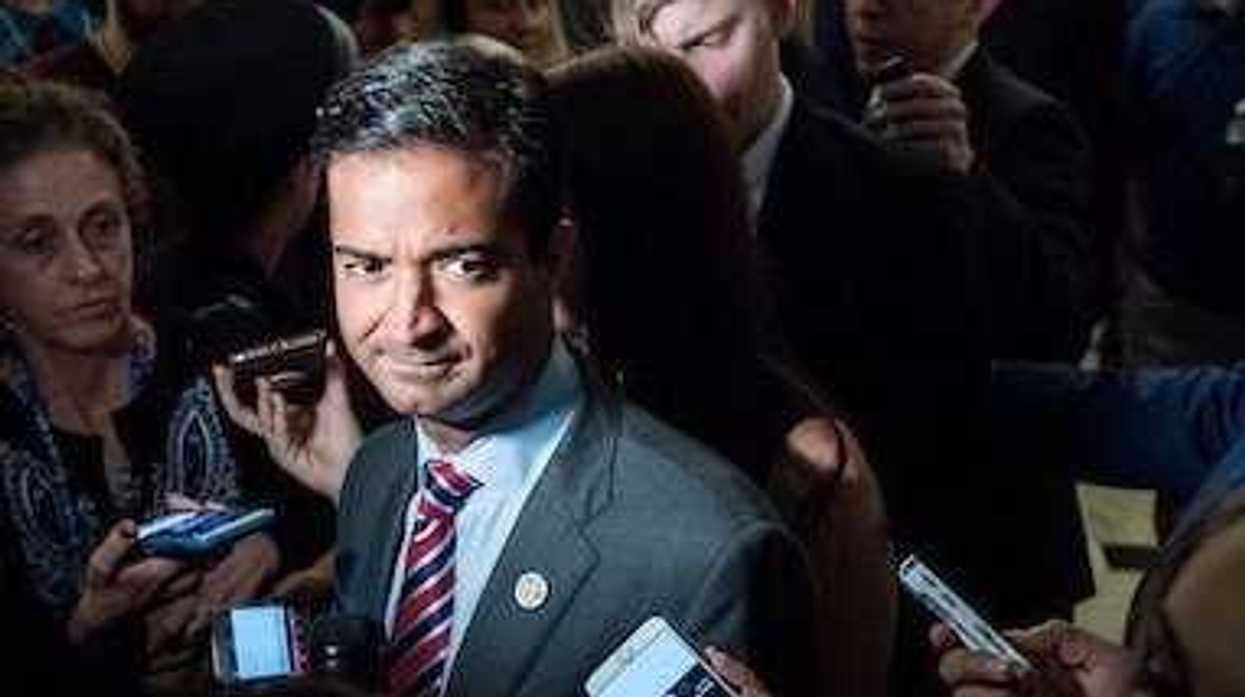
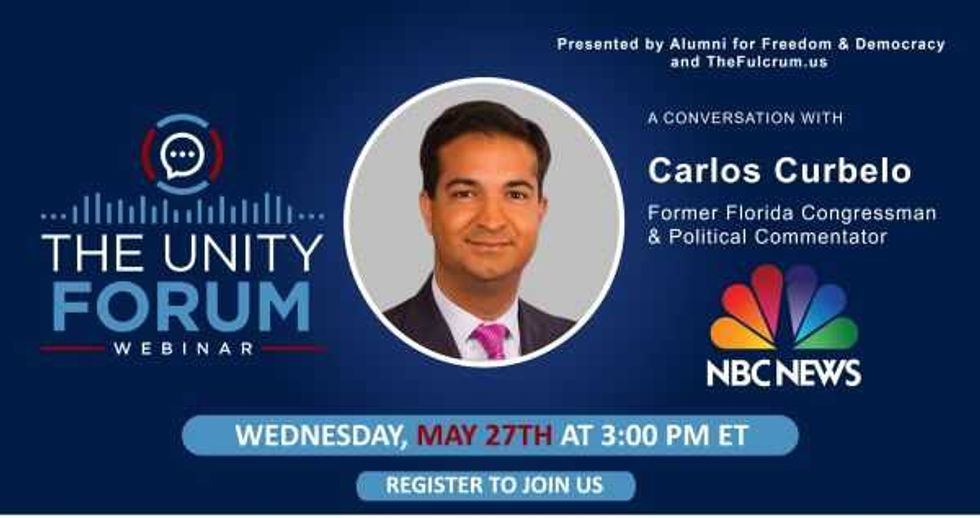
On May 27, the Unity Forum welcomes former U.S. Representative Carlos Curbelo, who represented Florida’s 26th Congressional District from 2015 to 2019. During his time in Congress, Curbelo earned a national reputation as a principled, bipartisan voice, particularly on climate and energy policy, immigration reform, and efforts to restore constructive, bipartisan governance. His co‑founding of the House Climate Solutions Caucus remains a defining example of coalition‑building on one of the nation’s most polarized issues.


Congressman Curbelo is especially well-suited to lead a nonpartisan discussion on today’s most divisive topics.

Redistricting and Democratic Legitimacy

In the next Unity Forum webinar, Curbelo will share his perspective on the ongoing redistricting debates happening across the country. He will talk about how changing district lines are affecting political incentives, especially in Florida, and what these changes mean for democracy and voter trust. He will also discuss the role of state courts and constitutions in ensuring fair maps, using examples from Florida’s legal and political experience.

Register now:

Immigration: A Personal and Policy Perspective

Immigration is still one of America’s most complicated and misunderstood topics. As the son of Cuban immigrants, Curbelo offers both personal experience and policy knowledge. He will explain what a practical, bipartisan immigration plan could include, such as border security, asylum processing, legal immigration options, work permits, protections for Dreamers, E-Verify, and more. With so many misunderstandings about asylum rights right now, his views on bringing order and fairness are especially important.

Climate Risk and a Generational Shift

Even though climate change may not be a major topic in national politics, it remains a major concern for young Americans. Recent data shows a big generational change: a 2025 AP–NORC/EPIC poll found that 42% of Republicans under 45 now think climate change is mostly or entirely caused by humans, up from 26% in 2017. Almost 9 out of 10 young people who have faced severe weather believe climate change played a part, and about half say it was a major reason.

For young people, climate change is not just a future problem. It is something they experience now, and it shapes how they see the world.

Curbelo will talk about how state leaders can turn climate risks into practical, bipartisan policies. This is especially important in Florida, where rising sea levels, stronger storms, and higher insurance costs make the issue urgent.

Join the Conversation

To find out more, sign up for the free Unity Forum live webinar on Wednesday, May 27, 2026, at 1:00 PM ET. The session will be interactive, with a live Q&A, so you can ask questions directly to Congressman Curbelo and the moderator.

The event will cover redistricting, immigration, and climate risk, with Congressman Carlos Curbelo talking to Chris Malone, host of The Unity Forum and co-founder of Alumni for Freedom & Democracy.

Register to attend or to get a link to the recording.
The Unity Forum Discussion The Unity Forum Discussion w/ Carlos Curbelo. After registering, you will receive a confirmation email about joining the webinar.us06web.zoom.us

Welcome! You are invited to join a webinar: The Unity Forum Discussion w/ Carlos Curbelo. After registering, you will receive a confirmation email about joining the webinar.

David Nevins is the publisher of The Fulcrum and co-founder and board chairman of the Bridge Alliance Education Fund.



Read More

Texas Capitol building

Texas Capitol, Austin

Texas GOP’s Closed-Primary Push Hits Pause. The Next Fight Is in Austin

Austin, Texas—A federal court effectively told the Republican Party of Texas Friday that—at least for now—if they want primary elections closed, they will have to convince their members in the legislature to do it. This puts the matter on hold until the 2027 legislative session.

It wasn’t a dismissal. The court did not rule on the constitutionality of Texas’ open primary system. Instead, US District Judge Matthew Kacsmaryk paused the GOP’s lawsuit, stating that the Legislature may soon take steps to close the state’s primary elections on its own.

Keep ReadingShow less
First Amendment being torn

First Amendment text of the US Constitution ripped in half -- Freedom of Speech , Religion or Press unconstitutional concept

Getty Images

Lawsuit Says Press Access Is Essential to Democratic Accountability

When POLITICO, CNN, and MS NOW announced Monday that they were filing a federal lawsuit to restore their reporters’ access to the White House, they challenged more than the sudden and unexplained revocation of press credentials. They underscored a fundamental constitutional principle: a free press does not operate at the government's discretion.

According to their joint statement, the outlets are seeking urgent relief after the Secret Service denied their reporters entry to the White House complex on Saturday and confiscated their credentials. The action followed recent stories by these outlets examining the administration’s handling of classified documents and raising questions about transparency related to policy meetings. They wrote, “Without notice or process, the White House revoked our journalists’ credentials because it objected to our reporting. Left unchallenged, this threatens press freedom and the public’s right to independent journalism free from government interference.”

Keep ReadingShow less
Cropped shot of a group of people joining their hands in solidarity

A new union political director explains why labor membership has halved since 1983 even as public approval hits record highs—and what's driving the gap.

LumiNola/Getty Images

The Ongoing Fight for Bread and Roses

Last Monday, I started a new job as the political director for IBEW 569, a local electrical workers' union based here in San Diego. In talking to friends about what I’m doing–while learning, fast, in real time, how to do the job myself–it occurred to me that there’s actually quite a knowledge gap in society today regarding an understanding of what unions are and what they’re supposed to do. So let’s get into it.

A union is, at its core, a group of workers who agree to negotiate together instead of alone. One worker asking a boss for a raise has almost no leverage. A thousand workers asking together hits different. That leverage of teamwork, that collective bargaining, is how the overtime pay, workplace safety standards, and employer-sponsored health insurance all came to exist in this country. None of it was handed down out of corporate goodwill. Fair wages (bread) and dignity (roses) were won, often at real cost. In 1890, the average workweek for manufacturing employees and building tradesmen was around 100 hours or more. Workers in Chicago who rallied for an eight-hour workday faced police violence, but we have that and weekends now because people were willing to lose their jobs, and sometimes their lives, to organize for it.

Keep ReadingShow less
A woman sitting down and speaking with a group of people.

Research shows Americans see political opponents as more extreme than reality. Learn how closing this 'perception gap' can restore civil discourse.

Getty Images, Luis Alvarez

Closing Perception Gaps Strengthens the Whole Democracy Ecosystem

Perception gaps — misunderstandings about our fellow Americans across the political spectrum — are damaging the fabric of our country. Correcting these gaps is essential to preserving the kind of democracy that respects free speech, individual dignity, and civic responsibility.

At their core, perception gaps reflect a tendency to see those in the other party as more extreme and worse than they actually are. Too often, Americans assume their political opponents are more hostile, closed-minded, dishonest, or even supportive of political violence and rule-breaking than in reality. These caricatures drive fear and division.

Keep ReadingShow less