
After Senator Lindsey Graham died in office, South Carolina’s governor appointed his sister, Darline Graham, to serve out the remainder of his term. Just over a month later, campaigning for a full term of her own, when asked at a debate whether Taiwan and the South China Sea are national security issues for the United States, she said she was “not that informed on national security.” The President has endorsed her candidacy. Call me old-fashioned, but I want a Congress that is informed on national security. The founding fathers seemed to agree: Article I, Section 8 of the Constitution hands Congress the power to declare war, “raise and support Armies,” “provide and maintain a Navy,” and “make Rules for the Government and Regulation of the land and naval Forces.” That’s the job description, and I want a president who doesn’t endorse someone for that job who can’t handle that responsibility.
Our Commander-in-Chief and Secretary of Defense have turned away from Taiwan and the South China Sea. When I was a Navy pilot, the spoken and unspoken adversary of our future was China. I don’t mean to make a judgment about whether that was the right call, but just to say that in my 14 years affiliated with the Navy, of every potential adversary we discussed, China was always the most formidable. As I trained to be a mission commander, most of the simulations I flew and the scenarios I hashed out on oral boards revolved around the South China Sea. That’s the fight we trained to fight. Then, a few months after I separated from the Navy, Secretary Hegseth announced our priorities were shifting away from the Pacific to “restore U.S. military dominance in the Western Hemisphere.” That didn’t stop us from starting a war with Iran we can’t seem to get out of, but the promise to take focus away from the Pacific does seem to have held.
The Navy’s footprint in the Pacific keeps shrinking. Just this week, the USS George Washington was sent to 5th Fleet, leaving 7th Fleet, our forward-deployed presence in the Pacific, without an aircraft carrier there at all. Just last month, the USS Benfold, a destroyer, went four days without power in the South China Sea, and the Navy didn’t confirm it publicly until three weeks later (and only after a trade outlet found out on its own). Putting aside the pattern of the Pentagon withholding information, if we’re going to make ourselves this vulnerable in the region, it would be nice to hear a clearly articulated rationale for why such a long-understood, long-term threat no longer alarms us.
Nearly a decade ago, Xi Jinping told his own party that China had entered a new era in which it would assume “center stage in the world.” Sure enough, China’s dominance in the world has become self-evident. China’s military carries just over 2 million active-duty troops to our 1.35 million, its Navy just passed 370 ships to our 287 (built out of a shipbuilding industry with 230 times our capacity), and its tech sector, a decade behind us not long ago, is now setting the pace in fields we used to dominate. On top of that, ever since the Trump administration gutted USAID, China has been handed an opportunity to fill the vacuum with soft power. That’s to say nothing of their impressive infrastructure and overall economy. In fact, as part of Beijing’s Belt and Road Initiative, a 35,000-ton container vessel just left the Chinese port Ningbo on Friday for an Arctic shipping route in what may mark a new era for global trade. But while I would be happy to live in harmony and cheer on whichever country wins the great power competition, since when–and why–did our government stop caring about ceding power and influence to China?
Back in 2021, Admiral Philip Davidson told the Senate that China could move on Taiwan within six years. His successor, Admiral Charles Richard, predicted reunification “by 2027 if not sooner.” Presidents of both parties said out loud that the United States would defend Taiwan if China invaded. Whatever you thought of that policy, at least it was one.
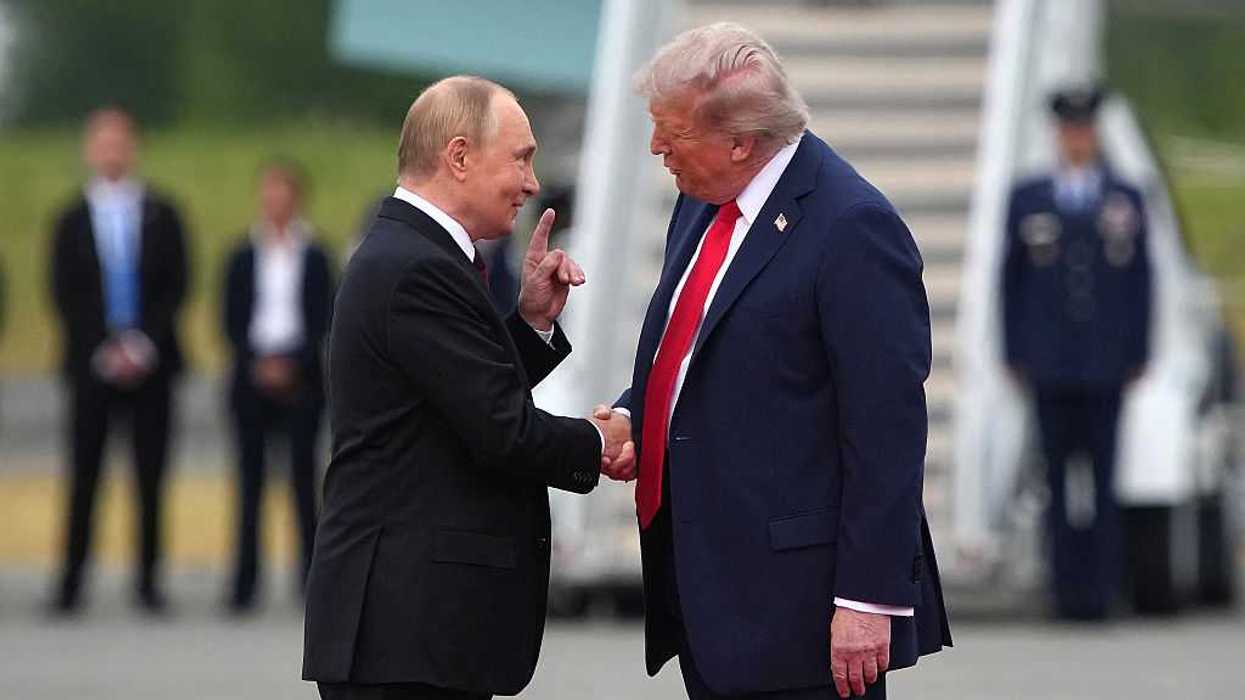
Trump doesn’t have a policy. He seems to think he and Xi are buddies. I don’t buy it. After the Busan summit, Trump came home bragging he’d rate the meeting a “12 out of 10.” Scholars watching the exchange called Trump “extremely deferential to Xi Jinping.” I’ll say. He told Xi, on camera, “You’re a great leader. I say it to everybody, you’re a great leader.” He also said Taiwan “never came up.” Then he explained he didn’t need to raise the issue because Xi Jinping’s people “know the consequences.”
Our Pacific allies have reason for concern. Days ago, Trump ordered the Pentagon to scale back joint exercises with our ally South Korea to punish them for not providing more support in the war against Iran. This is after North Korea just resumed ballistic missile testing activities in defiance of U.N. bans. Ulchi Freedom Shield, an eleven-day, 18,000-troop exercise with South Korea, was an annual tradition our country called an “ironclad commitment” to “defend their homelands.” When this is how we honor ironclad commitments, Taiwan may rightfully feel it needs to prepare for the worst without our help. Taipei just wrapped ten days of Han Kuang drills, exercises built specifically to counter China’s gray-zone tactics short of open war. These drills include anti-blockade naval maneuvers, mock internet blackouts, and civilians rehearsing air-raid shelters, and were followed with a proposed 18% jump in defense spending for 2027.
Trump should maybe be less trusting of China, which has been supplying weapons to Iran. Indeed, Reuters reported that Iran is soon expected to receive up to 400 Chinese-made shoulder-fired missile systems, worth as much as $70 million. When asked about it, Trump said he’d be “quite disappointed” if it turned out to be true, because Xi had personally told him China wouldn’t do it. When told the shipment was expected within weeks, Trump’s response was, “well, that would be surprising.” Is Trump getting duped and he’s in denial? Or does he know something we don’t and is trying to hide it? Either would be a problem.
I am not suggesting we go looking for a conflict with China, but I am saying we are currently making ourselves and our allies vulnerable, and I am not confident our leadership understands the consequences of that. If we keep softening our posture toward Beijing instead of deliberately cultivating trust and defense integration with Japan, the Philippines, and South Korea, we shouldn’t be shocked when Taipei–and Tokyo, Seoul, and Manila–stop wanting to work with us on anything at all. Certainly, if we let China take Taiwan, it will cost us. Any ally who ever bet on American credibility will think twice about doing so again. Beijing may not be looking for a war, but it probably wouldn’t mind a world that has stopped looking to the United States to prevent one.
It’s hard for allies to count on a country that forgoes decades of national security and diplomatic strategy for a foreign policy that runs on a president’s whims and fluctuates with his mood. It’s hard for American citizens to count on a government that does that, too. We deserve leaders who are competent, consistent, and concerned with our best interests–and who care enough about national security to answer a simple question about the South China Sea. We deserve a president who wants a Congress capable of meeting that challenge, and a president who can meet that challenge himself. Let’s challenge ourselves to hold our leaders to that standard–during elections and once they’re in office.
Julie Roland was a Naval Officer for ten years, deploying to both the South China Sea and the Persian Gulf as a helicopter pilot before separating in June 2025 as a Lieutenant Commander. She has a law degree from the University of San Diego, a Master of Laws from Columbia University, and is a member of the Truman National Security Project.