



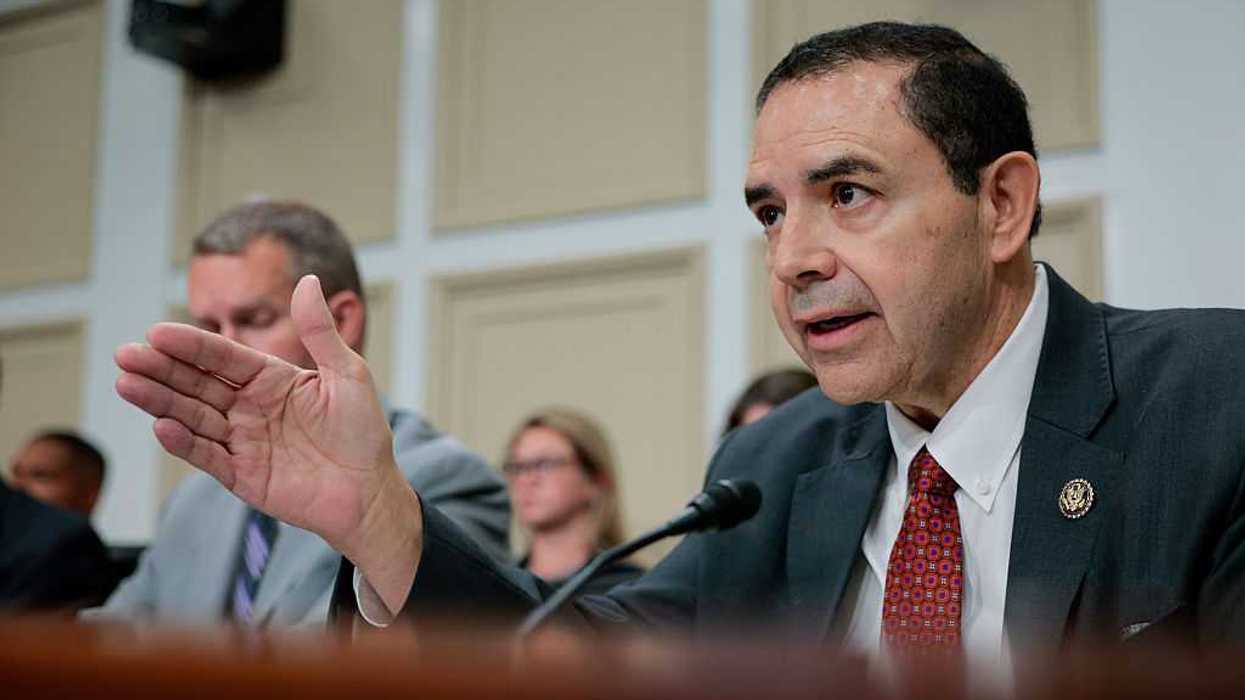
LAREDO, Texas — Rep. Henry Cuellar, D-Texas, knows President Donald Trump called on the state to redistrict to create five safe Republican seats, but Cuellar now says Texas redistricting actually strengthened his chances of reelection in November. Polling experts agree.
State legislators looked at where Trump won in 2024 to redraw the districts, especially the tight ones like Cuellar’s District 28. But Trump voters do not necessarily equate to people who will vote for Republicans for Congress.
“They based it on Trump numbers,” Cuellar told Medill News Service in his Laredo office. “In my district, they actually made it more Democratic.”
The Texas Republican-led legislature’s 2025 effort to flip Democratic House seats through gerrymandering triggered a wave of redistricting bills across the country in Republican and Democratic states.
However, the Texas GOP might have inadvertently made it harder for Republican nominee Tano Tijerina to unseat Cuellar. Tijerina was elected as a judge in Webb County as a Democrat before switching parties in 2024.
Trump was the first Republican presidential candidate in a century to win several counties throughout the district, including Cuellar’s home of Webb County. However, Cuellar won reelection in 2024 and is fighting for his 12th term. Many Trump supporters, particularly among Texas’ Latino population, no longer support him. 1 in 5 Texas Latinos now regret voting for him, according to a recent UnidosUS poll.
“A lot of these voters, they may have liked Trump in 2024, but they're not consistent Republican voters,” said Erin Covey, Cook Political Report analyst. “It's better to think of them as more independent voters who are open to being persuaded.”
In a sit-down interview with Medill News Service, Cuellar said that the Texas GOP looked at the wrong data when it redrew the map, by voting along party lines to pass a rare mid-decade redistricting bill known as HB 4 in August 2025. After months of lawsuits over alleged racial gerrymandering behind the bill, the lawsuit challenging HB 4 was stayed by the Supreme Court in December. The stay allows the map to take effect for at least the 2026 midterm election.
Texas draws new electoral maps every 10 years based on the Democratic Performance Index, or “DPI,” data. DPI is a specialized political map that measures the partisanship of voting areas based on local-level voting history and weighted election averages.
Rep. Todd Hunter (R-TX), admitted the maps were redrawn to favor the districts that swung in favor of Trump in 2024 according to the select redistricting committee report Hunter authored.
“[HB 4] seeks to revise the composition of the districts for the election of members of the U.S. House of Representatives from Texas by replacing the 2021 map with a new map to reflect the increased statewide vote for the Republican presidential nominee,” he wrote.
Several polls suggested that the Texas GOP’s reliance on Trump voters, without accounting for other features of the Texas voting bloc, made it unlikely the party would pick up five seats in the House of Representatives in November. But experts believe they will still gain some.
“I think there's a much better chance that they end up flipping maybe three seats as a result of the new map,” said Covey.
The Texas Partisan Index is a voting analysis tool published every two years after each statewide election by a local news organization called The Texan. The index looks at the Republican-to-Democratic partisan leanings of each legislative district and county in Texas, based on data obtained from the Texas Legislative Council and the Secretary of State.
The TPI initially found that following the 2024 election, Texas’ 28th Congressional District leaned 51% Democratic. The latest TPI, updated after the redistricting bill was passed, shows that the district is now 53% Democratic.
Bill King, a senior fellow at Rice University's Baker Institute for Public Policy, said Republicans are “much more unlikely” to win seats in the three redrawn South Texas districts, including the 28th Congressional District.
“In fact, they cut the margin so thin down there, and they relied on what we think are some false premises,” King said.
Cuellar elaborated on those false premises King alluded to. Cuellar said the Republican Party misunderstood South Texas’ voting history and the influences on Latino Trump supporters in 2024 would vote for other Republicans down-ballot.
“What they did is they looked at South Texas or the narrative by the Republicans that Hispanics voted for Trump and voted for Republicans,” Cuellar said. “But if you look at those numbers . . . here in Webb County, we had some Republicans running. The Democrats won. So it didn't happen in 2024. Trump won, but the people said, ‘I'm voting for this local Democrat.’”
Gov. Greg Abbott denied the redistricting was racially discriminatory but said in a Fox News interview, “Four of the five districts we’re drawing are going to be Hispanic districts; they happen to be Hispanic Republican districts.”
In Texas, 55% of Latinos voted for Trump. In the 28th District, Trump won Webb County, which is 90.6% Latino, and Zapata County, which is 93.6% Latino. An overwhelming majority of those Latinos are Mexican-American.
Cheyenne Rodriguez, a Zapata County resident who identifies as Hispanic and voted for Trump, told Medill News Service that border security was a key issue for her decision to vote for Trump. She feels that support for Trump in her area is strong but quiet.
“There's a lot of people who are hardcore-not Trump- and then they ended up voting Trump; you see it a lot,” she said. “I mean, I don't really see a whole bunch of Trump flags or people celebrating stuff like that. But it's just the general vibe, you know, like, you can relate on the subject. Ain't nobody gonna be voting for Biden. I'm sorry, but no.”
Despite Trump’s historic Latino support, King said polling since redistricting shows that many Latinos are shifting against Trump.
“The polling seems to show that they're having some real buyer's remorse on Trump and the Republicans, and it's likely to flip back this time to more traditional results that we've seen,” he said. “If that's the case, they probably don't pick up any of those seats in the [Rio Grande Valley], and might even lose another one that's vulnerable.”
According to a 2025 UnidoUS poll, 66% of Texas Latino voters now disapprove of Trump.
“The drivers of that erosion are telling: the cost of living and inflation (44%), immigration enforcement in American cities (33%), job and wage stagnation (26%), and the war in Iran (25%) top the list. Latino voters are not just disappointed; they are making the connection between this administration’s policies and the economic pain they feel every single day,” UnidosUS wrote in its analysis.
While Latino voting blocs in other states have found issues with Trump’s immigration policy for moral reasons, Bill King explained that Latinos in Texas are “complicated” and have found Trump’s immigration policies hurt their wallet.
“If you go online, you'll see a lot of business people down along the [South Texas] valley talking about the difficulty in finding workers,” he said. “The fact that, like I mean, every time somebody gets deported or self-deports or doesn't come here, that's one less customer for a restaurant. It's one less tenant for an apartment owner. It's having the economic effect down the valley that they're not happy about. Latinos in Texas are very much economic voters.”
The majority-Latino Maverick County used to fall squarely within the 28th District, but redistricting has split it up.
Luis Ruiz, former chairman of the Democratic Party in Maverick County, said most Latinos in Texas, “especially Tejano Latinos,” don’t support Trump’s immigration policies.
“Why? Because most of us see it not as a personal issue. But rather as a financial issue. If it hurts our pockets, we don’t like it. That is going to cause a big problem in 2026 and 2028,” he said.
Wisdom Howell and Jamie Gareh are student journalists with Medill News Service.












The President Invited Iran to Bomb My Home