
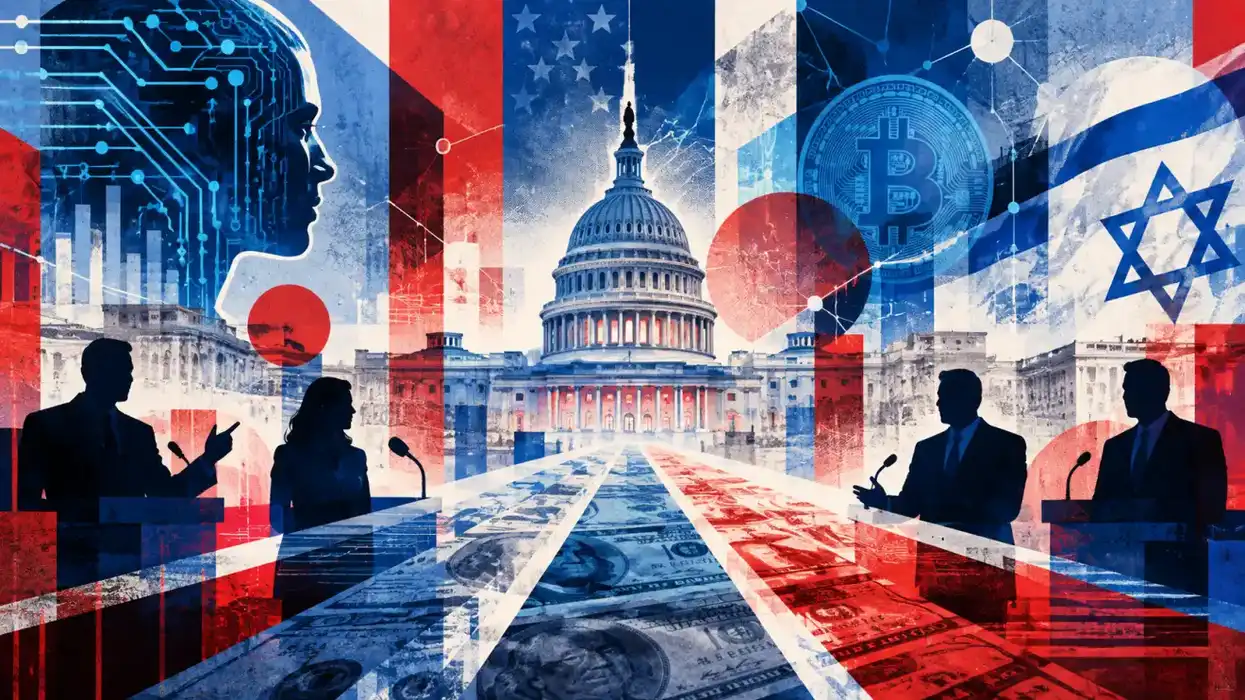
Campaign finance is where powerful interests intersect with government. The money spent does not just influence elections, it can also shape policies affecting society as a whole.
In terms of money flowing through the campaign-finance system, political action committees (PACs) direct nearly three times as much money as candidates running for reelection or office. That concentration of money gives PACs considerable potential influence over which candidates reach—and remain in—office.
The Power of the PAC Purse
In terms of spending, candidates for office paid out$2 billion, while PACs reported $6.5 billion in disbursements—3.22 times as much. On the fundraising side, super PACs and hybrid PACs raised roughly twice what congressional candidates raised. Candidates face stricter limits on how much donors can give while super PACs can raise unlimited sums to either support or oppose candidates.
In many cases, party leaders decide where the cash flows. ActBlue and WinRed are the two dominant political fundraising platforms for the two parties. While ActBlue acts independently, WinRed is tightly controlled by the GOP. Also, both parties have leadership PAC funds in the House and Senate.
Setting aside those party-related PACs, the remaining leading PACs are focused on promoting cryptocurrency, artificial intelligence, and Israel.
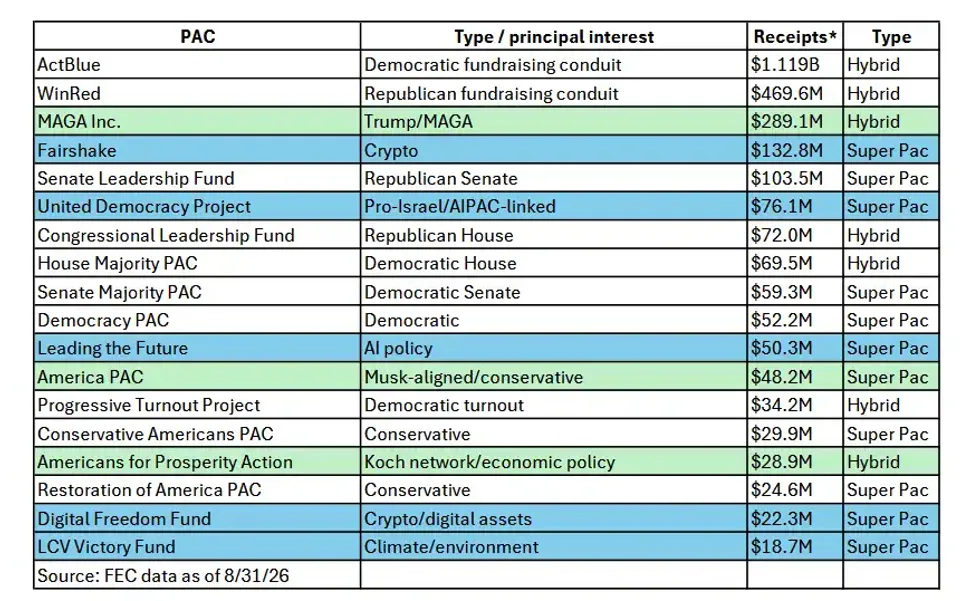 In terms of money flowing through the campaign-finance system, political action committees (PACs) are three times more active than candidates running for reelection or office. That is concentrated political power that leaves many congressional candidates running for reelection or office dependent on PAC support.
What Do Crypto, AI, and Israel Have in Common?
The one thing that advocates for cryptocurrency, AI, and the state of Israel have in common is engagement in the 2026 midterm elections. To a lesser extent, pro-climate and environmental concerns are also active, with $18.7 million held by LCV Victory Fund, a super PAC.
Crypto Cash
Fairshake is a pro-crypto super PAC with more than $108 million in cash on hand as of August. Its top contributors include Digital Currency Group, Ben Horowitz, Marc Andreessen, Ripple Labs, Coinbase and Universal Navigation.
Fairshake announced Monday that it would support 32 House candidates—19 Republicans and 13 Democrats—according to the Associated Press. The PAC is giving $1 million to each of the following Democratic candidates: Reps. Janelle Bynum of Oregon, Steven Horsford of Nevada and Derek Tran of California. It is sending the same amounts to Republican Reps. French Hill of Arkansas, Bryan Steil of Wisconsin, and Bill Huizenga of Michigan.
"Fairshake has always been and always will be an issue-focused organization. We back pro-crypto candidates who support American innovation in both parties,” said Geoff Vetter, a spokesman for the PAC.
But in Ohio, where the Senate race is one of the seven most contested, Fairshake is going all-in for the Republican. It is spending nearly $30 million in an effort to defeat Democratic Senate candidate Sherrod Brown’s bid against Republican incumbent Sen. Jon Husted. The same industry helped Republican Bernie Moreno, a former tech executive, win Ohio’s Senate seat in 2024 over Brown. As senator, Moreno has sponsored legislation, S. 1492, promoting the development of blockchain technology.
The Fairshake PAC transfers some of its funds to other super PACs, such as Defend American Jobs and Protect Progress, backing the crypto industry. Much of its spending goes to research, media and social media monitoring, legal fees, and strategy consulting.
The industry is pushing for legislation to establish a federal regulatory framework for digital assets. To date, a House-passed bill called the CLARITY Act is unable to clear a procedural hurdle in the Senate.
AIPAC’s United Democracy Project
Next to crypto spending, the pro-Israel United Democracy Project is the lead issue-oriented PAC in the 2026 elections. So far, it’s been hit-or-miss for the super PAC.
UDP is flush with $76 million in cash. This year, it supported Rep. Wesley Bell, in a Democratic primary rematch against Cori Bush. It poured $5.7 million into the Maryland Democratic primary campaign of Adrian Boafa, helping him win to fill the seat of retiring Rep. Steny Hoyer, a longtime Democratic supporter of AIPAC and the Israeli state.
It spent nearly $5 million in support of Chicago City Treasurer Melissa Conyears-Ervin, ultimately losing the Democratic primary to Rep. Danny Davis.
It took part in record spending in Kentucky’s 4th District primary to defeat Rep. Thomas Massie, a Republican who rejects foreign lobbying and fought to get the Justice Department’s records on Jeffrey Epstein released. On that election, UDP put $374,000 into Ed Gallrein’s campaign and poured another $3.6 million in negative ads against Massie.
The super PAC had less success in the Michigan Senate primary, where it spent over $30 million backing Rep. Haley Stevens over Abdul El-Sayed. Stevens’ campaign took in some $60 million in PAC funding. But El-Sayed, an epidemiologist, ultimately won in a close race. In an interview with Face the Nation, Stevens was unapologetic about her funding but said the system needs to change “to end dark money.”
AI Emerges as Big Player
Some of the most consequential political issues have to do with the supercharged AI industry. The industry’s prospective buildout could affect everything from consumer energy and water bills to data-center construction and the technological competition with China.
Follow PoliticsProponents argue that productivity through AI is the answer to the national debt, while skeptics argue that unregulated growth endangers jobs, clean water, and even humanity itself.
So, it is no surprise that AI advocates are pouring millions of dollars into the election. Interest in AI among lobbyists in Washington D.C. has skyrocketed over the past few years. OpenSecrets counted the number of times lobbyists included AI in their filing reports. The figure jumped from 702 times in 2022 to 3,530 in 2025. Furthermore, those lobbyists represented 774 organizations, including many in the defense industry, with interest in AI.
In terms of campaign spending, some AI creators and investors are donating directly to candidates. Others are influencing the election through PACs, subsidiary PACs, and through LLC vendors.
Check Voting InfoThe largest AI-themed super PAC is called Leading the Future. Notably, it is redistributing much of its money to other PACs opposing AI regulations, such as Think Big and American Mission. Top donors include OpenAI President Greg Brockman and his wife Anna Brockman, Palantir cofounder Joe Lonsdale, A16Z Capital Management LLC, and Marc Andreessen and Ben Horowitz, co-founders of venture capital firm Andreessen Horowitz.
The billions flowing through PACs do not necessarily determine how Americans will vote. But following the money shows which industries and interest groups believe the stakes are high enough to spend heavily trying to shape the next Congress. In 2026, cryptocurrency, artificial intelligence and U.S. policy toward Israel are among the clearest examples.
Crypto, AI, and Israel All Spending Big to Influence U.S. Elections was first published by Global Economic Report and is republished with permission.
Patti Mohr is a writer and editor-at-large.