




Congressional collaboration on Capitol Hill has become a lost art.
At Bridge Grades, we compile non-partisan 3rd party data to rank members of Congress on how collaboratively (or divisively) they govern. Our thesis is that a more collaborative and bipartisan Congress benefits Americans through a healthier Legislative Branch, stronger checks-and-balances, and more win-win legislation in our common interests.
With 46 states having completed their primaries and the mid-term match-ups taking shape, we are finally able to see how current legislative “bridgers” (grades As and Bs) and “dividers” (grades Cs and Fs) are faring as we march toward November’s general election.
First, let’s look at those voluntarily leaving Congress.
Net losses amongst those departing the Senate
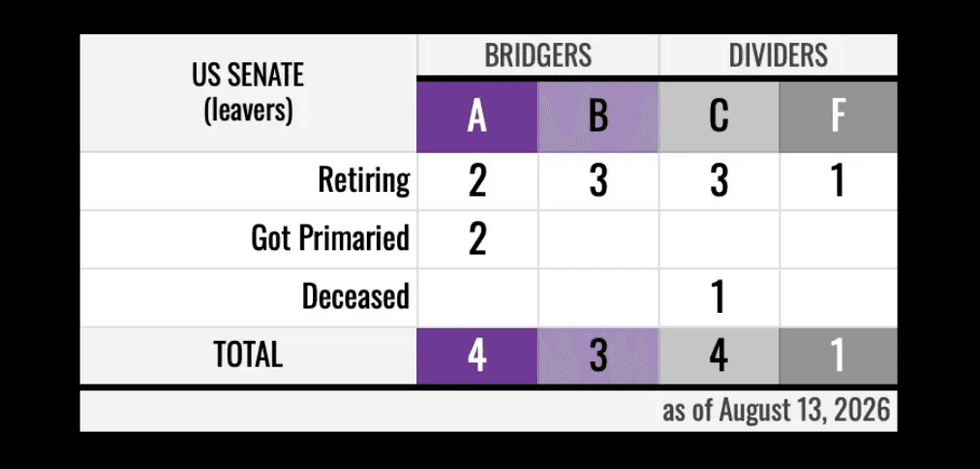
In the Senate, 12 seats are set to turn over (so far) with nine members retiring, two having been primaried, and one recently deceased. Of these 12, we will lose seven bridgers, including four A-graders Sen. John Cornyn [TX|85.6] and Sen. Bill Cassidy [LA|93.9] who were primaried and Sen. Jeanne Shaheen [NH|98.1] and Sen. Gary Peters [MI|95.7] who are retiring. With three more B-graders also retiring, there will be a net loss in collaboration against just five dividers departing (4 Cs and 1 F). Not great.
Net gains amongst those departing the House
The picture improves in the House with a net gain in collaboration coming from a higher share of dividers leaving the House than their bridging counterparts.
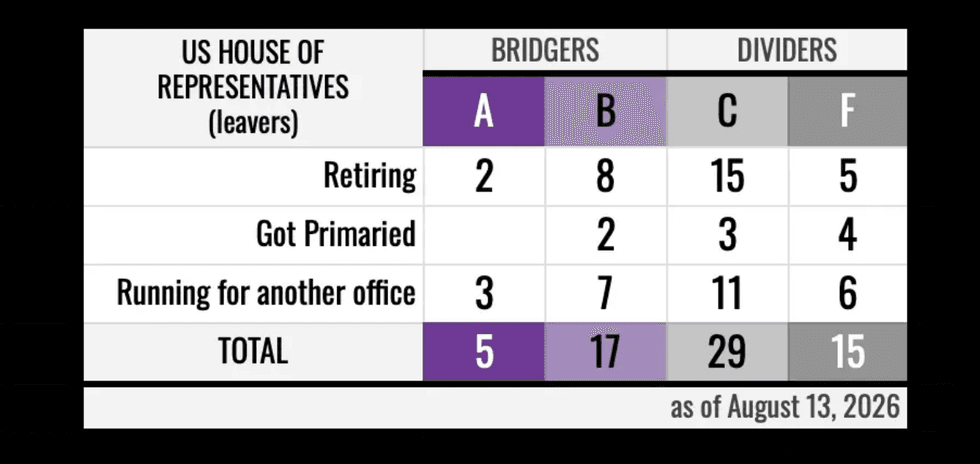
As of August 132, 66 lawmakers (so far) are guaranteed not to return to the House for the coming 120th Congress due to retirement, lost primaries, or seeking other offices.
Of these, 44 currently earn Cs and Fs with dividers representing 66% of the departers so far. Remember that there is by design a 50/50 split between bridgers and dividers in each chamber, so when two-thirds of the leavers are dividers, the overall collaboration tide rises — and sets us up for a higher median benchmark for the 120th Congress ahead. Good riddance.
Two-thirds of House leavers earn Cs and Fs for divisive governance.
It would be remiss not to recognize the five A-graded leavers including Rep. Don Bacon [NE|86.3] and Rep. Vern Buchanan [FL-16|96.9] who are retiring, Rep. Buddy Carter [GA-01|86.0] and Rep. Randy Feenstra [IA-04|93.8] who lost primary bids for Senate and Governor respectively, and Rep. Chris Pappas [NH|99.2] who is running Sen. Shaheen’s open Senate seat. Sorry to see you go.
What about the incumbents in the House who are up for re-election?
Don’t bury the lede, because the composition of the leavers is only part of the story.
The shift in composition of our lawmakers in Congress also depends on the outcome of the general elections in November — particularly in those districts which have not been drawn to be non-competitive by gerrymander-maxxing.
Cook Political’s race ratings are the industry gold standard and my go-to when it comes to election competitiveness ratings.3
In the House, of the 357 incumbents who remain in their races (some still with a primary ahead), 305 are in districts that are deemed uncompetitive by Cook Political. That leaves just 52 incumbents whose future in the 120th Congress still remains in doubt.
And, it is within this group where things look alarming.
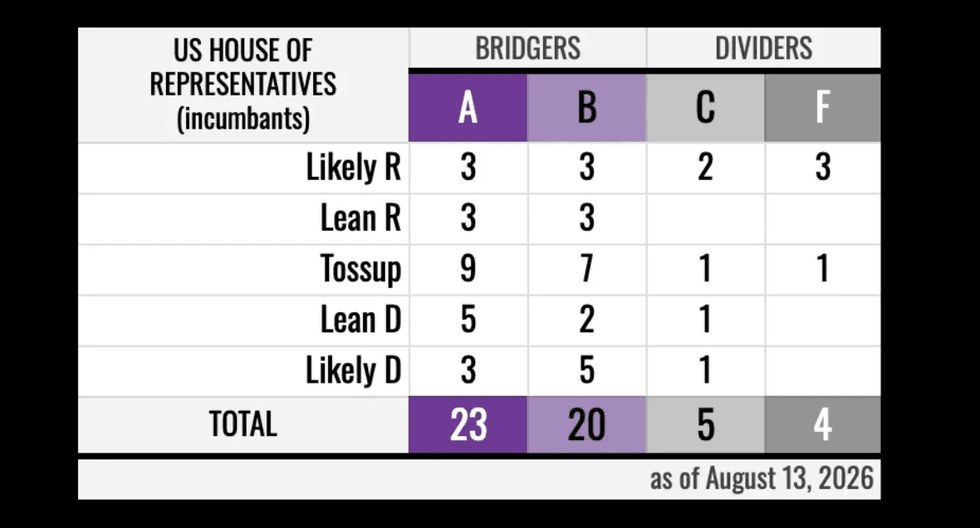
Bridge Grades of the 52 incumbents sorted by race rating from Cook Political.
The table above shows that 43 of the 52 incumbents in tight races are collaborators (grades A and B) who are at risk of losing their seats. In a moment when voters are frustrated and err toward a “throw the bums out” vibe, there is a significant risk that we lose many lawmakers who are currently governing more collaboratively than their peers.
A second reminder here, that ours is a non-profit project for voter education, and we deliberately avoid individual endorsements.
In the spirit of open data, we share a table of those incumbents below.
What about the incumbents in the Senate who are up for re-election?
To complete the picture, let’s revisit the Senate. With a dozen Senators leaving as described above, 21 are actively running in November to retain their seats for another 6-year term. This group looks somewhat balanced with 12 bridgers and 9 dividers across both parties. However, few of those races are remotely competitive. Again, we rely on Cook Political’s ratings to zoom into the five remainig competitive elections in the Senate. Four of these five (80%) see bridgers defending their seats, against just one C-grader in play.
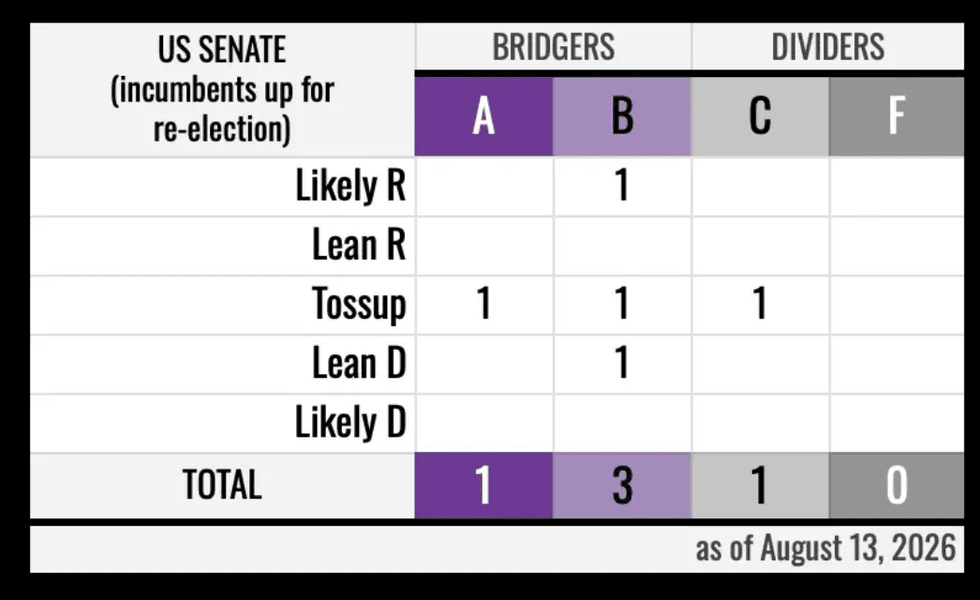
Conclusion: House bridgers are clearly under siege
In the House, the data is clear that Congressional leaders with more collaboration skills than their peers once again face harder work to retain their positions than their divisive colleagues. The Senate looks more balanced.
Sure, we should absolutely expect bridgers to be over-represented in more purple (competitive and less gerrymandered) districts. These legislators have been elected to represent an electorate who more often appreciates cross-party solutions. And they earn good grades when they do so.
But, who’s got their back?
Here’s the rub. It can be extremely lonely out there for these bridgers. First, they take heat from their own side for not being partisan enough. If they survive their primary, they get hammered from the other party, for playing for the wrong team. It’s double jeopardy. As bridgers, governing for our common interests, they sit out on a limb, highly exposed, and without cover.
These brave legislators need voters — especially those from the 45% of Americans who consider themselves independents — to have their back.
Because, with the health of the Legislative Branch at stake — and the need for a more cross-partisan Congress than ever — re-election headwinds for bridgers in November are unnerving for Americans who value cross-partisan governance for our common interests.
Bridgers in the House Face Disproportionate Headwinds in the Midterms was originally published by Bridge Grades and is republished with permission.
Brad Porteus founded and is building Bridge Grades as a non-partisan report card for Congress that aims to nudge incentives toward a more collaborative and healthier Legislative Branch for our common interests. A graduate of Duke with a masters from Stanford, Brad lives in Redwood City, California and enjoys timelapse photography, trails, and live music.













The President Invited Iran to Bomb My Home