



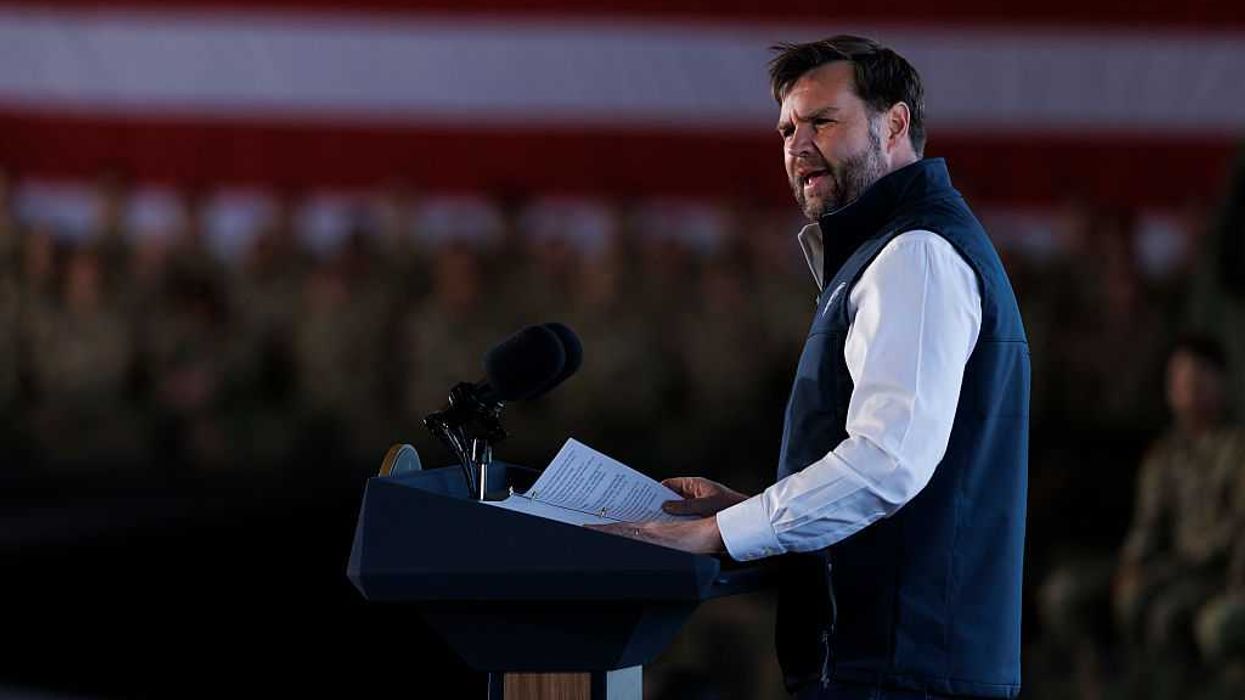

On issues including tariffs, taxes, public media like PBS and NPR, and Pete Hegseth’s confirmation as Secretary of Defense, Vice President J.D. Vance broke seven tied Senate votes this year.
Here’s a breakdown of Vance’s seven tiebreaking votes.
But first, a quick comparison
How do Vance’s seven tiebreaking votes in a year stack up to his recent predecessors?
Vance’s immediate predecessor, Kamala Harris, broke seven tied votes in 2023, 11 in 2022, and 15 in 2021 – the most ever in a single year. (However, she broke none in 2024.)
Vance’s precursor as Donald Trump’s vice president, Mike Pence, broke six tied votes in 2017 and seven in 2018. (Though none in 2019 or 2020.)
Confirming Pete Hegseth as Defense Secretary
The vote
Military veteran and Fox News television host Pete Hegseth was a controversial nominee due to allegations of spousal abuse, sexual assault, and alcohol abuse. (Hegesth admitted to infidelity but denies the claims of abuse and assault.)
Three Republican senators voted against him: Sens. Susan Collins (R-ME), Mitch McConnell (R-KY), and Lisa Murkowski (R-AK). No Senate Democrat voted in favor.
On January 24, Vance cast the tiebreaking vote.
Interestingly, this marked only the second time that a Cabinet nominee was confirmed by a tiebreaking Senate vote – with the other time also under Trump. In 2017, Pence cast the tiebreaking vote for Betsy DeVos as Secretary of Education.
What Vance said
Vance argued Hegseth would shake up a military system that had produced failed wars like Afghanistan and Iraq. For the former, the Taliban reclaimed control in 2021. For the latter, no promised weapons of mass destruction were found.
"I think Pete is a disrupter, and a lot of people don't like that disruption," Vance said in his first interview as vice president, with Margaret Brennan on CBS News’s Face the Nation. "If you think about all of those bipartisan, massive votes, we have to ask ourselves, what did they get us? They got us a country where we fought many wars over the last 40 years, but haven't won a war about as long as I've been alive."
What Republican opponents said
Murkowski cited Hegseth’s limited and troubling leadership experience.
“His leadership of two veteran organizations was marked with accusations of financial mismanagement and problems with the workplace culture he fostered,” Murkowski said in a January statement.
She also voiced concerns about his views on women in the military, particularly his hesitancy towards women serving in combat roles.
“Women have served our nation with distinction, overcoming immense obstacles to excel in combat and leadership roles,” Murkowski added. “They deserve to know that their leader honors and values their commitment to our nation.”
McConnell, meanwhile, was unimpressed by Hegseth’s answers during his confirmation hearings.
“Mr. Hegseth provided no substantial observations on how to defend Taiwan or the Philippines against a Chinese attack, or even whether he believes the United States should do so,” McConnell said in a January statement. “Absent, too, was any substantive discussion of countering our adversaries’ alignment with deeper alliance relationships.”
Upholding Trump’s national emergency on trade
The vote
On April 2, President Trump issued an executive order declaring the U.S. trade deficit a national emergency, implementing tariffs on a host of nations, including many international allies.
Sen. Ron Wyden (D-OR) introduced legislation to overturn this national emergency. Three Senate Republicans crossed party lines: Sens. Collins, Murkowski, and Rand Paul (R-KY). No Senate Democrat crossed party lines.
On April 30, Vance cast the tiebreaking vote to table the bill.
What Vance said
Vance argued that tariffs level the playing field against nations that have been undercutting American employees with low wages and working conditions.
“You hear people saying, ‘Well, how dare Donald Trump impose tariffs on foreign countries,’” Vance said at a March speech in Michigan. “And the answer is that unless you're willing to use American power to fight back against what those countries have been doing for a generation, you are never going to rebuild American manufacturing and you're never going to support the American worker.”
“When foreign countries make it impossible to ship American cars into their countries, why have we had leadership that refuses to fight back?” Vance continued. “When we have foreign countries that use slave labor that undercuts the wages of American workers, why have we had American leadership that has refused to fight back?”
What Republican opponents said
Sen. Paul countered that such important policies should be determined by an institution like Congress, rather than an individual.
Especially if that individual is someone like Trump, who’s frequently changed tariff rates on other countries for such minor reasons as he didn’t like how Brazil was treating his friend or he didn’t like a commercial Ontario (Canada) aired during the World Series.
“No country, no business, no family can plan a budget when the import tax rates and the cost of every commodity are determined by the whims of one man,” Paul said in a Senate floor speech. “There are now tariffs on steel, tariffs on aluminum, tariffs on lumber – and they change from day to day. But not one of these tariffs was voted on by the people’s elected representatives in Congress. These tariffs are simply announced by presidential proclamation.”
What happens now
Interestingly, the Senate would have voted to overturn Trump’s national emergency back in April, but two senators who likely would have voted that way were absent. Sen. McConnell was sick, while Sen. Sheldon Whitehouse (D-RI) was traveling from South Korea.
More than six months later, on Nov. 3, with Sens. McConnell and Whitehouse now present and voting in favor, the Senate actually did vote to overturn the national emergency. However, House odds of passage are low – in April, Speaker Mike Johnson didn’t even allow a vote on the measure at all.
One Big Beautiful Bill Act
The One Big Beautiful Bill Act is the biggest legislation Republicans have enacted this Congress: a combination of tax breaks, new spending on immigration and border enforcement, and deregulations, particularly in the energy sector.
Three Senate Republicans voted against: Collins, Rand Paul, and Sen. Thom Tillis (R-NC). No Senate Democrats voted in favor.
On July 1, Vance cast the tiebreaking vote for it.
Earlier that day, Vance also cast two tiebreaking votes in favor of two amendments to the bill introduced by Sen. Lindsey Graham (R-SC). The Senate votes were the exact same as for the “main” bill, with those same three Senate Republicans voting against.
What Vance said
Vance argued the legislation would supercharge the American economy and put more money in the pockets of working people.
“Here's what the One Big Beautiful Bill means for you in very concrete terms. Number one, we're going to see take-home pay go up in the United States of America. In this district, probably 7,000, $8,000 per family over the next three to four years,” Vance said at a July speech in Ohio.
“If you build or expand a great American factory, the federal government is going to reward you instead of penalize you, for a change. I think that's the biggest provision in the One Big Beautiful Bill,” Vance continued. “Invest in American workers, invest in American companies.”
What Republican opponents said
After Sen. Tillis announced he would oppose the bill, the internal Republican backlash was so severe that he announced mere days later that he wouldn’t seek reelection in 2026.
Medicaid cuts were his litmus test.
“I told the president, I really do believe it could be his Obamacare,” Tillis said in his first interview after the vote, with Jake Tapper on CNN’s The Lead.
“Because of the promise that [Obama] made, which was not true: ‘If you like your doctor, you can keep your doctor,’” Tapper clarified.
“And now it’s like: ‘If you like Medicaid and you’re eligible, you can keep it,’ Tillis answered. “That’s fundamentally untrue, because the funding mechanisms are probably going to take people who are eligible for it off of it over time. Or it’s going to create an enormous unfunded mandate on the states, in a timeframe that they can’t absorb.”
What happened next
Two days later, on July 3, the House passed the larger overall legislation by 218-214. Two House Republicans voted against: Reps. Brian Fitzpatrick (R-PA1) and Thomas Massie (R-KY4). No House Democrat voted in favor.
President Trump signed it into law on July 4, timed to Independence Day.
Rescissions Act
In March, Trump requested Congress rescind money for 22 government programs equaling $9.4 billion. These proposed cuts would primarily target international assistance like USAID and public media like the Corporation for Public Broadcasting, which funds local NPR (National Public Radio) and PBS (the Public Broadcasting Service) stations.
On July 15, two procedural votes were held on whether to advance to a roll call on the actual bill itself – essentially a “vote on whether to hold a vote.”
For both procedural votes, three Senate Republicans voted against: Sens. Collins, McConnell, and Murkowski. No Senate Democrats voted in favor.
Vance cast the tiebreaker for both.
What Trump said
The Trump-Vance administration argued that the conditions prompting the initial creation of public media 58 years ago no longer hold, in an era of mass websites, podcasts, apps, and cable television.
“Unlike in 1967, when the CPB was established, today the media landscape is filled with abundant, diverse, and innovative news options,” Trump said in a May executive order banning executive departments and agencies from funding CPB. “Government funding of news media in this environment is not only outdated and unnecessary, but corrosive to the appearance of journalistic independence.”
What Republican opponents said
Collins countered that PBS and NPR stations are a vital lifeline for local communities.
“In Maine, this funding supports everything from emergency communications in rural areas, to coverage of high school basketball championships, and a locally-produced high school quiz show,” Collins said in a Senate Appropriations Committee hearing. “Nationally-produced television programs such as Antiques Roadshow and Daniel Tiger’s Neighborhood are also enjoyed by many throughout our country.”
“I understand, however, the concern about subsidizing the national radio news programming that for years has had a discernibly partisan bent,” Collins acknowledged. “There are, however, more targeted approaches to addressing that bias at NPR than rescinding all of the funding.”
Later votes
The actual Rescissions Act itself was ultimately enacted later that week.
On July 17, the Senate passed the “actual” bill by 51-48. Two Senate Republicans voted against: Collins and Murkowski. No Democrats voted in favor. (Interestingly, McConnell voted in favor of the actual recissions, despite earlier voting against the bill’s procedural votes.)
The next day, on July 18, the House passed it by 216-213. Two House Republicans voted against: Reps. Brian Fitzpatrick (R-PA1) and Mike Turner (R-OH10). No House Democrat voted in favor.
President Trump signed it into law on July 24.
In August, the Corporation for Public Broadcasting (CPB) – which has funded U.S. public media, including PBS and NPR since 1967 – announced it would shut down in January 2026. However, PBS or NPR themselves will almost certainly continue to exist, due to a combination of listener or viewer donations, corporate or nonprofit contributions, and U.S. states' funding.Jesse Rifkin is a freelance journalist with The Fulcrum. Don’t miss his report, Congress Bill Spotlight, on The Fulcrum. Rifkin’s writings about politics and Congress have been published in the Washington Post, Politico, Roll Call, Los Angeles Times, CNN Opinion, GovTrack, and USA Today.
SUGGESTIONS:
Congress Bill Spotlight: $2.50 for America’s 250th Act
Congress Bill Spotlight: The Charlie Kirk Act












The President Invited Iran to Bomb My Home