




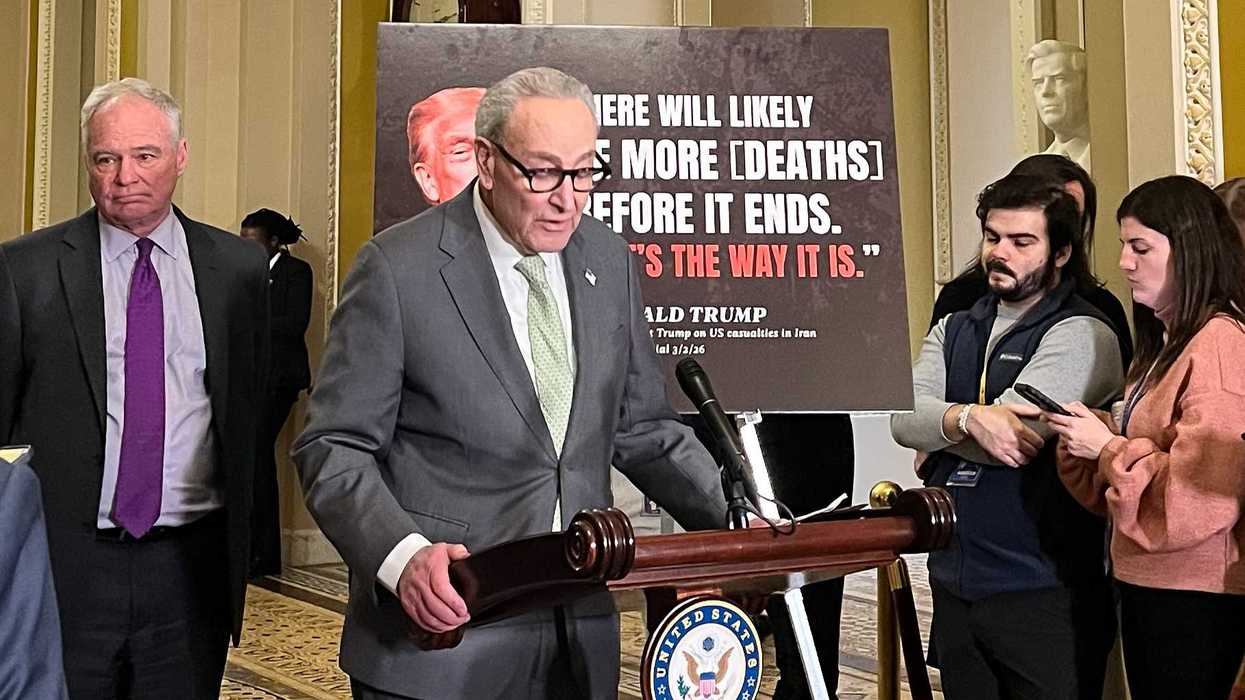

WASHINGTON — Senators seemed split along party lines over future military action in the Middle East after a classified intelligence briefing on Tuesday afternoon. Democrats called for increased clarity on the objectives and justifications for attacks, while Republicans supported the Trump administration’s current plan.
The conflicting reactions came as both the House and the Senate are scheduled to vote on a war powers resolution on Wednesday and Thursday, respectively. If passed, the resolution would limit further military actions in Iran without congressional approval.
Most Republicans criticized the measure and said that Congress should not take authority away from the president.
“We don’t need 535 commanders-in-chief,” Sen. Markwayne Mullin, R-Okla., told reporters in the Capitol on Tuesday. “The commander in chief is the president of the United States, and he has a duty in Article Two to be able to protect American interests, and he is initiating that and doing that with great authority and great effect.”
Democrats criticized the president for striking without congressional approval.
The Constitution grants Congress the sole power to declare war, but dictates that the president is the commander-in-chief of the armed forces.
“Nobody gets to hide and give the President an easy pass or an end run around the Constitution,” Sen. Tim Kaine, D-Va., said regarding the war powers resolution. “Everybody's got to declare whether they're for this war or against it.”
President Donald Trump launched strikes on Iran early Saturday morning. As of Wednesday morning, over 1000 people, including six U.S. service members, have been killed in the conflict, reported CBS News. Trump and members of his administration, including Secretary of State Marco Rubio, offered conflicting justifications for the war and different estimates of how long it might last.
Democrats expressed worry over the lack of clarity from the Trump administration.
“They have shifting goals, different goals all the time, different answers every day,” Senate Minority Leader Chuck Schumer, D-N.Y., told reporters Tuesday. “And I'm truly worried about the mission. There's no set plan being here day after day. ‘We're going to do this, this, this and this,’ and these are the reasons why you end up with an endless war.”
Schumer added that the answers given during Tuesday’s intelligence briefing were "unsatisfying."
Sen. Richard Blumenthal, D-Conn., echoed Schumer’s concerns about the unclear objectives.
“I am more fearful than ever after that briefing that we may be putting boots on the ground and that troops in the United States may be necessary to accomplish objectives that the administration seems to have,” said Blumenthal. “But I also am no more clear on what priorities are going to be of the administration going forward, whether it is destroying the nuclear capacity of the missiles or regime change or stopping terrorist activities.”
Blumenthal added that the “administration owes it” to the American people to release information about the Iran war.
Republicans came out of Tuesday’s briefing praising the administration and its objectives.
“They want to make sure that the ability for them to strike us anywhere at any time is gone,” said Mullin. “No way they'll be able to make a nuclear weapon or enrich uranium again. To take out their navy so they can't disrupt commerce in the shipping lanes, and to take out their ability to restock and rebuild their missiles and drones. That's the objective here.”
Mullin added that the U.S is “going to eliminate the threat that’s been threatening us for 47 years,” which “no other president was willing to stand up against Iran and eliminate it like President Trump.”
Others, like Sen. Lindsey Graham, R-S.C., expressed similar confidence in the U.S. military's power.
“Who’s going to win a war between the Iranian regime and the United States? We are. We’re going to win this conflict,” Graham said.
Marissa Fernandez covers politics for Medill on the Hill.














The President Invited Iran to Bomb My Home