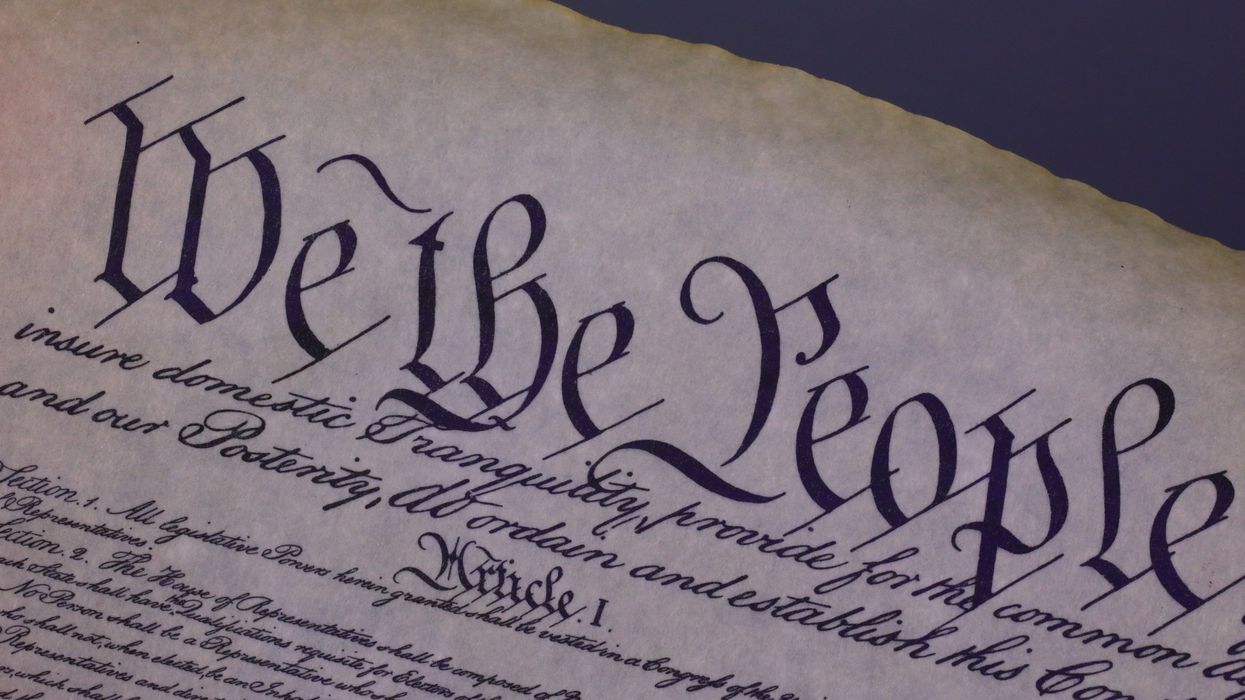
America was made for a purpose - to prosper, to live better, to be all one can be; they are one and the same thing. Our Constitution was designed to deliver that purpose. The Constitution is a business plan, a prototype invention intentionally designed to grow people.
The Constitution was a paradigm change in who governed whom, and for what ultimate purpose people would govern each other. By amending it with the Bill of Rights, it became a purposeful enterprise framework for people to prosper first, not the more powerful, self-centered, often tyrannical, and prosperity-limiting special interests.
The Constitution was designed to better accomplish Maslow’s 1943 landmark pyramid of the human ‘Hierarchy of Needs’. Being all one can be is the highest level of human need for prosperity and is inherent in all a person’s most basic needs. A person who lacks any of the basic securities of air, water, nutrition, home, and health is still striving to prosper and be all they can be.
Prosperity is the origin of commerce and finance. Abraham Lincoln nailed it, saying, ”Labor is the superior of capital, and deserves a much higher consideration.”
Today, 250 years after inventing the Constitution, the world knows for certain what our Founders were miraculously led to believe only in faith: that it is in humankind's common makeup to want to create, to help one another, and to prosper as one is best able. That is life 101, why people invest in themselves and others, create businesses, work at jobs, and relish in a common good they helped to create.
Given a choice, we would likely choose to work in businesses that benefit ourselves, our families, and our shared future on Earth over work that would reduce any of those. Prosperity is larger than just money or a financial target. Regardless of one’s station in life, prosperity means living more securely, more completely, and more (hope)fully.
The Constitution can be a life insurance policy we invest in with our votes and taxes. During the Cold War, my American quality of life and standard of living were in sharp contrast to the oppressed lives and often cruel methods under Soviet authoritarianism and European colonialism. The Constitution seemed like the greatest life insurance policy on Earth for a person TO BE ALL ONE CAN BE. Today, I know it isn’t a policy with guarantees. It should be a manufacturing system, an enterprise with a business-like purpose to build better lives.
We were wrong to think democracy and capitalism were America’s common unifying purposes. They are just processes, albeit critically important value-adding processes, in the constitutional system designed to build value-added lives.
Now there are two dozen nations with better-scoring life insurance policies than ours. They are knockoffs of our prototype Constitution, democratic representative systems, each achieving different prosperity outcomes for people. The renowned business consultant Peter Drucker famously said,” The purpose of a business is to create and keep a customer.” There are 7 billion potential customers who want what our prototype system was designed to do: enable better lives.
Building better people and lives, nurturing people TO BE ALL THEY CAN BE is the greatest business opportunity in the history of humanity! America is failing to improve or sustain the democratic system we invented for that purpose. We have run out of excuses to not reinvent ourselves yet again by taking the science of government to the next level. We, and every nation, democratic or otherwise, should commit to governing ourselves for a truly COMMON (global) UNIFYING PURPOSE - building better lives.
The Founders' concept of happiness and equality is mirrored in both ‘The Golden Rule’ and the Constitution. Both intend to achieve the same purpose: improved, more prosperous lives. The Constitution is as inspired and important as every religious version of ‘The Golden Rule’. For even greater benefit to humanity, the Constitution is an actual operational plan and social contract with laws to hold us accountable for human self-sustainment.
Perhaps both humanity and the Constitution were divinely inspired. Invented in an era lit by candlelight and lantern, the Founders could not fathom the electronic possibilities of the World Wide Web, the Hubble telescope, or a photograph of a ‘Pale Blue Dot’ (Earth) taken from an American spacecraft 3.7 billion miles from Philadelphia. Looking back at ourselves from outer space, our faith in a Creator and the possibility of a real heaven is more within reach now than ever before. Maybe mankind’s faith, hope and knowledge are beginning to come together; if what we see in that pale blue dot is actually the heaven we imagine. If Earth is not heaven, it is for certain our only home. There is no sensible reason not to treat Earth as we would treat the heaven we hope for.
During the Cold War we changed America’s motto from E Pluribus Unum (Out of many, one) to ‘In God We Trust’. We are exponentially more knowledgeable now and should hold ourselves more accountable to the supreme value of truth and trust. An improved motto would be - ‘In God We Trust, and God Trust Us’... to be all we can be.
The world is no more ready for another paradigm shift in the purpose of government than it was for the one America created 250 years ago. But the reality is this. Now the world knows what it couldn’t have then. The ‘Golden Rule’ is about building better lives and a better planet for an existential purpose. That business transcends religion, borders, race, and culture. It is not a business that will prosper with a strategy of domination and devaluation of truth and trust. America’s business, our common unifying purpose, must be a healthy competition for constant improvement and quality of the most important product to humanity - BETTER PEOPLE, LIVES, and PLANET.
Jerry Branum, Captain USN(Ret), is a graduate of the U.S. Naval Academy and the National Defense University, Industrial College. He realized in 2017 that military service was no longer the first line of defense of America and the Constitution. Voters are. He volunteers with Veterans for All Voters and other non-profits trying to make elections fair for soley people. Not as proud, but still an investor in and customer of The Constitution.