





Medicaid-funded school services are a lifeline and financial necessity for Monique McClure, a single mother of four, and her two children with learning disabilities.
Trent and Trenity, McClure’s 9-year-old twins, participate in a range of Medicaid-funded programs at their respective schools in Belleville, including speech, occupational, and developmental therapies.
Without such services provided by the Southwestern Illinois school, which could be threatened due to legislative funding cuts to the Medicaid program, McClure said her family would face a significant financial strain.
“These things aren’t cheap,” she said. “Especially with having a child on the spectrum, a lot of stuff that he’s doing in school would be hard for me to cover as a single parent, for him to do it outside of school and without Medicaid.”
The McClures aren’t alone. In fact, Medicaid is the fourth largest funding stream for schools, and it contributes over $8 billion annually to cover health services for students with disabilities and Medicaid-enrolled general education students.
But, the One Big Beautiful Bill Act, signed into law on July 4, is estimated to cut federal Medicaid spending by approximately $1 trillion over the next decade. While that doesn't directly target school Medicaid programs, the strain on state budgets could lead to a reduction in education funding, fewer covered services, and greater barriers for students maintaining Medicaid coverage, all of which could negatively impact school health services and student outcomes, according to education advocates.
“People don't realize that Medicaid really supports student success,” said Jessie Mandle, the National Program Director at Healthy Schools Campaign, a national nonprofit based in Chicago that aims to improve student wellbeing by creating healthier schools.
“If a kid is uninsured, and they don't have Medicaid, that leads to worse health but also poor academic outcomes,” she continued. “But Medicaid funding is so critical in schools to help schools support the success of all students. And I think that kind of foundational layer that Medicaid provides in schools is something that a lot of people don't realize.”
According to McClure, Medicaid-supported therapy has helped Trent — who attends Franklin Elementary, has Autism and was nonverbal from ages 2 to 7 — to build his vocabulary, find his voice, and gain independence through writing and completing daily tasks. It has also assisted Trenity at Westhaven Elementary, who had a speech delay and a stutter, to slow down, articulate clearly, and express herself confidently, McClure said.
“If Medicaid was cut, it would be hard for them to have the services to actually learn and grow, to be successful in everything that they're trying to be,” McClure said about her kids.
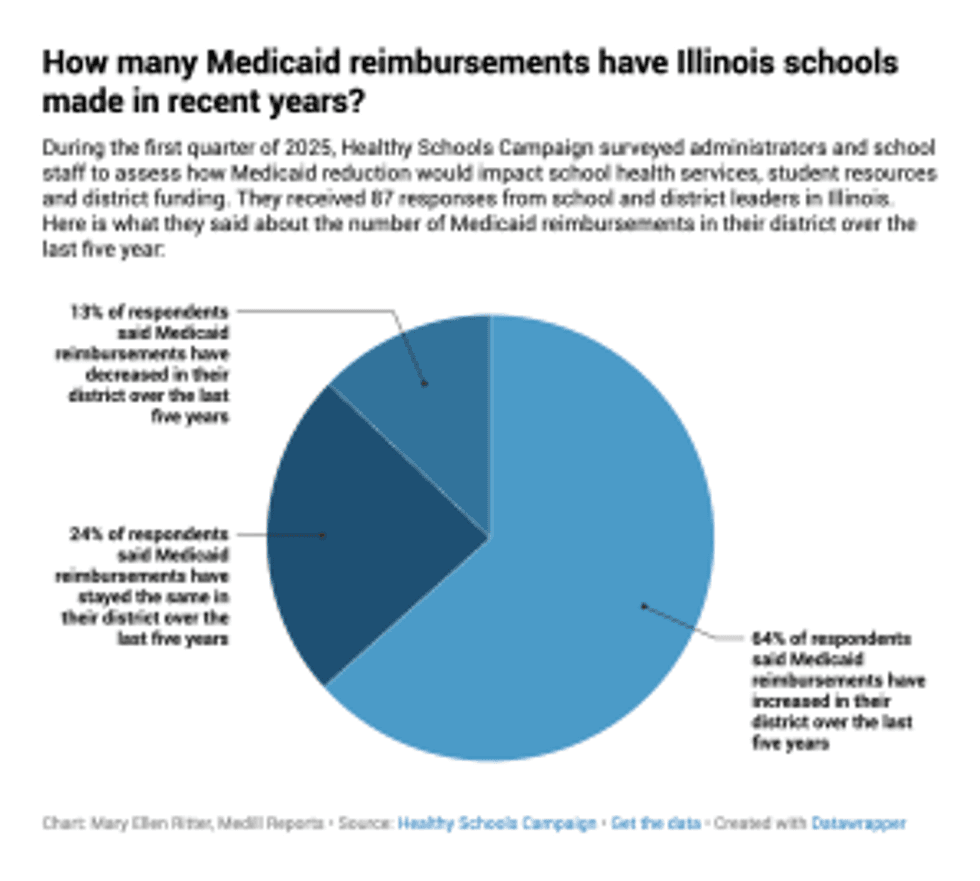
Illinois schools rely on Medicaid
A survey of school administrators and staff conducted in early 2025 showed that 64 percent of Illinois schools' Medicaid reimbursements increased in the last five years.
School leaders statewide said Medicaid reductions would force schools to pull from general education funds, hurting all students, not just those on Medicaid, according to responses to the survey conducted by HSC, which received 1,440 responses, 87 of which were from school and district leaders in Illinois.
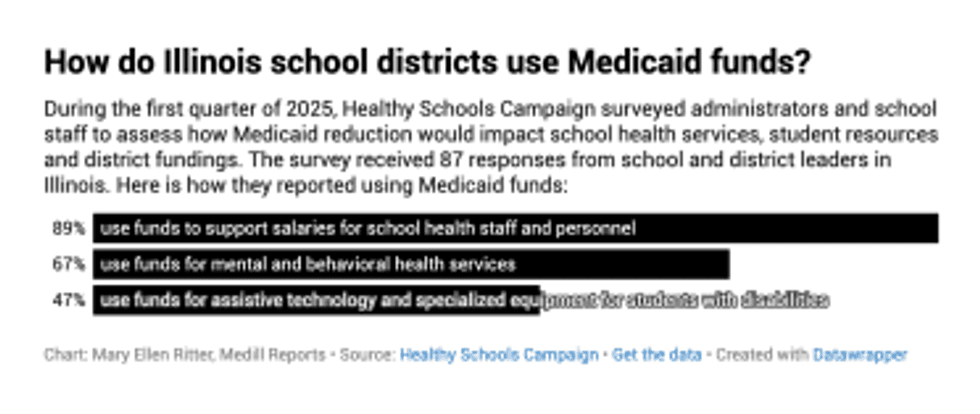
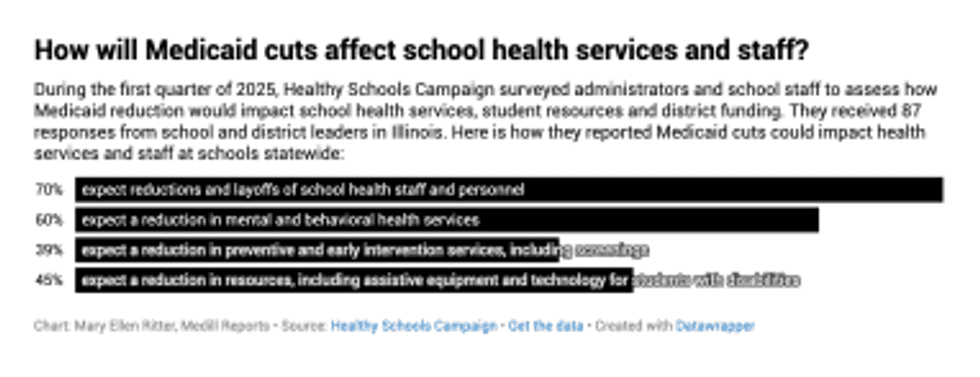
Cuts would reduce the availability of social workers, counselors, and psychologists and also limit districts' ability to provide technology that assists student learning and professional development, potentially threatening student wellbeing and academic progress, school staff and administrators said.
According to the National Alliance on Mental Health, more than one in seven U.S. students between the ages of 6 and 17 experience a mental health disorder each year. It is “irresponsible” to cut student health services during a youth “mental health crisis,” said Lena O’Rourke, founder of O’Rourke Health Policy Strategies and HSC’s school Medicaid consultant. This widely documented surge in mental health disorders among adolescents has been characterized by increasing rates of anxiety, depression and suicidal thoughts, and it is driven by numerous factors, including but not limited to the COVID-19 pandemic, social media and academic stress.
a widely documented surge in mental health disorders among adolescents, characterized by escalating rates of anxiety, depression, and suicidality. Driven by complex factors like the COVID-19 pandemic, social media, and academic stress, it has prompted national health emergencies across the globe.
“It is a short term and long term bad policy choice to do this,” she said during the February How to Protect Student Health & School Medicaid in Your State webinar.
Mandle said the survey gathered strong responses from rural districts, which would be especially impacted by potential Medicaid cuts because schools are often the primary and most accessible source of healthcare for students in those communities because long travel distances make it difficult for families to reach outside medical care. If Medicaid cuts reduce schools' ability to provide health services, rural students will have far fewer alternatives to turn to compared to their urban or suburban peers, she said.
“The cuts will be catastrophic to our students and diminish services to our most vulnerable students,” said a school business official at one rural Illinois district in response to the HSC survey.
Pulling all the levers
Since no direct cuts to school-based services have occurred yet, schools will not feel the immediate impacts of federal Medicaid cuts, but as states work to fill massive budget gaps over time, they will need to pull from other budgets, and schools will be part of that “ripple” effect, Mandle said.
“That's going to have an effect on the general fund overall, which could have an effect on education funding, which will then have an effect on school districts,” she said.
For districts that are already navigating financial difficulties – such as the state’s largest, Chicago Public Schools – this could add another stress to an already tight budget. CPS currently carries a nearly $10 billion debt and operates with a $734 million budget deficit due to declining enrollment and the end of federal COVID relief funding.
In order to mitigate impacts, Mandle said school districts should actively maximize Medicaid dollars. She suggested leveraging Medicaid to reimburse salaries for school nurses and psychologists or the services they provide.
“If they are kind of pulling all the levers they can now, they can bring more federal Medicaid dollars into their school district now to help buffer the impact of cuts in other areas,” she said.
Mary Ellen Ritter is a graduate student journalist in Medill's Chicago Investigative Lab and an education reporting fellow at Northwestern University. She previously served as a FOIA extern at The Chicago Reporter as well as an education reporter at The Daytona Beach News-Journal, where she covered about 76,000 students, nearly 10,000 employees and almost 100 K-12 schools in Florida’s Volusia and Flagler counties. Ritter has also worked for the Minnesota Star Tribune, Minnesota Daily, Los Angeles Magazine, Mpls.St.Paul Magazine, Minnesota Public Radio and Milwaukee Magazine. She grew up in Wisconsin and studied journalism and graphic design at the University of Minnesota, Twin Cities.














The President Invited Iran to Bomb My Home