




For the past year, families in need of child care assistance in Indiana have been sitting on a waitlist that has ballooned from 3,000 to 30,000 kids. It’s still climbing — and no one is coming off of it.
Emily Pike, the executive director of New Hope For Families in Bloomington, which cares for children experiencing homelessness, can’t remember a time when no families were coming off the waitlist. Before this year, she said, low-income families could expect to be on the list just a few weeks before they found placement at a center that took child care vouchers, which for most brought their costs down to zero.
But now, state officials project that no kids will come off the list until at least 2027.
That isn’t the only drastic change. In September, Indiana moved to lower its child care reimbursement rates, meaning the state will pay providers 10 to 35 percent less to care for low-income kids. Centers have had to pass those costs on to parents through higher co-payments.
Already, centers have closed classrooms as a result. Workers have been fired. Parents have pulled their children out of care.
Versions of this story have quietly been playing out across the nation, including in Arkansas, Oregon, Maryland and New Jersey. The reasons appear to be the same: States used a historic infusion of COVID-19 relief funds to improve their child care systems over the past few years, and now that the money has run dry, some can no longer keep their child care reimbursement rates up. To keep funds going to families already receiving state assistance, states have stopped accepting new children into their voucher programs and implemented waitlists.
At the same time, they’re facing cuts — or upcoming ones — in federal funding.
President Donald Trump’s tariff hikes are constricting budgets in states, like Indiana, that rely on international trade, and his Big Beautiful Bill spending package will dramatically cut funding for Medicaid and the Supplemental Nutrition Assistance Program, or SNAP. Scrambling to fill those new holes in their coffers, states have looked to child care.
“A lot of states are facing major budget pressures for various reasons and those are unlikely to get better, and very likely to get worse, as a result of the Big Beautiful Bill, said Elliot Haspel, a national child care expert. “In some ways it’s all the more alarming that states are doing this before they are feeling the full effects.”
In Arkansas, where the state proposed leveling reimbursement rates, the waitlist for child care vouchers is frozen.
Maryland has stopped offering new applicants child care vouchers because it has more children enrolled right now than it can financially support. The state would need more funding to shrink its waitlist, and legislators have said that is not likely to come because of cuts in federal funding.
In Oregon, the legislature has slashed the budget for its free preschool program by 10 percent due to poor economic projections for the corporate tax that funds the state’s program. The reason for those poor projections? Tariffs hitting a state economy that relies heavily on international trade. An estimated 640 kids will no longer get free preschool.
Helene Stebbins, the executive director of the Alliance for Early Success, a group that brings together early childhood advocacy at the state level, said some states “did not prepare for the very predictable end for the COVID dollars,” while others, like New Mexico and Connecticut, have instead invested more state money in child care after the funds ended.
“It’s a choice about how they collect and redistribute revenue and budget,” she said.
In 2021, child care got a $39 billion infusion after 16,000 child care centers and homes closed during the pandemic and more than 370,000 workers lost their jobs. It was money states used for a whole host of things, including paying providers more, raising wages and improving infrastructure. The last of those dollars expired in September 2024. Many advocates in 2023 warned that a child care cliff was coming. Years later, it’s now here.
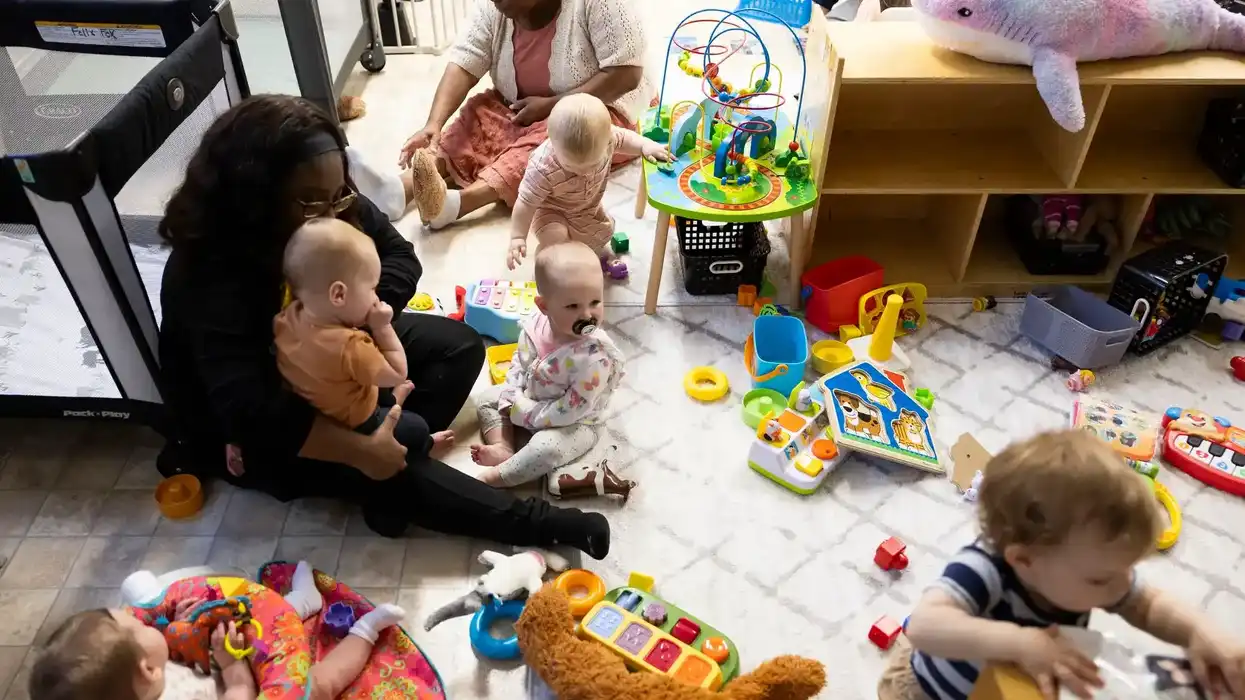
 Children and parents are suffering the impact of limited access and rising costs of childcare. (Michael Siluk/UCG/Universal Images Group/Getty Images)
In Indiana, the state said its recent changes were largely due to a projected $225 million funding gap created by “unsustainable” use of COVID relief funds by the prior governor’s administration. In 2021, the funds allowed the state to pay providers about 20 percent more to care for low-income kids and expanded the eligibility requirements, which led to more families enrolling in child care vouchers. But after the funds expired, Indiana could no longer cover those rates, even after it invested an additional $147 million in child care earlier this year.
The state declined an interview on the changes, but a spokesperson for the Office of Early Childhood and Out-of-School Learning told The 19th that Indiana is also battling lower revenue projections in part due to tariffs. Indiana is the fourth highest exporter of goods to China in the United States. Cuts to Medicaid and SNAP that will take effect in 2027 are very likely also going to affect the child care budget, a spokesperson said.
In a news release, Adam Alson, the director of Indiana’s early childhood office, said the state decided to focus its funding on the families already receiving aid. He reasoned it out like this: “There is only one pot of money — we could either protect providers or kids, and we chose kids.”
But if centers have to fire teachers, close classrooms or close entire buildings, children will also be impacted, multiple Indiana child care providers told The 19th. Most of the children on vouchers in Indiana are Black or Latinx kids from single-parent households. About 60 percent of those families are living below the poverty level and nearly all are working. If those children can’t be in care, their parents face missing out on work or losing jobs altogether.
“When policymakers decide to cut something like this, what they’re saying is, ‘Oh people will figure it out.’ I think they expect caregivers to figure it out,” Pike said. “It’s a dramatic misunderstanding of what the field does, because at the end of the day, we as a society make choices about what’s most important to us. When we choose not to fund early learning we are demonstrating real short sightedness.”
Cori Kerns, an early childhood advocate and staff consultant at Little Duckling Early Learning Schools in Indianapolis, said families there are seeing their co-pays rise from $5 to $15 a week, and even that modest increase is having a big impact. So big, in fact, that the centers had to consolidate their two buildings into one because so many parents stopped bringing their kids in after the rate hikes. The center is surviving only because the community has chipped in to cover electricity bills and rent payments.
Across Indiana, at least 36 centers have closed entirely since the start of the year, said Hanan Osman, the executive director for Indiana Association for the Education of Young Children, which is tracking closures.
Arkansas faces a similar situation: Providers were staring down as many as 400 layoffs and potential closures due to significant reimbursement rate cuts proposed by the state designed to spread the money across more kids and lower the number of children on the waitlist. The list now numbers 1,100 and has also been frozen since the start of the year.
In September, the state notified providers that it would no longer pay out higher reimbursement rates to higher-quality centers. In Arkansas, centers are rated for quality from 1 to 6 — the higher their quality rating, the more money the state puts in to cover the cost of providing that care, often because the provider is also spending more on curriculum, teacher pay and materials. The state then proposed that every provider will get a flat fee. Higher co-payments for families kicked in October 1, and the reimbursement rate change was delayed to November 1 after significant public opposition to the plan.
Last month Arkansas Secretary of Education Jacob Oliva said uncertainty around the federal government shutdown was part of it, and so was an unexpected reduction in the federal funds the state receives for child care due to a change in how state allowances are calculated. That led to a realization that the voucher program was significantly over budget, to the tune of as much as $9 million more a month, because so many more children were receiving services.
In late October, a task force of child care experts presented recommendations to the state to scale back the cuts, most of which have now been implemented. Instead of a new flat reimbursement rate, providers rated 3 to 6 in quality will still get higher rates, albeit not as high as they were previously.
It’s all been incredibly stressful for McKinley Hess, the executive director of Conway Cradle Care in Conway, Arkansas, which primarily serves teen parents. In the past, those teens had been able to bypass the waitlist because they are considered a priority population, but Arkansas removed the exception at the end of August. The center is a level 3 of 6 for quality, but under the proposed cuts she would have seen a cut of $20 less per infant per day and $16 per toddler per day. Now, the cuts will be less dramatic: $5 a day each for infants and toddlers.
Still, “it is a disaster,” Hess said bluntly. The center had been covering all costs for eight families who are sitting on the state’s waitlist for assistance and plans to continue doing so until those families come off it.
“While the new reimbursement rates are not as detrimental as the initially proposed cuts, our most pressing challenge remains the number of adolescent parents who are waitlisted and unable to receive assistance,” Hess said. “For our adolescent parents, access to child care is the bridge between continuing their education and being forced to drop out of school.”
In Mountain Home, Arkansas, Jill Wilson, the executive director of Open Arms Learning Center, was looking at a $32,000-a-month shortfall from the rate changes. Now the shortfall will be more like $3,200. Her center is accredited 5 stars out of 6, a quality level that she earned through significant investments like specialized curriculum for each class room — $4,000 each for 17 rooms.
Already, she had to cut two staff positions and combine classrooms.
“I have been here for 20 years and it’s never been like this,” Wilson said. “I feel like the rug has been pulled out from under me.”
For Pike in Indiana, the situation goes far beyond the dollars and cents of a state budget. For the families she serves, access to child care is the key to retaining a job and moving out of homelessness.
“I have seen families make devastatingly difficult decisions when they don’t have access to child care. It makes me emotional to talk about it. I have seen families choose to leave their children with someone with an active substance use problem. I’ve seen families leave little kids home with big kids. And I’m using big kids pretty loosely there — they might be 8 or 9 or 10. I have seen families lose jobs,” Pike said.
She started her center 10 years ago when she encountered a crying mom with a 4-year-old girl and an infant in the parking lot of a shelter. The little girl had been bitten by a dog at an unlicensed child care home the previous day and received 17 stitches in her neck. The mom’s boss was threatening to fire her if she missed work, and so the mother had no choice but to send her daughter back.
Pike helped the family that day and later started her center, an experience that has fueled her belief that cutting access to child care funding does not mean children no longer need care. They still have to go somewhere.
Put simply, she said: “When we take away subsidies, we are taking away low-income families’ access to safe care.”
States are quietly cutting child care funding — and families are out of options was first published on The 19th and was republished with permission.Chabeli Carrazana
Chabeli Carrazana is an economy and child care reporter.














The President Invited Iran to Bomb My Home