


I’m well aware that using the word fascist in the headline of an article about Donald Trump invites a predictably negative response from some folks. But before we argue about words (and which labels are accurate and which aren’t), let’s look at the most recent escalation that led me to use it.
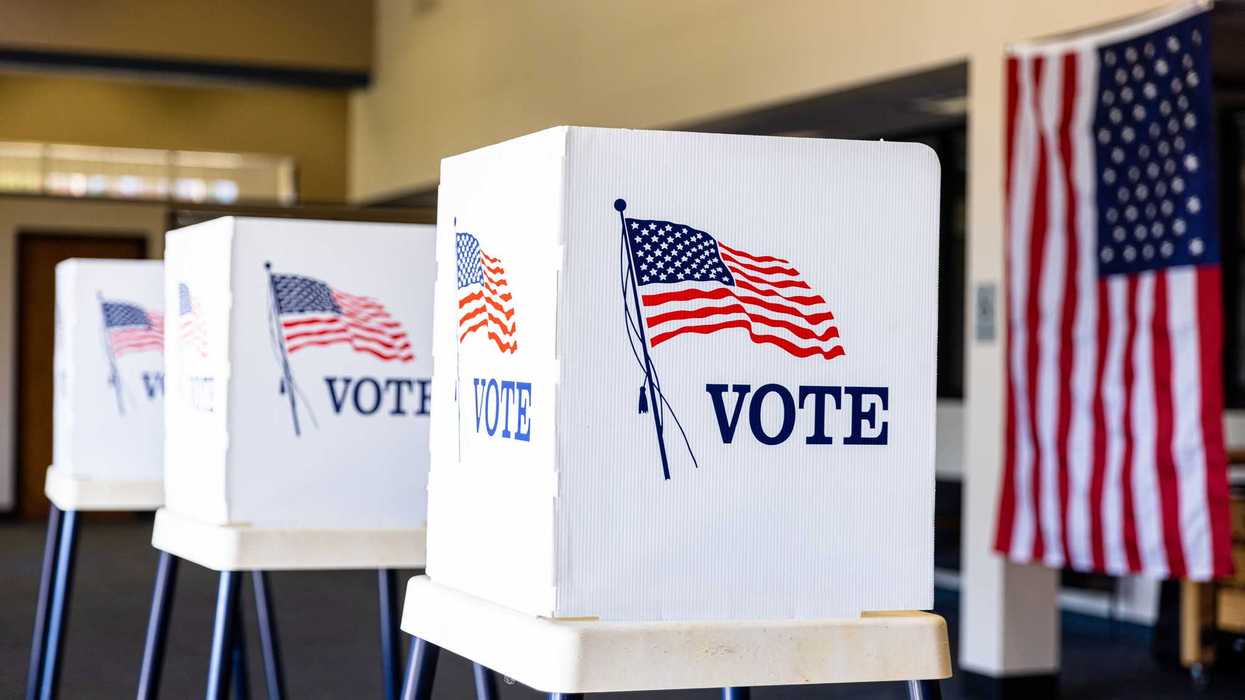
In Trump’s latest entry in his ongoing distraction-and-intimidation saga, he publicly suggested that elections should be “nationalized,” yanking control away from the states and concentrating it at the federal level. The remarks came after yet another interview in which Trump again claimed, without evidence, that certain states are “crooked” and incapable of running fair elections, a familiar complaint from the guy who only trusts ballots after they’ve gone his way.
It’s been a while since most of us took a civics class, so a quick refresher. Under the U.S. electoral system, outlined in the Constitution, states run elections for a reason. Decentralization makes it harder for any single national authority to decide who votes, how votes are counted, or which results are allowed to stand. Congress can tinker around the edges and set some rules, but election administration has historically stayed with the states. It’s a design choice meant to keep political power from pooling in one set of hands, especially when those hands belong to a mentally unstable would-be strongman who has already tried to overturn one election and operates openly on an agenda of ego, retribution, and revenge.
For decades, “small government” Republicans have defended this arrangement as a core element of federalism. States’ rights arguments have anchored conservative opposition to federal overreach, particularly in voting, education, and law enforcement. In theory, anyway. In practice, not so much, especially when it comes to civil liberties that belong to someone else. But I digress. The desperate hypocrisy from these backsliders would be comical if it weren’t so dangerous.
Like most things authoritarian movements do, this latest sideshow is rooted in fear. Rather than calling for national standards to expand access or improve election security, Trump is arguing for federal control because some states are producing outcomes that frighten him and threaten his “legacy.” Legal scholars and election law experts have noted that such a move would face serious constitutional obstacles and go against long-standing norms governing elections.
Or maybe this is just another Trumpian sleight of hand, the latest intentionally outrageous distraction designed to pull attention away from unresolved scandals, most notably the Epstein files, millions of pages of which were just released, with significant material still withheld. Who knows.
But the comments come against the backdrop of several high-profile special elections that defied Republican expectations, most recently in Tarrant County, Texas, where Democrat Taylor Rehmet, an Air Force veteran and union leader running for public office for the first time, defeated MAGA-aligned activist Leigh Wambsganss by a decisive 14-point margin in a state Senate special runoff, flipping a seat in a district that Trump carried by 17 points in 2024.
Rehmet was out-fundraised 10-to-1 by big-money donors backing his opponent, yet still won by a double-digit margin in a district Republicans had controlled for decades, after his message clearly connected with working-class voters. Trump gave Wambsganss his “complete and total endorsement,” publicly touted her as a “great candidate” and a “true MAGA Warrior,” and repeatedly urged Texans to support her in the runoff.
It’s possible Wambsganss lost on her own, but that seems unlikely. She embraced the same rhetoric that helped Trump cruise through Tarrant County just over a year ago. It’s hard to read her loss as anything other than a rejection by some Texas voters of Trump himself. His constant lies, a faltering economy, broken foreign-policy promises, and an immigration agenda that appears less focused on the border than on masked agents operating deep inside the country, ignoring constitutionally protected due process, and branding American citizens as “domestic terrorists” after federal goons shoot and kill them in the street.
Whether that rejection holds through the 2026 midterms remains to be seen. But Trump’s latest call to “take over” elections suggests that he’s afraid it will.
Trump has a long history of questioning the legitimacy of elections that don’t go his way, dating back well before 2020. That particular effort escalated into direct pressure on state officials and an attempt to overturn certified results, which in turn sparked the violent insurrection at the Capitol, resulting in deaths and widespread injuries to law enforcement. The push to centralize election control follows the same trajectory.
No formal proposal has been introduced, and Trump hasn’t offered a realistic legal pathway to concentrate electoral authority at the federal level, not that something being “illegal” has ever stopped him from trying. Even with a Republican-controlled House and Senate, such a move would face immediate constitutional challenges from states across the political spectrum and would almost certainly stall in the courts. Election administration remains a state function by design, and dismantling that structure wholesale would be politically radioactive. But of course I’m pretty much done pretending that Trump or his diehards care about political optics anymore. They seem determined to pursue their fascist agenda by any means necessary.
Alright. Let’s go ahead and talk about that word for a minute. Fascist. I personally know a few people who don’t necessarily support Trump or his policies but still bristle when some of us use that word, or draw comparisons to 1930s Germany. Fine. In some cases, that’s a debate about strategy, and I’m willing to have it. But there are moments when the comparison isn’t rhetorical overreach, and this is one of them.
Fascism, noun: an authoritarian and nationalistic right-wing system of government and social organization.
I think people make a mistake when they recoil from that word or comparison. “Fascist” isn’t defined by the worst crimes at the end of the timeline. Hitler didn’t come to power in 1933 and immediately start rounding up Jews and sending them to the gas chamber on day one. It was a gradual consolidation of power, marked by attacks on the press, the scapegoating of minorities, the portrayal of political opponents as internal enemies, the erosion of legal norms, the push to concentrate power in the executive, and repeated efforts to undermine or bypass democratic institutions, all justified as temporary, necessary measures to “save” the nation.
Trump and his movement have checked those boxes repeatedly, and he’s checking another one now with open talk of seizing control of elections themselves. We don’t need to reach the point of mass extermination to make valid historical comparisons. The past is the only scaffolding we have for interpreting the present, and history is clear about what happens when warning signs are dismissed simply because the worst outcomes haven’t arrived yet. The intent to drag this country away from a constitutional republic and toward an authoritarian state is plainly there, and even if I’m overestimating their ability to pull it off, I’d much rather overestimate an existential threat than underestimate one.
And I’m not pretending this is some uniquely original insight. People far more educated than me, including neuroscientists and senior fellows at the Brookings Institution, were reluctant to use this label for years before the evidence became impossible to ignore.¹
So, no, in short, we aren’t living in the final stages of some historical Nazi nightmare, and pretending otherwise would be dishonest. But it would be equally foolish to ignore how closely the early patterns resemble ones we’ve already seen. To paraphrase Theodor Reik, history doesn’t repeat itself, but it often rhymes.²
Most “states-rights” Republicans, and more than a few fence-sitting independents, seem content to ignore that rhyming for now. A sitting president casually floating the idea of “taking over” the voting process should not be treated as business as usual. A small handful of Republicans, including Senate majority leader John Thune, have at least acknowledged that the idea runs headlong into the Constitution. But beyond those limited objections, party leadership has largely responded with silence, deflection, or nervous hedging, unwilling to risk Trump’s approval even as the foundations of democratic governance are questioned out loud. When people in power decide that loyalty to a leader and personal ambition matter more than the Republic they’re sworn to defend, history has a way of rhyming even more clearly.
And if any of this sounds alarmist, good. There are moments when an alarm is warranted. If your house caught fire and the flames started spreading, you wouldn’t sit around debating whether the thing that looks, smells, and sounds like a fire technically qualifies as one yet. You also wouldn’t cross your fingers and hope that, even if it is a fire, it might just go out on its own. Even if your own house has never burned down before, you already know how this ends when no one intervenes. You’d rely on that history, recognize the pattern, and act before there was nothing left but ash and people standing around afterward saying, well, shit, I guess that really was a fire.¹ See Sam Harris’s recent conversation with Jonathan Rauch discussing Rauch’s Atlantic essay Yes, It’s Fascism. In the piece and accompanying discussion, Rauch explains why he finally stopped avoiding the term after systematically cataloging eighteen characteristics commonly associated with fascist movements, including the erosion of democratic norms, attacks on independent institutions and the press, leader worship, the portrayal of political opponents as internal enemies, the glorification or normalization of state violence, and efforts to consolidate executive power. Rauch argues that, taken individually, none of these traits is dispositive, but that their steady accumulation under Trump made continuing to dodge the label intellectually dishonest.
² The line commonly written as “History doesn’t repeat itself, but it often rhymes” is frequently attributed to Mark Twain, despite the absence of any evidence that he ever wrote or said it. The earliest strong match appears in a 1965 essay by psychoanalyst Theodor Reik, a Jewish intellectual and student of Freud who fled Nazi persecution. In “The Unreachables,” published in Curiosities of the Self (1965), Reik wrote: “There are recurring cycles, ups and downs, but the course of events is essentially the same, with small variations. It has been said that history repeats itself. This is perhaps not quite correct; it merely rhymes.”
Nick Allison is a college dropout, combat veteran, and writer based in Austin, Texas. He’s not a journalist or a pundit—just a political independent, unaffiliated with any party, who still believes the Constitution is worth defending. Nick’s essays and poems have appeared in HuffPost, CounterPunch, The Chaos Section, The Shore, Eunoia Review, New Verse News, and elsewhere.










The President Invited Iran to Bomb My Home