
Skip to content
Search

Latest Stories

Follow Us:
Top Stories

Pritzker uses State of the State to defend immigrants, says Chicago targeted by federal actions

News

Pritzker uses State of the State to defend immigrants, says Chicago targeted by federal actions

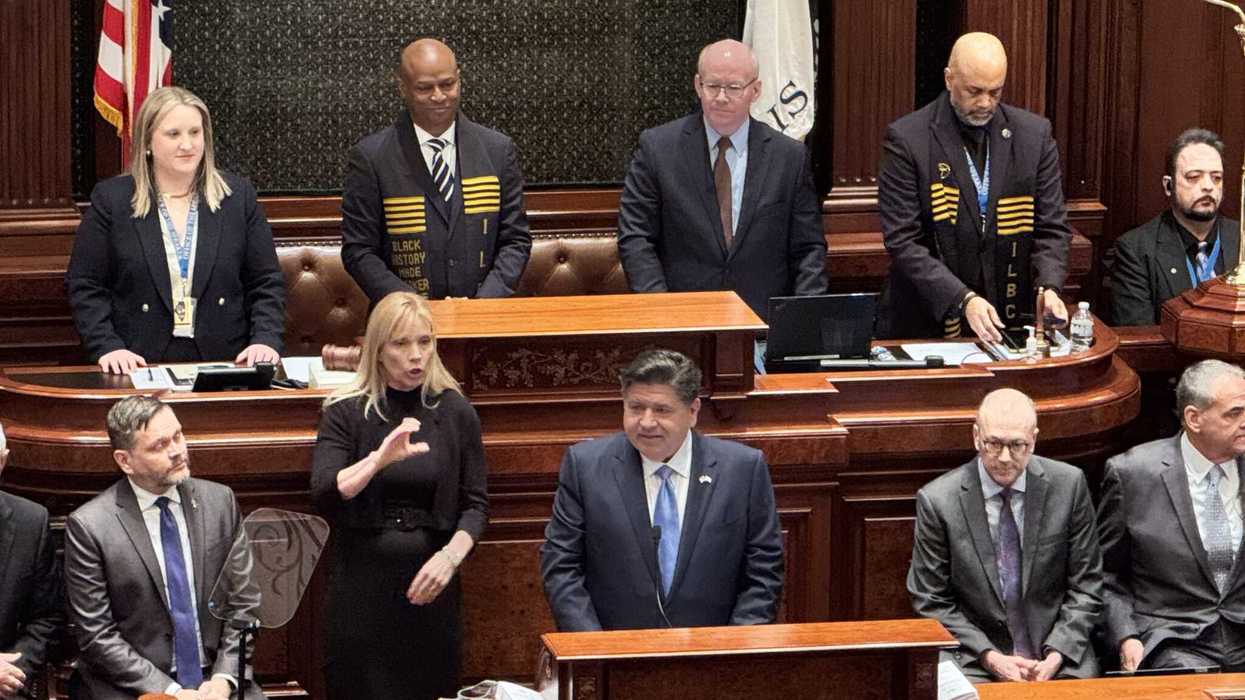
Governor JB Pritzker delivers his FY2027 state budget proposal at the Illinois State Capitol in Springfield, Ill. on Wednesday, Feb. 18th, 2026.

Angeles Ponpa, Illinois Latino News

SPRINGFIELD, Ill. — Illinois Gov. JB Pritzker used part of his State of the State address Wednesday to criticize federal immigration enforcement actions and contrast Illinois’ approach with federal policy.

The annual address largely centered on the governor’s proposed state budget and affordability agenda, but Pritzker devoted his last remarks to immigration, framing the issue as a broader test of national values.


“The problem for Donald Trump and Stephen Miller was that Illinoisans did notice,” Pritzker said. “Last year was not the first time a President has tried to subdue the Illinois population with hired thugs.”

Pritzker also referenced remarks from his address a year earlier, saying recent federal actions answered his warning about escalating enforcement tactics.

“Masked, unaccountable federal agents — with little training — occupied our streets, brutalized our people, tear gassed kids and cops, kidnapped parents in front of their children, detained and arrested and at times attempted to deport US citizens, and killed innocent Americans in the streets,” Pritzker said.

The governor’s comments echoed historic tensions between Illinois leaders and federal intervention. He gave the example of the 1894 Pullman labor strike where workers walked off their railroad jobs to protest a percentage cut in their wages. At the time, President Grover Cleveland sent thousands of federal marshals and troops into the state to suppress unrest, an action condemned at the time by Illinois Gov. John Peter Altgeld as federal overreach.

“Illinois was the canary in the coal mine for what we saw happen in Minnesota,” Pritzker said. “It’s a playbook as old as the game – overwhelm communities, provoke fear, suggest that those tasked with enforcing the law are also above it, and drip authoritarianism bit by bit into our veins in the hopes that we won’t notice we are being poisoned by it.”

According to Pritzker, federal policies have cost Illinois residents $8.4 billion through tariff taxes on working families and small businesses, trade wars devastating farmers, cuts to healthcare, food assistance and education, and increased bureaucracy on states such as Illinois.

Pritzker also described community responses across Illinois, pointing to residents supporting immigrant neighbors, including volunteers assisting families, parishioners protecting places of worship and residents demonstrating in public spaces.

He cited examples he said showed public reaction across the state, including bicyclists in Chicago’s Little Village neighborhood buying food from street vendors so they could safely leave, parishioners forming human chains outside churches so immigrants could worship, and parents organizing outside schools during enforcement activity.

He concluded by urging residents to view the immigration debate beyond party politics, but rather about whether Illinois will be a state of empathy.

“Love is found in every act of courage – large and small – taken to preserve the country we once knew. You will find it in homes and schools and churches and art. It is there; it has not been squashed,” Pritzker said.

“What you choose to arm yourself with in this fight – love or hate – exposes which side you are fighting on. Only the weakest of people believe that love is the weakest of weapons. And it turns out that love actually is all around – and that those who think that cruelty can destroy it, are incapable of understanding the power of a nation moved by it.”

Lawmakers will continue budget negotiations in the spring legislative session.

Pritzker uses State of the State to defend immigrants, says Chicago targeted by federal actions was first published on Illinois Latino News and republished with permission.

Angeles Ponpa is a journalist based in Illinois.


Read More

Latino Voter Landscape Shifts as Economic Pressures Reshape Support for Both Parties

Your Vote Counts postid

Latino Voter Landscape Shifts as Economic Pressures Reshape Support for Both Parties

New polling and expert analysis reveal a shifting and increasingly complex political landscape among Hispanic and Latino voters in the United States. While recent surveys show that economic pressures continue to dominate voter concerns, they also highlight a broader fragmentation of political identity that is reshaping long‑standing assumptions about Latino electoral behavior. A Pew Research Center poll indicates that President Donald Trump has lost support among Hispanic voters, with 70% disapproving of his performance, even though 42% of Latinos voted for him in 2024, a ten‑point increase from 2020. Among those who supported him, approval remains relatively high at 81%, though this marks a decline from earlier polling.

At the same time, Democrats are confronting their own challenges. Data comparing the 2024 American Electorate Voter Poll with the 2020 American Election Eve Poll show that Democratic margins dropped by 23 points among Latino men, raising concerns among party strategists about weakening support heading into the 2026 midterms. Analysts argue that despite these declines, sustained investment in Latino voter engagement remains essential, particularly as turnout efforts have historically influenced electoral outcomes.

Keep ReadingShow less
Compassion and Common Sense Must Coexist in Immigration Policy
Changing Conversations Around Immigration
Leif Christoph Gottwald on Unsplash

Compassion and Common Sense Must Coexist in Immigration Policy

I am writing this not as a Democrat or a Republican, but as an American who believes that compassion and common sense must coexist. I understand why many people feel sympathy for those who come to the United States seeking safety or opportunity. That compassion is part of who we are as a nation. But compassion alone cannot guide national policy, especially when the consequences affect every citizen, every community, and every generation that follows.

For more than two centuries, people from around the world have entered this country through a legal process—sometimes long, sometimes difficult, but always rooted in the idea that a nation has the right and responsibility to know who is entering its borders. That principle is not new, and it is not partisan. It is simply how a functioning country protects its people and maintains order.

Keep ReadingShow less
SCOTUS Tariffs Case: Representative Government vs Authoritarianism.
scotus rulings voting rights, disclosure

SCOTUS Tariffs Case: Representative Government vs Authoritarianism.

The Supreme Court Learning Resources, Inc. v. Trump (Tariffs) and consolidated related cases relate to the following issues:

(1) Whether the International Emergency Economic Powers Act (IEEPA) authorizes the tariffs imposed by President Donald Trump; and

Keep ReadingShow less
Immigration Was the Loudest Silence in Trump’s State of the Union

U.S. President Donald Trump delivers the State of the Union address during a joint session of Congress in the House Chamber at the Capitol on February 24, 2026 in Washington, DC.

Immigration Was the Loudest Silence in Trump’s State of the Union

President Donald Trump spoke for 108 minutes during the 2026 State of the Union — the longest address in American history. He covered the economy, foreign policy, manufacturing, and national pride. But for all the words, one of the most consequential issues facing the country was reduced to a single statistic and then set aside.

Immigration — one of the administration’s signature issues — was nearly invisible in the address. A Medill News Service analysis shows the president devoted less than 10% of his remarks to the topic, amounting to roughly ten minutes in total.

Keep ReadingShow less