
Skip to content
Search

Latest Stories

Follow Us:
Top Stories

For Trump, the State of the Union is delusional

Opinion

For Trump, the State of the Union is delusional

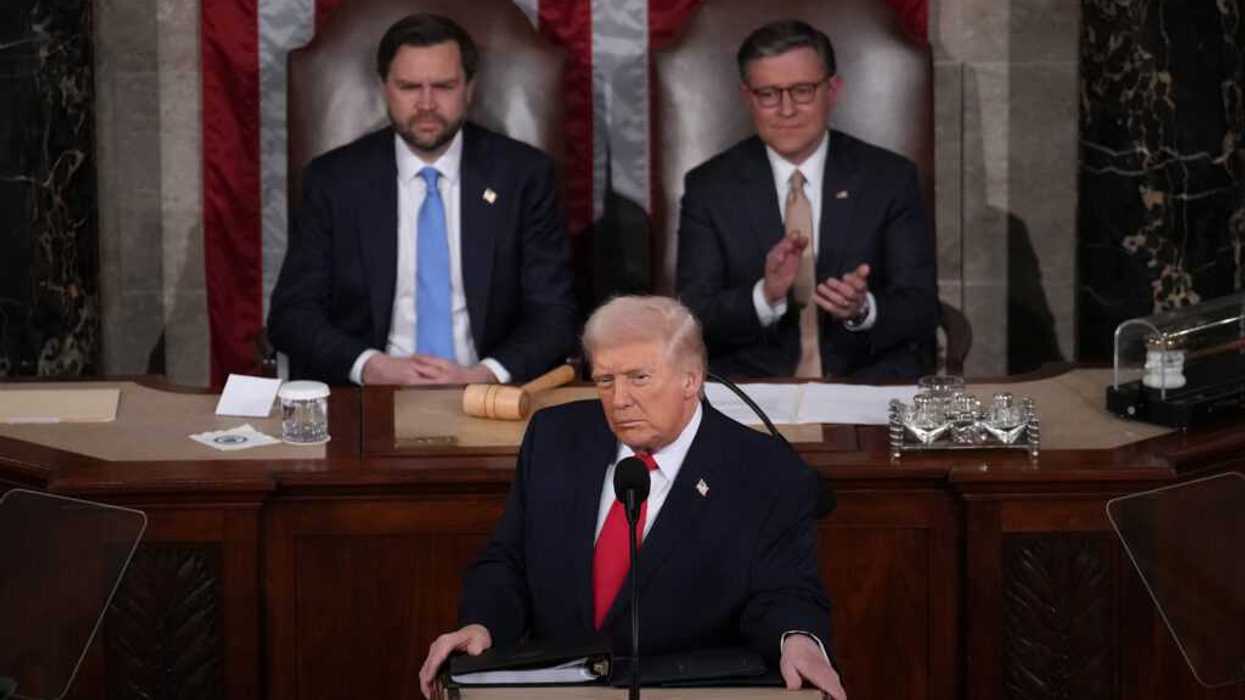
U.S. President Donald Trump, with Vice President JD Vance and Speaker of the House Mike Johnson looking on, delivers his State of the Union address during a Joint Session of Congress at the U.S. Capitol on Feb. 24, 2026, in Washington, D.C. Trump delivered his address days after the Supreme Court struck down the administration's tariff strategy and amid a U.S.


(Getty Images)

State of the Union speeches haven’t mattered in a while. Even in their heyday, they were only bringing in 60-plus million viewers, and that’s been declining substantially for decades. They rarely result in a post-speech bump for any president, and according to Gallup polling data since 1978, the average change in a president’s approval rating has been less than one percentage point in either direction.

To be sure, this is good news for President Trump. He should hope and pray this State of the Union was lightly watched.


His speech was a chaotic cacophony of lies, bigotry, gaslighting, and willful ignorance, painting the portrait of a man who has lost the country, and he knows it.

If Trump is confident about the state of the union, the health of the Republican Party, and keeping the majority come November, his unhinged and delusional address belied that confidence. Instead, his cartoonish overcompensating for a disastrous first year only drove home the point that his administration is spiraling out of control and has no plans to change course.

Sounding very much like Joe Biden and Kamala Harris — who, I’ll remind you, lost all seven swing states in 2024 — Trump bragged about a country and economy that most Americans don’t recognize.

“Our nation is back: bigger, better, richer and stronger than ever before,” he declared. “This is the golden age of America.”

Few Americans feel that way, however. Polls show Trump’s job approval is at an all-time low. Most Americans think Trump is moving the country in the wrong direction, and a plurality believes Trump is doing a worse job than Biden. Most think he’s focused on issues that aren’t very important to them, and a majority say they are very concerned about the cost of health care, food, consumer goods, and housing. Less than a third of Americans believe the economy will be better in a year.

This anxiety over the economy and health of the country could not match Trump’s bombastic gloating any less. Americans are worried and frustrated, and are in no mood for Trump’s delusional victory laps.

He didn’t fare much better on immigration, another one of Trump’s signature issues. In April of 2025, 48% of Americans approved of Trump’s handling of immigration. In the months following, which saw ICE surges in major cities, ugly confrontations with citizens, the unlawful detainment of several illegal immigrants, and the shocking deaths of two protesters, his approval has dipped to a low of 41%, with his disapproval skyrocketing to 55%.

There was no acknowledgment of this or attempt at a course-correction in his speech, though. Instead, he played to the cheapest of seats with gory tales of violence by illegal drug lords, murderers and rapists — criminals no one has an issue with removing.

Finally, on tariffs, Trump told voters the sky was green. “Everything was working well,” before the Supreme Court shot them down, he insisted, and said that “factories, jobs, investment and trillions and trillions of dollars will continue pouring into America” because of those tariffs.

But according to independent estimates, his tariffs have cost U.S. households as much as $2,600 per year and polls show a majority of Americans oppose them.

Now, if he doesn’t want to listen to voters, that’s certainly his prerogative and I imagine Democrats won’t get in his way. Republican lawmakers who are up in November, though, probably wish he’d start sounding different when he talked about the economic pain most Americans were feeling.

But they’d need a different president, one who isn’t delusional and totally unwilling to admit what most people can see and feel: the state of the union is bad, and Trump is to blame.

S.E. Cupp is the host of "S.E. Cupp Unfiltered" on CNN.


Read More

The spectacle of Operation Epic Fury
A general view of Tehran with smoke visible in the distance after explosions were reported in the city, on March 02, 2026 in Tehran, Iran.
(Photo by Contributor/Getty Images)

The spectacle of Operation Epic Fury

The U.S. and Israel’s joint military campaign against Iran, which rolled out under the name Operation Epic Fury, is a phrase that sounds more like a summer action film than a real‑world conflict in which people are dying. The operation involves massive strikes across Iran, with U.S. Central Command reporting that more than 1,700 targets have been hit in the first 72 hours. President Donald Trump described it as a “massive and ongoing operation” aimed at dismantling Iran’s military capabilities.

This framing matters. When leaders adopt language that emphasizes spectacle, they risk shifting public perception away from the gravity of war. The death of Iran’s supreme leader following the bombardment, for example, was a world‑altering event, yet it unfolded under a banner that evokes adrenaline rather than anguish.

Keep ReadingShow less
How Race and Species are Leveraged Against Each Other

Texas Rep. Al Green held a sign reading "Black People Aren't Apes," protesting a racist video Trump had previously shared on Truth Social. Green was escorted out of the House chamber just minutes into President Donald Trump's State of the Union address.

How Race and Species are Leveraged Against Each Other

This was nothing new.

Before President Donald Trump released a video on his Truth Social account earlier this month that depicted Michelle and Barack Obama as apes, many were already well aware of his compulsive use of AI-generated deepfake content to disparage the former president. Many were also well aware of his tendency to employ dehumanizing rhetoric to describe people of color.

Keep ReadingShow less
President Franklin D. Roosevelt addressing congress, December 8, 1941.

President Franklin D. Roosevelt addressing congress, December 8, 1941.

Getty Images, Fotosearch

Four Freedoms: What We Are Fighting For

The record of the Trump 2.0 administration is one of repeated usurpations and injuries to the body politic: fundamentally at odds with the principles of democracy, without legal or ethical restraint, hostile to truth, and indifferent to human suffering. Our nation desperately needs a stout and engaging response from the party out-of-power. It’s necessary but not sufficient for Democrats to criticize Trump, rehearsing what they are against. If it is to generate renewed enthusiasm among voters, the Democratic Party must offer a compelling positive message, stating clearly what it stands for.

Fortunately, Democrats don’t need to reinvent this wheel. They can reach back to a fraught moment in our history when a president brought forward a timely and nationally unifying message, framed within a coherent, memorable, and inspiring set of ideas. In his address to Congress on Jan. 6, 1941 – a full 12 months before Pearl Harbor – Franklin Delano Roosevelt termed the international spread of fascism an “unprecedented” threat to U.S. security. He also identified dangers on the home front: powerful isolationist leanings and, in certain quarters, popular support for Nazi ideology. Calling for increased military preparation and war production (along with higher taxes), he reminded citizens “what the downfall of democratic nations [abroad] might mean to our own democracy.”

Keep ReadingShow less
How Trump filled record-breaking State of the Union

President Donald Trump delivered the longest State of the Union address in American history, standing at nearly 108 minutes and more than 10,000 words.

(Cayla Labgold-Carroll/MNS)

How Trump filled record-breaking State of the Union

WASHINGTON — President Donald Trump delivered the longest State of the Union in history at almost 108 minutes Tuesday night. He began the address to Congress, which totaled more than 10,000 words, by stating that America is the “hottest country” in the world.

Trump centered his fourth official State of the Union address — the first of his second term — on economic, immigration, and international policy. He framed his accomplishments around America’s 250th birthday.

Keep ReadingShow less