





Our sisters in arms are facing a life cycle of abandonment. Female service members have a separation rate 28% higher than men, largely attributed to sexual assault, family planning, and childcare—inherently sexist issues that threaten to weaken our force. When women are more likely to be raped by a fellow soldier than killed by the enemy, with decades of unsuccessful efforts to reduce rape in the ranks, the military is lucky women volunteer to serve at all. But for those who do take the oath, the betrayal only deepens. In states with abortion bans, the uniform offers no protection against healthcare deserts created by Dobbs. Instead of expanding care, the Departments of Defense and Veterans Affairs have retreated, leaving these women with less access to care than they would have in a federal prison. Their president might be a blue falcon, but We the People are going to have their backs.
Just as the military sees more rapes than the civilian population, it also sees more unplanned pregnancies. Maternal death rates are higher in America than in other developed nations, but they are higher still in states with abortion restrictions. In fact, for women of reproductive age who live there, death rates are higher, independent of pregnancy. Following Dobbs, 40% of female service members saw increased risks to their health and careers, simply by being stationed at one of the 100 military installations housed in one of those states, while Pentagon officials admitted: “there is not much they can do [for them].”
The DOD’s efforts to defend against the damage of Dobbs have been feeble at best. Their original strategy involved sending women to other states to receive essential healthcare now unavailable locally. Though then Defense Secretary Austin asked commanders not to be discriminatory or retaliatory about reproductive healthcare decisions, women reasonably feared professional consequences, as “some leaders [viewed] the necessary time off…as an unwanted distraction.” For junior enlisted service members, a legal abortion could also cost half a month’s pay. Nevertheless, as soon as Secretary Hegseth took over, the Pentagon rescinded all these policies. Nothing has replaced them. As veteran and Governor Mikie Sherill put it, “servicewomen…shouldn’t have to risk their lives while stationed in a state with severe abortion bans like Texas or Florida. When they said, "no man left behind,” did they mean to exclude women?
Current federal law—specifically the Hyde Amendment—prevents the military from publicly funding abortion services or performing abortions even if the patient pays out-of-pocket, with limited exceptions. Elective abortion is one of the safest medical procedures available, about 14 times safer than childbirth, yet only 91 have been performed in U.S. military hospitals since 2016, while over 860,000 were performed nationally in 2017 alone. Unfortunately, there are gaps in women’s healthcare access that the military should reasonably be able—but is not allowed—to close.
The betrayal does not end at the moment of discharge either. This January, the VA effectively closed its doors on women seeking reproductive autonomy, ending nearly all abortion services and counseling for veterans—even in states that protect abortion rights. Agency officials said they were simply complying with a Department of Justice (DOJ) opinion that reversed a Biden-era policy that had expanded abortion access. Now, even most counseling for veterans regarding abortions has ended. Women are the fastest-growing segment of the veteran population. By abdicating its responsibility to the 462,000 women of reproductive age who rely on VA healthcare, the agency has abandoned its obligation to take care of veterans.
In March, Democrats narrowly lost a pivotal effort to overturn the VA’s restrictive policy. Senator Patty Murray, the first woman to ever serve on the Senate Veterans’ Affairs Committee, said after: “Republicans sent a clear message that they don’t care if your health is in danger, if you’re a veteran, or if you’ve been raped—they want abortion outlawed everywhere, in every circumstance, for everyone.” This abandonment forces our veterans to navigate “confusing and often dangerous barriers like shifting laws, inconsistent information, and growing legal risk.” For survivors of military sexual trauma, this policy could even force them to carry pregnancies resulting from the very crimes the military failed to prevent while they were in uniform. The burden shouldn’t be theirs to carry alone.
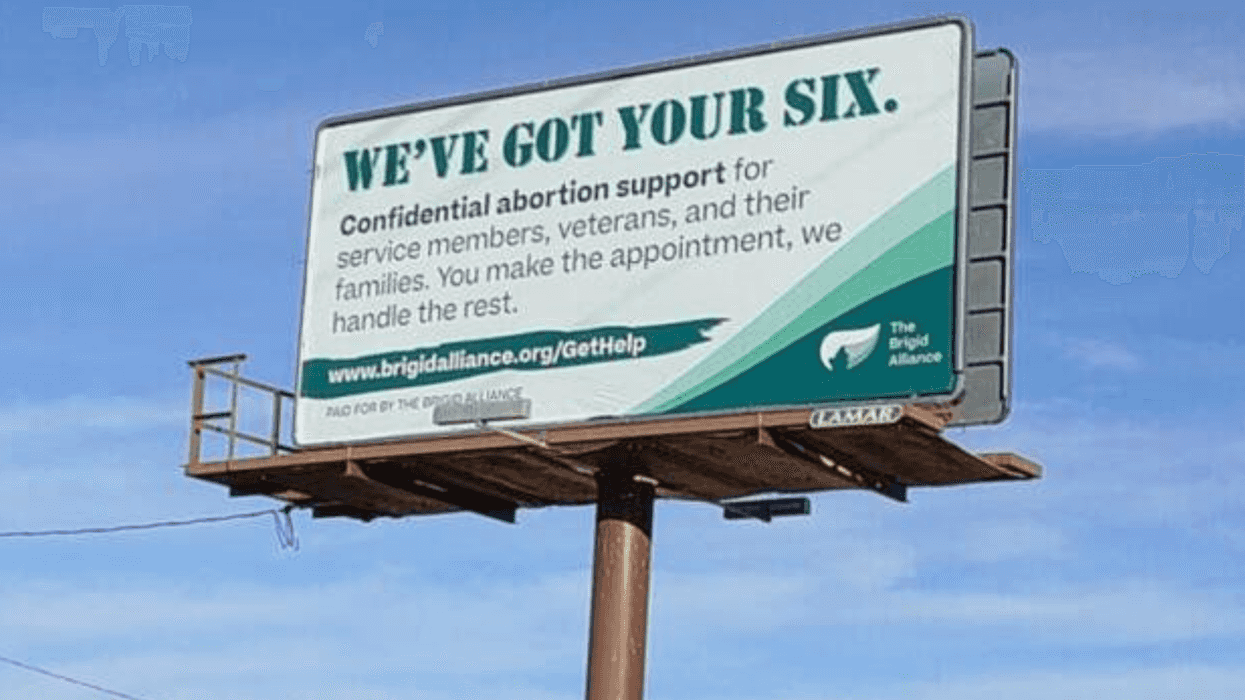
The need for intervention is urgent and growing. The Brigid Alliance, an organization that helps women get the abortion care they need, reported that 8% of their clients last year were U.S. veterans, military members, or their families; the Vet Voice Foundation (VVF) has also seen an uptick in requests. Now, the Brigid Alliance and VVF have partnered up to place high-visibility billboards outside major VA clinics in states like Georgia, New Mexico, and Virginia with resources for women seeking abortions or other reproductive healthcare. These billboards offer logistical information for travel arrangements, lodging, and funding for procedures, with a simple, powerful message: “We’ve got your six.” Together, they offer a beacon of hope for women. We must follow their example.
Moving forward, the DOD should build bases only in states where reproductive healthcare is codified, close bases in states restricting abortion access, and/or ensure women will no longer be stationed there. If this seems dramatic, expensive, or unnecessary, then it may be time to consider the obvious, sensible alternative: end the Hyde Amendment. Then military healthcare providers could actually provide necessary healthcare at any base in the country, which would be a stark and welcome contrast to its lack of progress in preventing sexual assault.
Our servicewomen may be sent to an illegal war of indefinite length with Iran. The least this government can do for those willing to put their lives on the line is to provide them with the full spectrum of healthcare. A pregnant veteran should be able to go to her local VA to get counseling and care; she should not have to navigate a confusing system and potentially risk jail time for taking a medication abortion pill. These patriots deserve support, respect, and care. Let’s get their six.
Julie Roland was a Naval Officer for ten years, deploying to both the South China Sea and the Persian Gulf as a helicopter pilot before separating in June 2025 as a Lieutenant Commander. She has a law degree from the University of San Diego, a Master of Laws from Columbia University, and is a member of the Truman National Security Project.














The President Invited Iran to Bomb My Home