


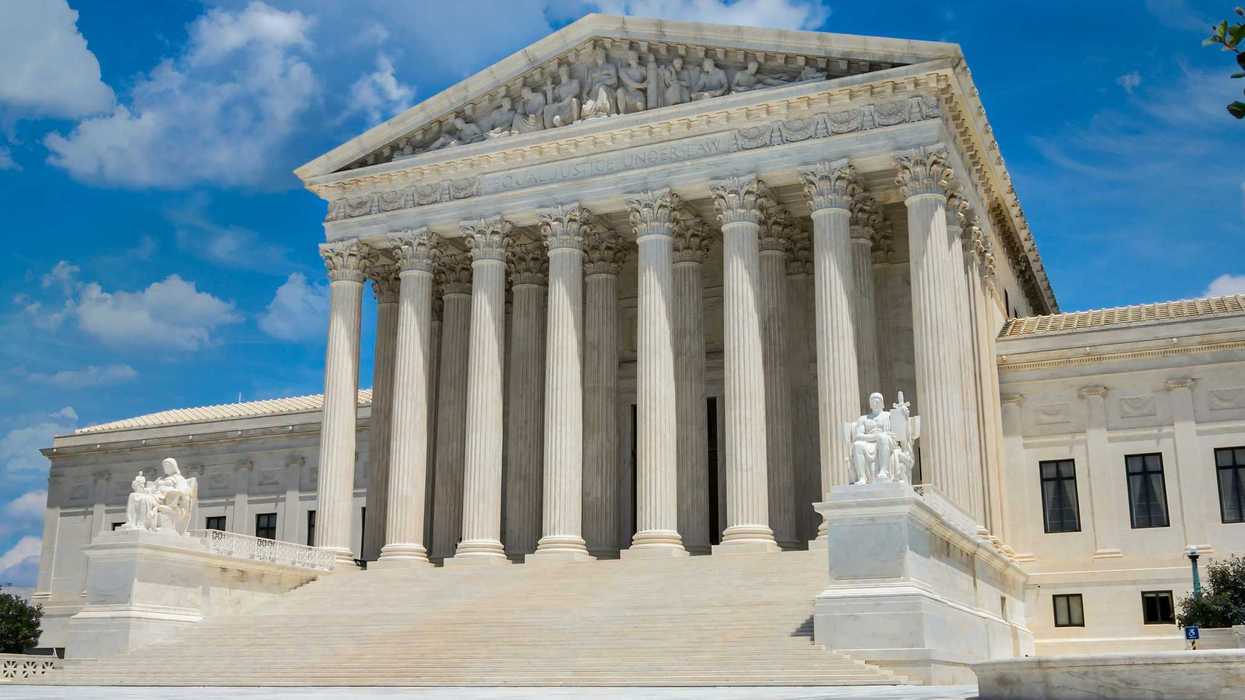

The Supreme Court recently ruled that Louisiana violated the Constitution in creating a new Black-majority voting district. This was after a Federal court had ruled that the previous map, by packing Blacks all in one district, diluted their votes, which violated the Voting Rights Act.
The question is what impact the decision in Louisiana v Callais will have on §2 of the Voting Rights Act ... and on the current gerrymander contest to gain safe seats in the House. The conservative majority said that the decision left the Act intact. The liberal minority, in a strong dissent by Justice Kagan, said that the practical impact was to "render §2 all but a dead letter," making it likely that existing Black-majority districts will not remain for long.
I agree with Justin Kagan's critique, but I believe there is a way forward.
The Court found that compliance with §2 of the Voting Rights Act does supply the compelling state interest to allow the use of race as a factor (in a positive way). But, the Court stated that:
1. The Voting Rights Act only guarantees minorities the same opportunity to elect members of their choice as others, which typically depends on where you live and the voting preferences of others in the area; there is a randomness to the process.
2. To allow a minority-majority district, the minority voters need to be in a compact area and sufficiently numerous so as to allow a reasonably configured district. Otherwise, as in the case before them, the district is not in compliance with the Act and race is clearly a discriminating factor..
Because of the facts of this case—a rambling, not compact district—the district was not in compliance with the Voting Rights Act and thus constituted an unconstitutional use of race as a discriminatory factor.
The decision on these facts makes sense. If Blacks are so scattered that a Black-majority district meeting these criteria cannot be drawn, then the Black vote is not being diluted by White legislators; Black's have diluted their vote by living apart from one another and in the midst of Whites. That's a natural result of integration. As is commonly said of court decisions: different facts, different decisions.
The decision could have and should have ended there. The troublesome parts of the decision—the necessity of finding an intent to discriminate and the analysis of partisan v racial motives—were totally unrelated to the facts before the Court. These matters would be critical in cases claiming state action to deprive Black voters of a majority district.
.The Court stated one would have to show a pattern from which the strong inference is that the state's intent was to use race as a factor, that it drew the districts to afford minority residents less opportunity "because of their race."
And in a final twist, the Court stated that if racial bloc voting could be explained by partisan affiliation—Blacks vote Democratic because they are Democrats, not because they are Black—then a map which diluted their votes would be permissible because the Court has held that partisan manipulation of districts is allowable. (Why, if these two intents—racial and partisan—are evident, the rule is to choose the less problematic one is another matter.)
Bottom line: The Court's imposition of both the need to find an intent to discriminate because of race and the need to show that diluting the Black vote was not the same as diluting the Democratic vote creates a Catch-22 that certainly could gut the Act,.
How do you get past this Catch-22? For example, if a large contiguous area of Black voters was carved up and combined with White areas, or if such an area exists but was not created a district, what would one do?
I would argue that both deprived Blacks of the "same opportunity" as others and provided evidence of the use of race as a factor. In either situation, if one makes the argument that Blacks are prevented from voting with other Blacks, although they live together in a tight, contiguous area with enough voters to have allowed a "reasonably configured" district, then they are being deprived of the same opportunity as other voters to elect representatives of their choosing.
By the Court's own reasoning, this would be a violation of the Act. The Court said that the Act does not require the creation of such a district; I would argue otherwise.
Further, one would argue that Blacks vote Democratic not because they are committed Democrats, but because they are Blacks and Democrats are the Party that fights for the interests of Blacks. Thus, it is their vote as Blacks, not as Democrats, that is seeking to be diluted. The analysis required by the Court might show that Blacks vote as a bloc for Democrats, but that does not mean that they vote as Democrats rather than as Blacks.
The Court's analysis is simplistic. For example, Blacks have a desire to elect Black representatives, not just Democrats. There is no question that the creation of Black-majority districts under the Voting Rights Act made the major expansion of Black officials, at the local, state, and federal levels, possible. And it is highly likely that Southern White Republicans have a particular desire to reduce Black Democratic elected officials, apart from their being Democrats. Thus, the Republican effort in the South to dilute the Black vote is motivated largely by racial concerns, not just partisan ones. But as I show next, this intentional discrimination requirement is invalid.
The 15th Amendment itself says nothing about motivation or intent. It simply states that people cannot be denied rights "on account of race." That is to say, if you're Black, you lose rights; the Amendment doesn't say anything about intent.
The requirement to show intent regarding voting rights was added by the Court in a 1980 case, Mobile v. Bolden. In response, Congress, in 1982, amended the Act and explicitly adopted a "results" test, rather than an "intent" test. In an earlier case, White (1973), which influenced Congress's amendment, there was no mention of discriminatory intent; rather, there was ample evidence that gave rise to an inference that the state had acted to "prevent the election of candidates preferred by minority voters."
The Court notes this action by Congress but then proceeds to ignore it. Nor does it apply "originalist" analysis to the question of the need for intent. And it does not distinguish the Court case in which the necessity of intent first appeared, Washington v Davis (1976), the facts of which were a facially nondiscriminatory hiring test.
So the key to moving beyond this decision is to argue that by breaking up a cohesive compact Black-majority district or by not creating one where the conditions exist, the state is depriving Blacks of the same opportunity to elect representatives (Black) of their choice, in violation of the Act. Plus, the effect is clearly racial discrimination, and though not required, there is cause to infer such an intent.
The decision in Louisiana v Callais should not be the final word on this matter.
Ronald L. Hirsch is a teacher, legal aid lawyer, survey researcher, nonprofit executive, consultant, composer, author, and volunteer. He is a graduate of Brown University and the University of Chicago Law School and the author of We Still Hold These Truths. Read more of his writing at www.PreservingAmericanValues.com










The President Invited Iran to Bomb My Home