
Skip to content
Search

Latest Stories

Follow Us:
Top Stories

Whenever political violence erupts, Washington starts playing the blame game

Opinion

Whenever political violence erupts, Washington starts playing the blame game

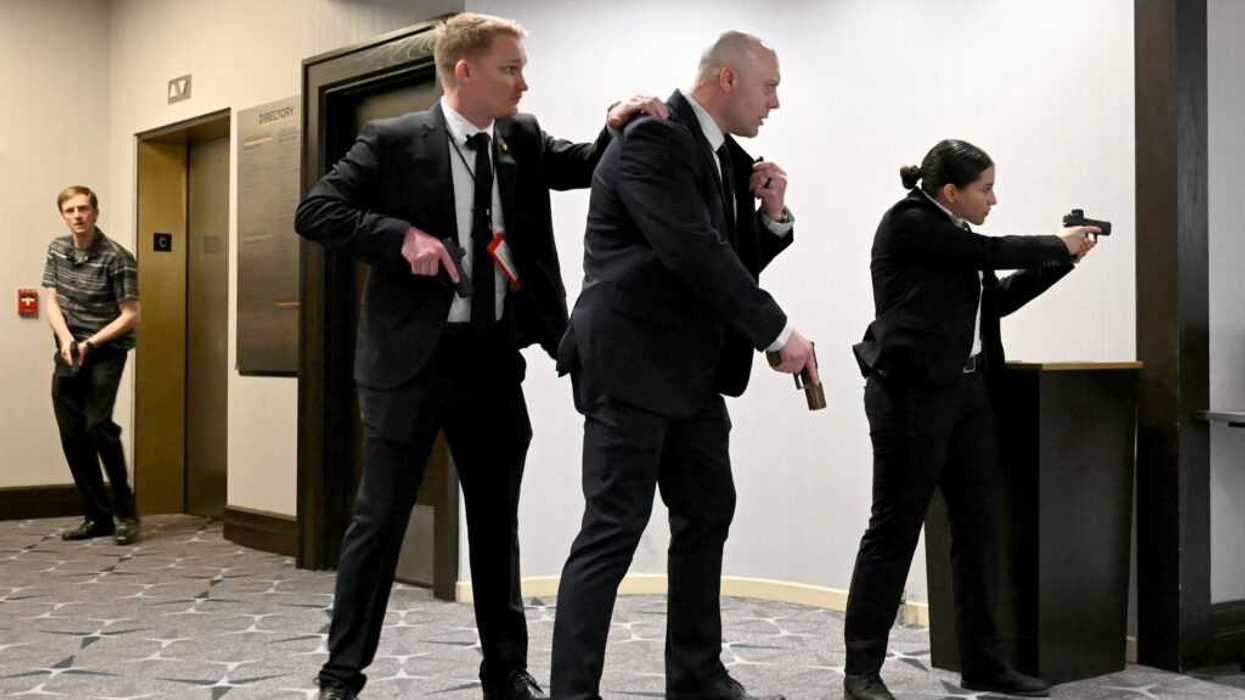
Agents draw their guns after loud bangs were heard during the White House Correspondents' dinner at the Washington Hilton in Washington, D.C., on April 25, 2026. President Trump is attending the annual gala of the political press for the first time while in office.

(Mandel Ngan/AFP/Getty Images/TNS)

A heavily armed California man was caught trying to storm the White House correspondents’ dinner Saturday with the apparent intent to kill the president.

It didn’t take long for Washington to start arguing. Democrats denounce violent rhetoric from the right, but the alleged assailant seemed to be inspired by his own rhetoric. President Trump, after initially offering some unifying remarks about defending free speech, soon started accusing the press of encouraging violence against him. Critics pounced on the hypocrisy.


The argument about hypocrisy isn’t about mere inconsistency. The point of the accusation is to say that condemnations of violence are insincere. “Your team says it’s against violence” or “your side says my side encourages violence” but just look at what your language inspired!

The hypocrisy is bipartisan.

Indeed, for two decades now, it seems that whenever political violence erupts, there’s a moment where partisans wait to learn the motives of the perpetrator so they can start blaming the other side for inciting it. Sometimes they don’t even wait. Jared Loughner, the man who shot former Democratic Rep. Gabrielle Giffords and killed several others, was instantaneously labeled an agent of the tea parties and Sarah Palin. The truth is he was such a paranoid schizophrenic, a court found him incompetent to stand trial.

I don’t have the space to run through the dozens of examples — the congressional baseball shooting, the Charleston AME church slaughter, the El Paso Walmart massacre, the recent murder of Minnesota lawmakers, the Jan. 6 riot or the failed attack Saturday night. But in the wake of these bloody crimes, partisans of left and the right will scour the killer’s social media or read their “manifestos” and place the blame on the rhetoric of the team closest to the assailant’s ideology.

Now, my point isn’t to say that blaming the rhetoric of nonviolent people for the crimes of violent people is wrong. It is wrong, of course, particularly as a matter of law. If I quote Shakespeare and write, “Let’s kill all the lawyers,” I am not responsible for someone who actually shoots a lawyer (nor is the Bard). But that doesn’t mean violent, extremist rhetoric is laudable, healthy or blameless for the sorry state of American politics or society or that it never plays a role in inspiring wrongdoing.

However such rhetoric might encourage violence, it certainly encourages the sense that something is broken in American life. More specifically, it fuels the idea that our political opponents are existential enemies.

Outgroup homogeneity” is the term social psychologists use to describe the very human tendency to think the groups you belong to are diverse and complex, but the groups you don’t belong to aren’t. A non-Asian person might think all Asians are alike, but for Asians the differences between — or among! — Chinese, Japanese, Korean and Indian people are both obvious and significant.

American politics right now are almost defined by outgroup homogeneity. Many Democrats and progressives think all Republicans and conservatives are alike, and vice versa. That would be bad enough, but the problem is compounded by the fact that each side tends to think the consensus on the other side is defined by their worst actors and spokespeople. This is sometimes called “nutpicking.” You find the most extreme person on the other side and hold them up as representative of all Democrats or Republicans.

Partisan media amplifies this dynamic at scale. Pew finds that Republicans (who watch Fox News) are more familiar with the term “critical race theory” than Democrats, the supposed devotees of it. Democrats recognize the term “Christian nationalist” more than supposedly Christian nationalist Republicans do.

Consider the recent debates over Hasan Piker and Nick Fuentes, both prominent social media influencers, one far left the other far right, who say grotesque, indefensible and stupid things. The arguments within the two coalitions are not over whether they should be spokesmen for their respective sides, but whether their “voices” (and fans) should be welcome inside the broader Democratic or Republican tents. Few accommodationists endorse the worst rhetoric from Piker or Fuentes, but they oppose “purity tests.”

On the merits, I think both should be shunned and condemned. But even if the question is purely a political one, they should still be ostracized. Why? Because people outside the respective coalitions will — however fairly or unfairly — hold up the extremists on the fringe as representative of the whole. The only way for either party to prove it opposes extremism to people outside the tent is by opposing it inside their own tents first. Otherwise, their hypocrisy will continue to define them.

Jonah Goldberg is editor-in-chief of The Dispatch and the host of The Remnant podcast. His Twitter handle is @JonahDispatch.


Read More

Fulcrum Roundtable:  ‘Chilling Effect’ on Dissent
soldiers in truck

Fulcrum Roundtable:  ‘Chilling Effect’ on Dissent

Congress and the Trump administration are locked in an escalating fight over presidential war powers as President Donald Trump continues military action against Iran without congressional authorization, prompting renewed debate over the limits of executive authority.

Julie Roland, a ten-year Navy veteran and frequent contributor to The Fulcrum, joined Executive Editor Hugo Balta on this month's edition of The Fulcrum Roundtable, where she expressed deep concerns regarding the Trump administration’s impact on military nonpartisanship and the rights of service members.

A former helicopter pilot and lieutenant commander, Roland has used her weekly column to highlight what she describes as a systemic attempt to stifle dissent within the armed forces.

Keep Reading Show less
Florida Democrat resigns, moments before the Ethics Committee was supposed to weigh her expulsion

House Ethics Committee Chair Michael Guest, R-Miss., says the committee is committed to accountability for members of Congress on both sides of the aisle.

(Photo by Samantha Freeman, MNS)

Florida Democrat resigns, moments before the Ethics Committee was supposed to weigh her expulsion

WASHINGTON – Florida Democrat Rep. Sheila Cherfilus-McCormick resigned from the House of Representatives on Tuesday, moments before the full Ethics Committee convened to weigh expulsion for allegedly stealing millions of dollars and funneling some into her congressional campaign.

Cherfilus-McCormick was not present at the hearing. “After careful reflection and prayer, I have concluded that it is in the best interest of my constituents and the institution that I step aside at this time,” her statement read.

Keep Reading Show less
People protesting in the Cannon House Office Building on Capitol Hill, holding tulips and signs that read, "We can't afford another war" and "end the war on iran.'

Veterans, military family members, and supporters occupy the Cannon House Office Building on Capitol Hill calling upon the Trump administration to end the war on Iran on April 20, 2026 in Washington, DC.

Getty Images, Leigh Vogel

Trump’s Iran “Victory” Echoes Iraq’s "Mission Accomplished"

It didn’t exactly end well the last time a president declared victory this quickly. On May 1, 2003, President George W. Bush landed on the USS Abraham Lincoln in a flight suit, strutted across the deck for the cameras, then changed into a suit and tie, stood in front of a banner that read “Mission Accomplished,” and declared the end of major combat operations in Iraq. It was 43 days after the invasion began. Over the next eight years, as the conflict devolved into a protracted insurgency and sectarian war, more than 4,300 Americans and hundreds of thousands of Iraqis died.

On April 7, Trump—presumably not wearing a flight suit—declared in a telephone interview with AFP that the United States had achieved victory in Iran. “Total and complete victory. 100 percent. No question about it.” This was the day after the President threatened to destroy a “whole civilization,” hours after a two-week ceasefire was announced. It took six days for the whole thing to fall apart. By April 15, he was back on Fox Business: “We've beaten them militarily, totally. I think it’s close to over.”

Keep Reading Show less
A Lesson on “Matters of Morality” for the Vice President

American Cardinal Robert Francis Prevost presides over his first Holy Mass as Pope Leo XIV with cardinals in the Sistine Chapel at the conclusion of the Conclave on May 09, 2025 in Vatican City, Vatican.

(Photo by Simone Risoluti - Vatican Media via Vatican Pool/Getty Images)

A Lesson on “Matters of Morality” for the Vice President

The Vice President has stepped into the fray between the President and Pope Leo. For those of you who have not been following this, Pope Leo has been critical of various things that Trump has said regarding his war with Iran, including his statement that he was ready to wipe out the civilization. In response, Trump called Pope Leo too liberal and easy on crime. He also said that the Pope was only elected because he was an American, in response to Trump having been elected President. In response, the Pope said that he had no fear of the Trump administration and that his job was to preach the gospel. He said in response to Secretary of War Hegseth's invoking the name of Jesus for support in battle, that Jesus “does not listen to the prayers of those who wage war, but rejects them.”

Into this exchange steps the Vice President, who says he thinks the Pope should stick to "matters of morality" and let the President of the United States dictate American public policy. The Vice President obviously doesn't understand the meaning of morality and its scope.

Keep Reading Show less