



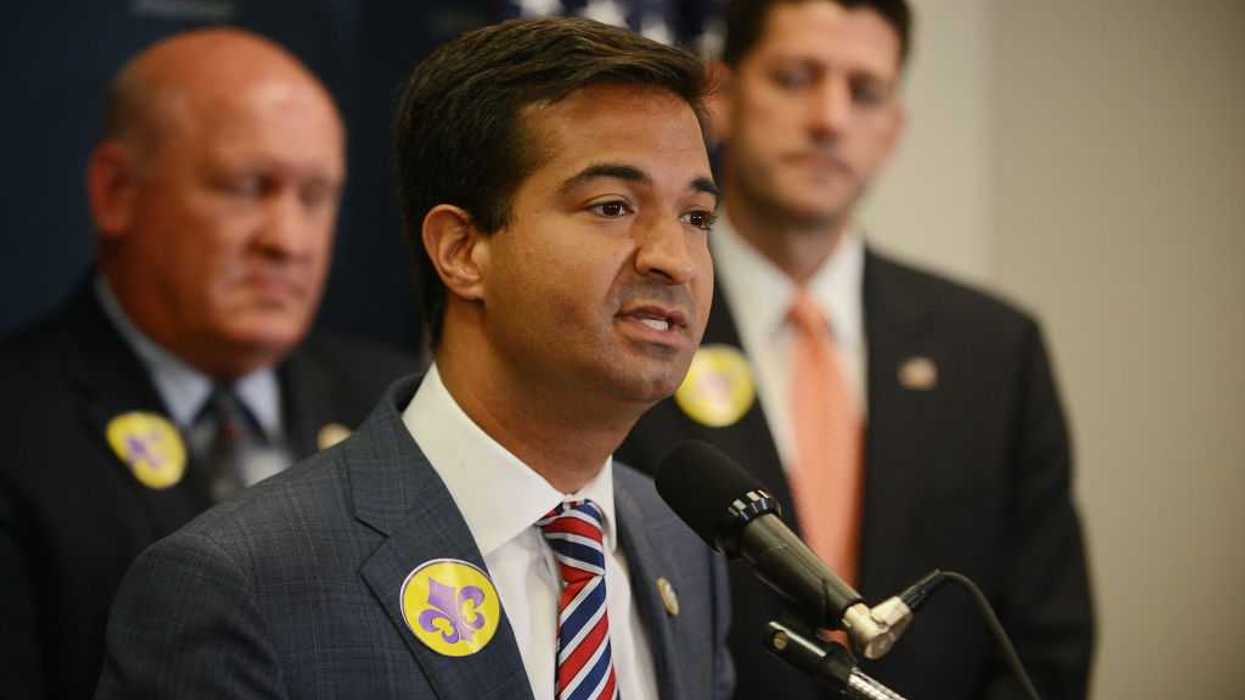
Last week’s Unity Forum conversation featured former U.S. Representative Carlos Curbelo giving a cross-partisan assessment of two issues at the heart of America’s polarized politics: gerrymandering and immigration. His message was a refreshing change from common partisan banter. It was grounded in constitutional principle and the pragmatic belief that democracies survive only when citizens feel represented and when political incentives reward problem‑solving rather than extremism.
Curbelo, a Republican who represented a swing district in South Florida from 2015 to 2019, has long been known as a bipartisan voice on issues ranging from energy to immigration. He co‑founded the House Climate Solutions Caucus, a bipartisan group working to develop practical, economically viable solutions to climate-related issues.
And in his view, the most corrosive of those distortions is gerrymandering.
The Disappearing Middle
Curbelo did not mince words. “I’m opposed to all gerrymandering efforts in any state, whether they benefit Republicans or Democrats,” he said. “All of it is bad for our country.”
He pointed out that when districts are rigged, they eliminate competition, and the political system stops rewarding consensus‑builders. It rewards the loudest voices in the safest seats. The result is a Congress increasingly formed by the extremes of both parties, while the vast middle of the electorate lacks meaningful representation.
Curbelo illustrated the consequences by comparing California and Florida. California, he noted, “is gonna have a negligible number of Republicans,” while Florida’s new map leaves Democrats with only a sliver of representation. In both cases, the minority party becomes too small to represent statewide interests efficiently when the other party controls Congress.
That imbalance, he argued, is not simply a political problem; it’s a governance problem. States need bipartisan delegations to navigate federal priorities, secure disaster relief, and advance local needs regardless of which party holds power.
But the more serious damage is the destruction of voters' belief in the system. Gerrymandering, he said, “further disenfranchises people… they feel like they don’t count, like they don’t matter.” When citizens believe the system is rigged, trust collapses. Once trust collapses, polarization hardens, turnout drops, and the angriest voices dominate the elections.
In Curbelo’s view, the long‑term consequence is unavoidable: “Eventually… this is going to open up a lane for a third way in our country.” Not because Americans are clamoring for a new ideology but because the two major parties have structurally insulated themselves from accountability.
Structural Reform, Not Wishful Thinking
Curbelo offered solutions to the present dysfunction. He argues in favor of reforms that increase competition and broaden participation—open primaries, independent redistricting commissions, and systems like those in Maine, Alaska, and Washington that reward candidates who appeal beyond their base.
Florida came close to adopting open primaries in 2020. The measure received 57–58 percent support—just shy of the 60 percent required for a constitutional amendment. “Both parties united to fight the ballot measure,” Curbelo noted, revealing that the duopoly’s strongest point of agreement is often self‑preservation.
Still, he believes the public is ahead of politicians. “Sixty‑five, seventy, seventy‑five percent of the public is being shut out,” he said. “That’s not okay.” He sees citizen‑driven ballot initiatives as the most hopeful route forward.
Whether state courts can or will intervene is less clear. Florida’s Constitution explicitly prohibits drawing districts for partisan advantage, but Curbelo was candid about the political reality: “If I had to bet… I think they’re gonna uphold the new map.” He stressed that the courts’ decision—whatever it is—does not absolve citizens of responsibility. “It’s not gonna fix itself,” he said. “People have to take action.”
A Parallel Crisis at the Border
The conversation then moved to immigration, where Curbelo again urged realism and humanity. As the son of Cuban immigrants, he embraces America’s identity as a nation of newcomers. But he insists that immigration must be “orderly… legal… predictable… and managed so that it helps advance our economic interests.”
He credited the current administration for stabilizing the southwest border—“It is no longer a disorderly situation,” he said—while criticizing its failure to address the millions of undocumented immigrants already living, working, and contributing in the United States.
These individuals, he argued, are essential to the economy: caring for children and older people, working in restaurants, cleaning buildings, and filling labor shortages across sectors. “Why are we going to throw them out of the country?” he asked. “Why not afford them the opportunity to earn legal status?”
He emphasized that this does not require a path to citizenship—though he supports one. It requires political courage and the readiness to acknowledge economic reality.
He also addressed the elephant in the room: due process. While defending constitutional protections, he warned that asylum laws have been exploited by smugglers who coach migrants to make claims that do not reflect their true circumstances. “Most of the people… have shown up at the southwest border for economic reasons,” he said. That reality requires both compassion and reform.
A Call for Citizens to Reclaim Their Democracy
Across both topics, Curbelo returned to a single theme: the health of American democracy depends on structural incentives that reward problem‑solving rather than polarization. Gerrymandering, closed primaries, and broken immigration laws push the system in the wrong direction.
But he stays guardedly optimistic. “Average citizens,” he said, “will sign petitions and organize and say, enough of this.”
If they do, the country may yet reclaim a politics that reflects the broad, pragmatic middle rather than the narrow extremes. If they don’t, the system will continue to drift toward an outcome in which politicians choose their voters—and not the other way around.
Now is the time to get involved. Whether by keeping informed, talking with neighbors, signing petitions, or supporting reforms, every action helps strengthen our democracy. The future depends on citizens like you—your voice and your participation matter.
Watch the full interview to learn more:
https://www.youtube.com/channel/UCVzt6TOg-jbdoML_b...
David Nevins is the publisher of The Fulcrum and co-founder and board chairman of the Bridge Alliance Education Fund.









The President Invited Iran to Bomb My Home