


Skip to content
Search

Latest Stories

Follow Us:
Top Stories

Donald Trump’s Third World presidency

Opinion

Donald Trump’s Third World presidency

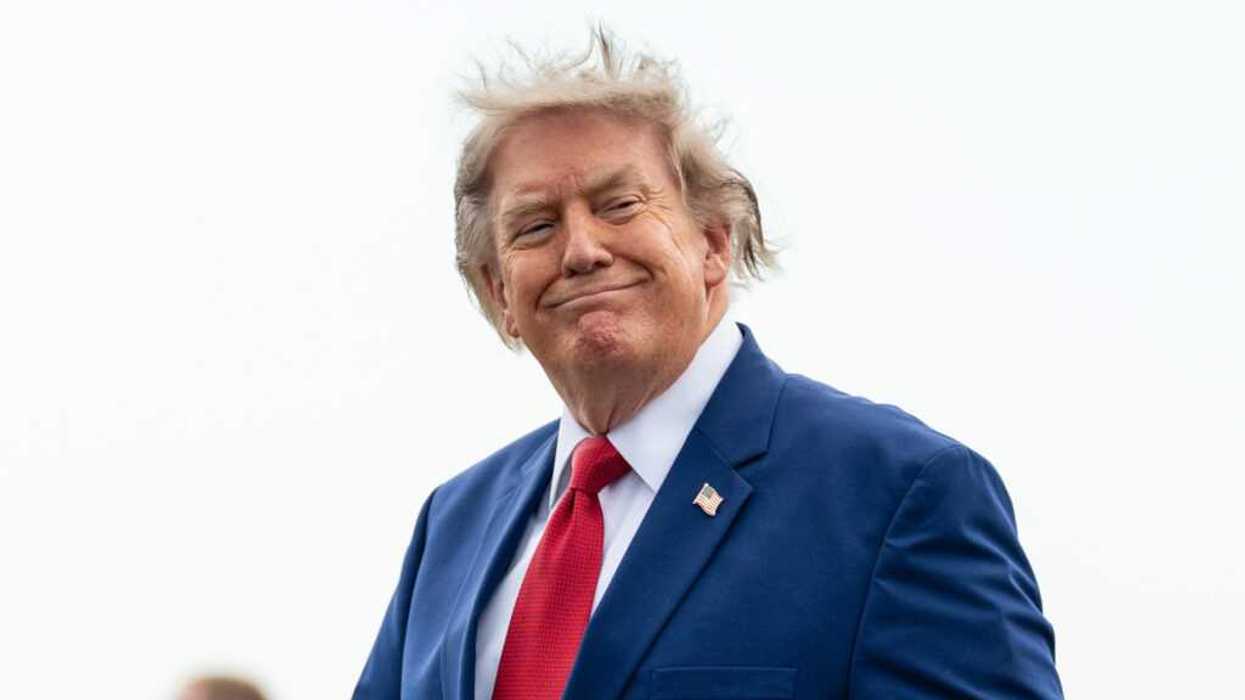
President Donald Trump walks off of Air Force One at Newark Liberty International Airport on Aug. 7, 2026, in Newark, New Jersey.

(Eric Lee/Getty Images/TCA)

In October 1980, then-candidate Ronald Reagan asked voters a very important question: “Are you better off than you were four years ago?”

It was during the only televised debate he had against incumbent President Jimmy Carter, whose presidency had been marred by one crisis after another, from record-high inflation and rising unemployment, to soaring gas prices and the Iran hostage crisis.


Reagan knew the answer to his question was a resounding “no,” and asking it helped propel him to a landslide victory. It also became a regularly-invoked rhetorical feature of presidential campaigns going forward.

No one knows the cautionary tale of Carter’s presidency more than our current president, who has repeatedly used it as a stand-in for presidential failure and American weakness. Although Carter’s legacy greatly improved in the years since leaving office, he ended his only term with a bleak 34% approval rating.

Donald Trump currently sits at an abysmal 32%, according to Quinnipiac’s latest polling, and likely for many of the same reasons Carter finished where he did, ironically — high inflation, rising gas prices, and a foreign policy crisis in Iran.

So, the question of whether voters are better off than they were two years ago isn’t hard to answer for most — in January of this year just 28% said they were better off than they were a year ago, and in July that number had dropped to 19%.

And it’s no wonder — when you move beyond the economic numbers, which are bad enough, the picture of Trump’s America gets worse and worse with every peak behind the MAGA curtain.

In fact, it can feel at times like America has become a Third World country.

Case in point, the U.S. is in the midst of a measles outbreak, with more cases than it’s seen in more than three decades, thanks to the administration’s vaccine misinformation. We are now at risk of losing our official measles elimination status, which we’ve held for more than a quarter century.

We’re also facing no fewer than 11 foodborne illness outbreaks, including two separate cyclospora outbreaks, as well as outbreaks of listeria, salmonella and E. coli, all since Trump downsized oversight agencies, dropped food-facility inspections, and stripped back mandatory reporting requirements at the federal Foodborne Diseases Active Surveillance Network.

Trump’s dumb war in Iran has depleted American munitions significantly — up to 80% in some categories — straining stockpiles and raising readiness concerns. And there are new reports of sailors on the USS Abraham Lincoln, deployed to the North Arabian Sea since November, desperately jumping overboard amidst poor conditions — from clogged toilets to mildewed showers, food supply problems to mental health concerns.

This is America — the superpower? Where college grads can’t find work, where housing is unaffordable for 75% of the population, where families must choose between paying rent or paying doctors bills? Where you can be shot dead for peacefully protesting? Where your government is shuttering important health agencies while spewing junk science about autism and Tylenol? Where our allies are skeptical of us and our enemies no longer seem to fear us?

While Trump fiddles with reflecting pools, golden statues and ballrooms, it feels like America is burning, becoming less and less formidable and functional with every passing day.

And Republicans are asking for two more years of control of it all. Who could possibly want more of this?

Upon the occasion of Carter’s 100th birthday in October 2024, Trump did what Trump does — and insulted him. But only to insult former President Joe Biden worse, saying Carter was happy because he “is considered a brilliant president by comparison.”

Just think what they’ll say about Trump — overseeing all of this chaos, destruction, corruption and incompetence. “Are you better off?” Are you kidding?

S.E. Cupp is the host of "S.E. Cupp Unfiltered" on CNN.

Read More

Trump’s hubris rivals the fallen heroes of ancient Greek mythology

A golden tray sits on the Resolute Desk as President Donald Trump speaks during an announcement on American nuclear innovation in the Oval Office at the White House on July 24, 2026, in Washington, D.C. Trump is signing multiple executive orders targeting the nuclear energy sector and easing rules for new reactors and nuclear fuel supply chains.

(TNS)

Trump’s hubris rivals the fallen heroes of ancient Greek mythology

In January, the New York Times asked President Donald Trump if there were any limits on his global powers.

“Yeah,” the president responded, “there is one thing. My own morality. My own mind. It’s the only thing that can stop me.”

Keep Reading Show less
A Sudden Vacuum: Unpacking Lindsey Graham’s Legacy and Implications for the GOP’s Senate Agenda

U.S. Sen. Lindsey Graham (R-SC) speaks during a Senate Appropriations Committee hearing on the FY2027 budget request in the Dirksen Senate Office Building on Capitol Hill on May 12, 2026 in Washington, DC.

(Photo by Chip Somodevilla/Getty Images)

A Sudden Vacuum: Unpacking Lindsey Graham’s Legacy and Implications for the GOP’s Senate Agenda

On July 11, 2026, South Carolina Senator Lindsey Graham unexpectedly passed away at age 71. The likely cause of death was a tear in the main vessel that carries blood out of the heart, otherwise known as aortic dissection. According to a medical examiner’s preliminary report, the aortic dissection itself was due to a “brief and sudden illness” known as arteriosclerotic cardiovascular disease, which hardened Graham’s arteries.

Graham’s death prompted widespread, bipartisan tributes from across the political spectrum. President Trump ordered all flags to be flown at half-mast in the senator’s honor, later exclaiming that “Lindsey will be greatly missed!!!” on social media. On the global stage, key international allies mourned the loss of a fierce advocate for overseas alliances, with tributes coming from Ukrainian President Volodymyr Zelenskyy, Israeli Prime Minister Benjamin Netanyahu, and German Chancellor Friedrich Merz.

Keep Reading Show less
Woman struggling to pull blue donkey with rope

How can the Democratic Party regain public trust? Ronald Hirsch argues for a renewed mission centered on equality, opportunity, fiscal responsibility, and American democracy.

Klaus Vedfelt / Getty Images

Can the Democratic Party Still Lead?

During the 20th century and for the first part of the 21st, the Democratic Party certainly led the nation in advancing the cause of equality and the ability of people to pursue their right to life, liberty, and happiness. At the same time, they led the nation by increasing its military might and advancing its power around the world to protect the human rights of others.

The American worker would likely still be toiling for low wages in industrial hell-holes were it not for the laws that Democratic-led Congresses passed to increase the rights of workers vis-a-vis employers and the rights of unions. Black individuals and other people of color would still be burdened by widespread discrimination—official and otherwise—were it not for the laws that Democratic-led Congresses passed to protect their rights as American citizens. This is not to say that we have achieved equality, but we have made much progress.

Keep Reading Show less
As Cruelty Normalizes, America’s Authoritarian Drift Deepens

Josh Hokit on April 11, 2026 in Miami, Florida.

(Photo by Carmen Mandato/Getty Images)

As Cruelty Normalizes, America’s Authoritarian Drift Deepens

It happened in a moment so small that many viewers may have missed it. After a UFC fight, athlete Josh Hokit used his victory speech not to celebrate his win but to demean former First Lady Michelle Obama, repeating a long‑running racist and sexist trope by calling her a man. Standing beside him, the President of the United States did not correct him. He did not defend a woman who served this country with dignity. He did not reject the bigotry embedded in the remark. Instead, he offered a smirk — a half‑smile of approval that traveled farther than any microphone could carry.

That smirk mattered. It was a signal. And millions recognized it for exactly what it was.

Keep Reading Show less