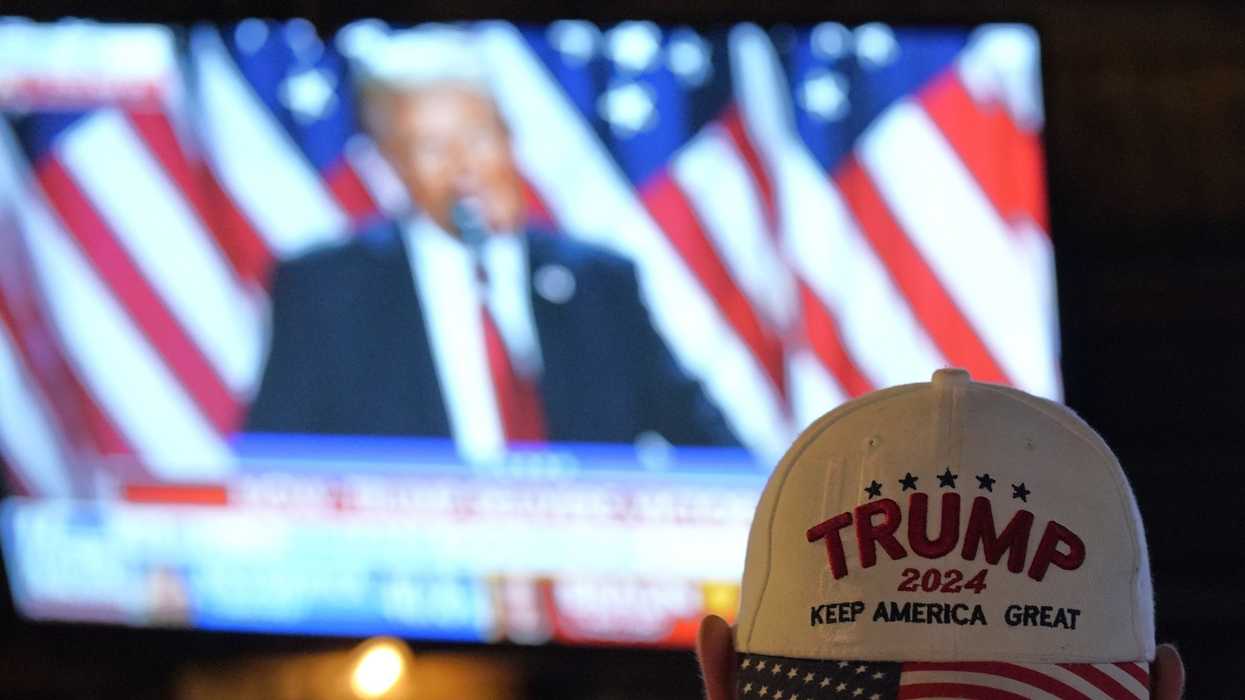

In 2016, Donald Trump told supporters, “The only important thing is the unification of the people — because the other people don’t mean anything.” The message was unmistakable: there are “the people,” and there are “the other people.” Only one group counts.
Trump has never pretended to be a unifier. His political power has always depended on sharpening divides, not healing them. What many once dismissed as impulsiveness or incompetence has, over time, revealed itself as something far more deliberate: a governing strategy built on chaos, conflict, and the constant widening of America’s internal fractures.
Analysts have long noted that Trump’s political instincts are rooted in generating conflict. As WBUR reported, Trump’s ability to “manufacture conflict about culture war issues is in overdrive,” a tactic that keeps him at the center of public attention while destabilizing the institutions meant to check him. This chaos is not merely noise; it’s a tool that exhausts the public, overwhelms the media, and blurs accountability.
A Fulcrum analysis goes further, arguing that Trump’s governance “fractures institutions, fuels anxiety, and tests America’s democratic core” by leveraging polarization as a political resource rather than a problem to solve. In this view, chaos is not a failure of leadership — it is the leadership.
Nowhere is Trump’s chaos‑as‑strategy more visible than in his approach to immigration. From the earliest days of his first term, Trump framed immigrants—particularly Latino and Black migrants—as threats to national security, crime, and cultural identity. This framing wasn’t incidental. It created a permanent state of emergency that justified increasingly aggressive enforcement tactics.
In 2025, as his second administration took shape, he escalated the language further, telling a rally crowd that immigrants were “poisoning the blood of our country,” a phrase that drew condemnation from historians for its echoes of 20th‑century authoritarian movements.
Under Trump, ICE was encouraged to operate with maximal force. Reports throughout his presidency documented racial profiling, neighborhood sweeps, courthouse arrests, and raids that targeted entire communities rather than specific individuals. Civil rights groups and legal observers repeatedly warned that these tactics were designed not only to detain undocumented people but to instill fear across immigrant neighborhoods, chilling cooperation with police, schools, and hospitals.
The recent killings of Alex Jeffrey Pretti and Renee Nicole Good by ICE agents echo this history. Within hours, DHS Secretary Kristi Noem labeled Good a “domestic terrorist” — despite incomplete footage and no independent investigation. CNN’s interview with Noem showed her doubling down on claims of “unpublished evidence,” mirroring the administration’s long‑standing habit of defining the narrative before facts are established.
This is the same playbook used throughout Trump’s immigration agenda:
- Escalate enforcement.
- Justify it with fear‑based rhetoric.
- Defend agents reflexively, regardless of evidence.
- Frame targeted communities as threats.
It is chaos deployed with purpose.
Trump’s political identity depends on the existence of enemies — immigrants, the media, Democrats, “RINOs,” protesters, bureaucrats, and sometimes even his own appointees. Unity would collapse the narrative architecture that sustains his movement.
A unifying president seeks to lower the temperature. Trump raises it. A unifying president tries to build coalitions. Trump breaks them. A unifying president sees political opponents. Trump sees existential threats.
Division is not a side effect of his leadership. It is the fuel.
As the country faces rising polarization, institutional distrust, and political violence, Trump’s strategy of governing through chaos is destabilizing and dangerous. Democracies depend on shared facts, functioning institutions, and a basic level of civic trust. Trump’s leadership style corrodes all three.
The question is no longer whether Trump thrives in chaos. The evidence is overwhelming. The real question is whether the country can withstand another era defined by it — and what citizens can do to strengthen the guardrails that democracy relies on.
That work doesn’t begin in Washington. It begins with people choosing to engage rather than withdraw. It means supporting local journalism that verifies facts instead of amplifying outrage. It means participating in civic life — voting, attending public meetings, serving on boards, and holding leaders accountable through lawful, democratic channels. It means refusing to let disinformation go unchallenged in our own circles, and choosing dialogue over dehumanization even when disagreements run deep. It means reinforcing the institutions that make self‑government possible: independent courts, professional civil servants, nonpartisan election workers, and the peaceful transfer of power. And it means voting in the midterm elections.
Midterms are one of the few structural tools Americans have to rebalance power, impose oversight, and correct course when any administration — regardless of party — operates without meaningful checks. They determine who writes the laws, who conducts oversight hearings, who controls budgets, and who can restrain or enable a president’s agenda. In moments of heightened instability, those levers matter even more.
Voting in midterms is not about endorsing one personality over another. It is about deciding what kind of governance the country will tolerate, what level of accountability it expects, and whether the institutions designed to prevent excess will be empowered or weakened. When turnout drops, the loudest and most extreme voices fill the vacuum. When turnout rises, the system reflects a broader public will — and becomes harder for any leader to bend toward chaos.
Citizens cannot control the rhetoric coming from the White House, but they can control whether they participate in the process that shapes the nation’s future.
Chaos thrives when people feel powerless. Democracy survives when people remember they aren’t.
Hugo Balta is the executive editor of the Fulcrum, the publisher of the Latino News Network, and twice president of the National Association of Hispanic Journalists.